Contents
What Perpl is and why your money sits in AUSDGetting money in: bridge, swap, and keep some MONWhat one trade actually costsMarkets, leverage and the cap on withdrawalsPoints, the MON campaign and the referral shareWho is blocked, and what Perpl has not published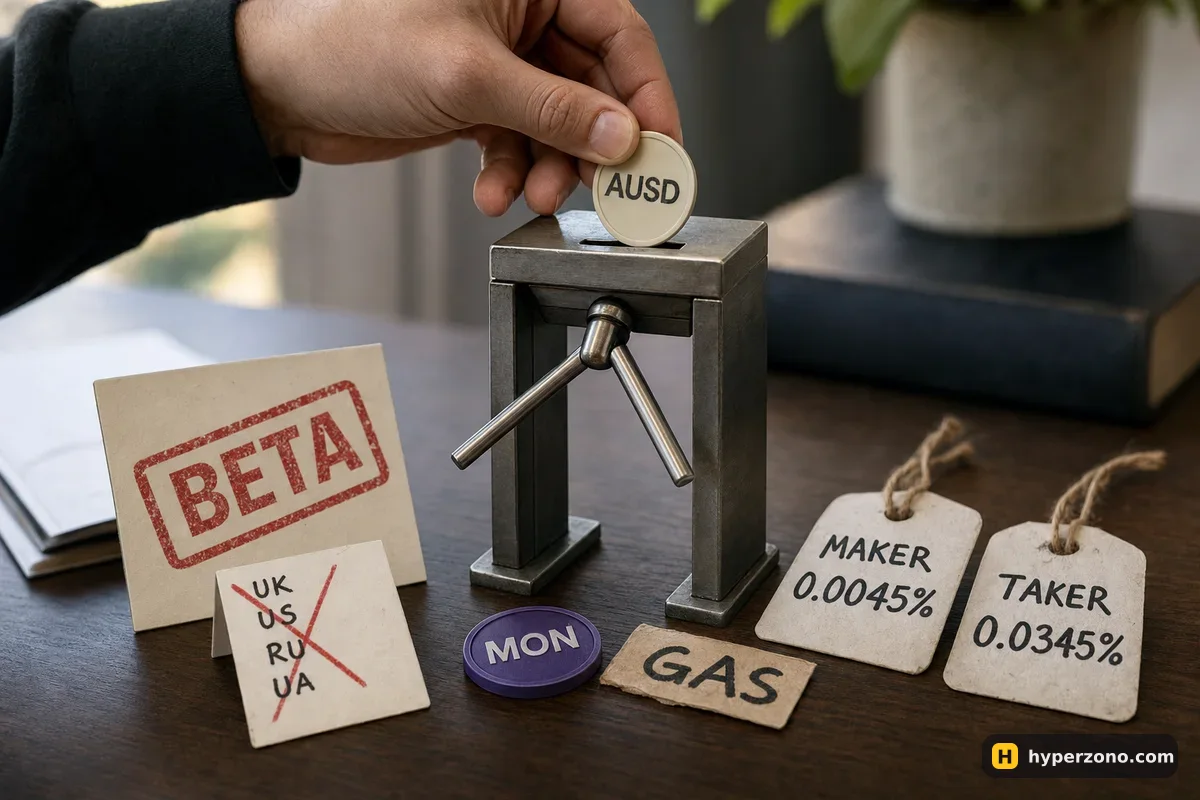
What Perpl is and why your money sits in AUSD
Perpl runs on Monad, a layer-1 blockchain, and the whole exchange lives there. When you press buy, your order joins the queue with everyone else's and the trade is written onto the blockchain itself — there is no company server in the middle keeping the books. On screen it still behaves like any order window: orders line up by price, and at the same price whoever arrived first gets filled first.
The app runs on Monad mainnet (chain ID 143), the interface is provided by the Perpl Foundation, and its terms of use, last updated 26 November 2025, are governed by the law of England and Wales. That detail matters less than where you are sitting, which we come back to at the end.
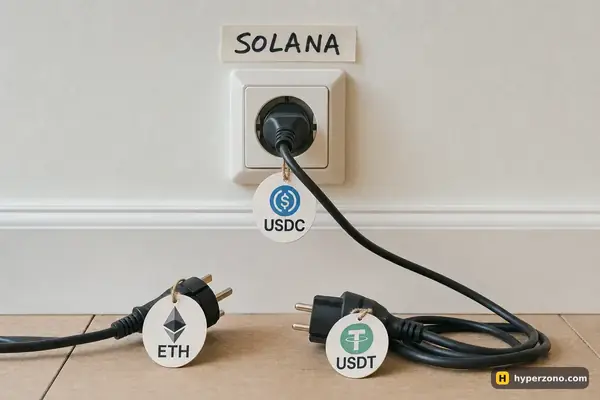
The collateral is the first surprise. Perpl does not take USDC as margin — your money has to be AUSD, the Agora Dollar, a dollar token on Monad with its own contract address. If you bridge USDC or ETH over, you swap it to AUSD on Monad before you can deposit, and that swap is not free: you pay the bridge, a little MON for gas and a small difference in the swap price, each way. With 50 or 100 dollars those few steps can cost more than the trading itself, so look at what actually lands in AUSD before you plan the trade.
The rest follows simply: your profit and loss are counted in AUSD, and you get AUSD back when you withdraw, so you will usually swap once more on the way out. If that extra step is the part you dislike, the perp DEX comparison shows which venues stay on plain USDC.
Getting money in: bridge, swap, and keep some MON
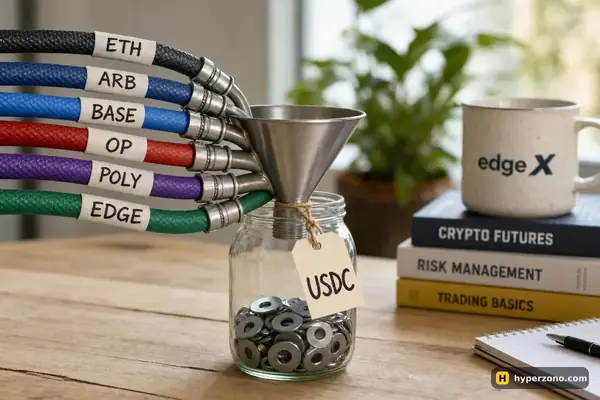
To get money across you use monadbridge.com, which brings funds over from Ethereum, Base, Arbitrum or Optimism and takes one to five minutes; the app also has a Fun.xyz bridge option switched on. Once the money is on Monad you swap it to AUSD, connect your wallet — Rabby, MetaMask, Phantom and Uniswap Wallet all work — sign a free "Enable Trading" message, and deposit.
Keep a small amount of MON in the same wallet for gas. Monad is the chain Perpl settles on, chain fees are paid in its own coin and not out of your collateral, so a wallet holding 200 AUSD and zero MON cannot even send the deposit transaction. The first deposit that opens an account is 10 AUSD, the minimum withdrawal is 0.01 AUSD, and the smallest order is one size unit of the market (0.00001 BTC, for example), so position sizes are not what will block a small account.
What one trade actually costs
A trade costs you 0.0345% if you take the price that is already on the screen, and only 0.0045% if you place a limit order and wait for someone else to come to you. On the exchange these two are called taker and maker. Higher volume tiers turn the maker side into a rebate, but that rebate is worked out away from the trade and paid separately, usually every two weeks — it is not a discount you see on the fill. A "recycle fee" also appears in the fee documentation and is currently set to zero on mainnet.
Here is what that looks like with numbers. Say you put in 100 AUSD of margin and open a 10x long on BTC, so your position is worth 1,000 AUSD. Taking the price on the screen costs 0.345 AUSD on the way in and the same on the way out, about 0.69 AUSD for the round trip.
While your trade is open, longs and shorts also pay each other a small amount at fixed times — this is called funding, and the venue does not keep it. The live app shows a funding interval of about 43 minutes, while the documentation describes it as hourly, so read the countdown on the screen rather than assuming. At an illustrative 0.003% per payment, with roughly 33 payments in 24 hours, holding that 1,000 AUSD position for a day costs about 1 AUSD. Your day in the market therefore costs around 1.7 AUSD, or 1.7% of your margin, and price has to move about 0.17% in your favour before you are even.
Long 1,000.00 USDT, entry 100,000 → exit 100,500, fees 0.03% + 0.03% (example rates).
Now the other direction, because being wrong costs exactly the same. If price goes 0.5% against you, you lose 5 AUSD on the move and still pay the same 1.7 in costs — about 6.7 AUSD out of your 100, before you have even decided whether to hold on.
The venue does not wait until your 100 AUSD is completely gone. It keeps a safety cushion — on BTC about 4% of the position — so with 10x the trade is usually closed after roughly a 6% move against you, and fees and funding bring that moment a little closer. The app shows your exact liquidation price next to the position; look at it before you confirm the order.
The way to never meet that price is to decide your exit before you enter: set a stop-loss when you open the trade, and size the position so that hitting it costs a few AUSD rather than the whole balance. Here is what a stop loss is if you have not used one yet. And if you place limit orders that sit in the book instead of crossing it, your entry cost drops from 0.345 to 0.045 AUSD — on a venue this cheap, that is the easiest saving available, and it costs nothing but patience.
Markets, leverage and the cap on withdrawals
There are 11 markets and all of them are crypto: BTC, ETH, SOL, MON, HYPE, ZEC, LIT, VVV, PUMP, NEAR and UNI. No stocks, no gold, no oil, no currency pairs — if that is what you came for, stock and commodity contracts on crypto exchanges live elsewhere. Maximum leverage is 15x on BTC and 12x on ETH and SOL, with 10x on MON and HYPE; the documentation and the live app disagree on ZEC (8x versus 10x). The 15x is the best case: the bigger your position and the faster the market is moving, the less leverage Perpl will let you take, and when a lot of money is already in one market the limit can drop to 1x. Whatever the order window shows at that moment is the real number.
Margin is isolated, so each position is walled off with its own money and one bad trade cannot reach into the rest of your balance. If losses eat into the margin on a position, the venue closes that trade for you — that is liquidation. Perpl takes the price for it from Chainlink, written on-chain every time the price moves more than 0.1%; if that price stops arriving, the venue refuses to liquidate anyone until it is back. Liquidations run through the order book, and whatever margin survives is split 80% back to you, 10% to the market's insurance fund and 10% to the protocol.
All the money sitting on Perpl came to about $3.3M on 22 October 2026, with roughly $12M changing hands in a day, most of it in BTC. That is small, so a large market order moves the price against you more than it would on a big exchange. On a venue this size, limit orders and a modest position size are not a style preference — they are how you keep your fill close to the price you saw.
The exit door has a width limit. Withdrawals are rate-limited across the whole venue, not per user: the default is 10% of deposits per hour with a $1M floor, and about a quarter of that can be taken at once. It exists to stop a mass drain, and on a normal day you will never notice it — but in a panic, everyone queues through the same door. There is also a reduce-only backup app, Rescue Mode, hosted on IPFS, so you can close positions and withdraw if the main site is unreachable.
Points, the MON campaign and the referral share
There is no Perpl token, and no token launch has been announced in the documentation, the blog or the terms. What exists is points: Season One started on 10 June 2026 with 50,000 points per epoch, plus the "Purple Summer" mPoints campaign that began on 8 July 2026 and runs 16 epochs — ending around 28 October 2026 — with a reward pool of $500,000 to $1,000,000 paid in MON. The referral programme pays a real share of fees rather than points alone: 10% of the fees of people you invite directly, and 5% at the second level.
Treat all of that as a possible bonus on top of trading, never as the reason to trade. Points programmes can be changed or cancelled by the venue that issues them, and the usual way beginners lose here is paying the higher taker fee all day to farm something whose value nobody has published yet. Our page on trading rewards and points walks through how to put a number on it before you start.
Who is blocked, and what Perpl has not published
The app blocks Belarus, Cuba, Iran, North Korea, Russia, Syria, Ukraine, the United Kingdom and the United States. It also looks set up to show a block notice to people in Ontario, Canada, so treat Canada as doubtful and check at the connection step. The written terms are narrower — they name only the United States plus sanctioned territories and their citizens — so the live block is what will actually stop you at the door. The terms forbid hiding your real location or claiming a false country, and we do not help anyone get around country restrictions. In several of those places crypto derivatives are off limits to retail traders under local rules anyway, so start from which exchanges are available in your country.
Two gaps are worth saying out loud. The audits page in the Perpl documentation is empty, so there is no published security report to read — on a venue that holds your collateral in its own contracts, that is a real risk you are accepting, and the sensible response is to keep the amount small rather than to look away. The app also still labels itself Beta. Perpl raised $9.25M led by Dragonfly in May 2025 and its engineering write-ups on mark-price limits are unusually detailed, but a detailed blog post is not the same thing as an audit.
If you want to look at the venue itself, the official documentation is at docs.perpl.xyz and the app at app.perpl.xyz; we have no referral arrangement with Perpl, so there is nothing to click here for it. Before you send any money, check four things with your own eyes: that your wallet connects at all from where you are, that the wallet holds a little MON for gas as well as AUSD, what leverage and what liquidation price the order window actually shows for the market you want, and where the funding countdown stands. Then start with an amount you would not mind losing in full — on an unaudited beta venue, that is not a figure of speech.
If Perpl blocks your country, or you would rather start on a venue with plain USDC collateral and a much deeper BTC book, Hyperliquid works in a similar way from a wallet: an order book, hourly funding and no exchange registration. You can connect a wallet and deposit USDC on Hyperliquid and compare the order window with what you read here.
Do I need USDC to trade on Perpl?
No — the collateral is AUSD, the Agora Dollar on Monad. You can bridge USDC in from Ethereum, Base, Arbitrum or Optimism, but you then swap it to AUSD on Monad before depositing. You also need a little MON in the same wallet to pay the chain fee, and the bridge plus the swaps cost something each way, so check what finally lands in AUSD.
Is Perpl still invite-only?
No. Access codes were removed on 7 July 2026, and anyone who is not geo-blocked can connect a wallet and trade. The app still shows a Beta label, which is a different thing: the venue describes itself as early software, it does not gate your entry.
How often does Perpl charge funding?
The documentation describes funding as hourly, applied after a fixed number of Monad blocks. The live app shows an interval of about 43 minutes, because blocks arrive faster than the documentation assumes. Watch the funding countdown on the trading screen and count your holding cost from that.
At what point does Perpl close my trade?
Not when your margin hits zero. The venue keeps a maintenance cushion — on BTC around 4% of the position — so a 10x trade is usually closed after roughly a 6% move against you, with fees and funding pulling that point slightly nearer. Your exact liquidation price sits next to the position in the app, and a stop-loss placed well before it is what keeps the loss small.
Can I trade Tesla, gold or oil on Perpl?
Not today. There are 11 markets and all of them are crypto: BTC, ETH, SOL, MON, HYPE, ZEC, LIT, VVV, PUMP, NEAR and UNI. For stock, index and commodity perpetuals you need a venue that lists them, and whether any such venue serves you depends on where you live.
What happens if the Perpl website goes down while I have a position?
Perpl hosts a reduce-only backup interface called Rescue Mode on IPFS, at recovery.perpl.xyz. It lets you close positions and withdraw when the main app is unavailable. Save that address somewhere before you need it, not during the hour you need it.
Sources and fact-check
Exchange terms were checked against official documents on October 22, 2026. Terms change — before you trade, check what matters to you in the exchange app and in your contract’s specs.
Perpl docs: networks and configuration (Monad mainnet, AUSD collateral)Perpl docs: feesPerpl live app context (markets, leverage, funding interval, geo-block list)