Contents
What edgeX is today, and what happened to the old versionGetting USDC in and out: networks, minimums and what it costsWhat you can actually trade thereFees and funding: what you pay and where to read itRestrictions, the token, and what to weigh before depositingA sensible way to try this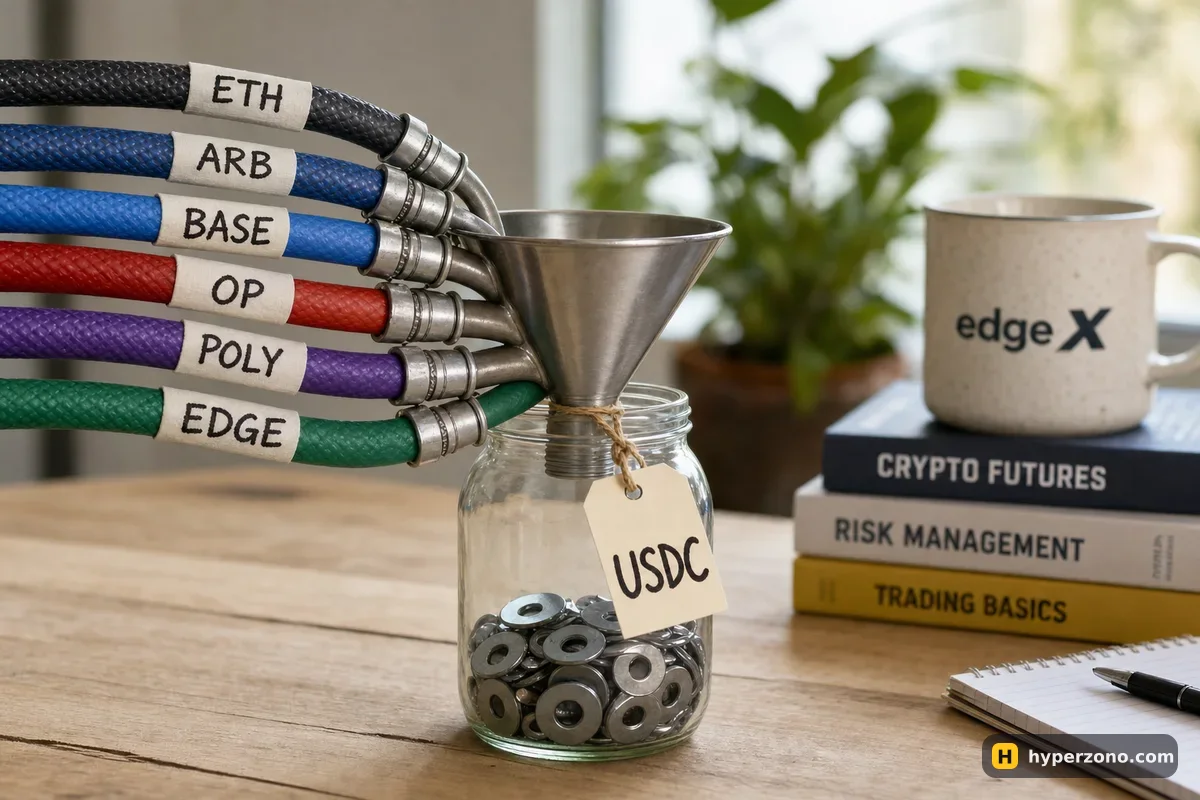
What edgeX is today, and what happened to the old version
edgeX runs an order book for perpetual contracts — buyers and sellers meeting at a price, the way they do on a normal exchange screen — except you arrive with a wallet instead of a registered account. Everything today runs on edgeX's own chain, called EDGE Chain. Circle, the company behind USDC, describes that chain as one that borrows Arbitrum's security and settles on Ethereum, and says Circle Ventures invested in edgeX. The live data confirms the production setup: mainnet, native chain "Edge", USDC as collateral.
There was an earlier version. It ran on different technology and has been switched off. According to L2BEAT, a third-party research site, V2 went live on 26 May 2026 and the V1 contract froze on 14 August 2026 after a forced withdrawal went unprocessed for seven days; L2BEAT treats that as a planned shutdown during the migration and says anything still sitting on V1 can only be recovered through the emergency exit built into the contract. Those dates come from L2BEAT rather than from an edgeX page, so treat them as reported, not official. If you had money on V1 and never moved it, that is the first thing to deal with, not your next trade.
One more thing worth reading before you fund anything: the terms are with edgeX Trading Inc. and its affiliates, and they describe edgeX as a developer of software that does not operate a digital asset or derivatives exchange platform. In practice that means there is no registered account in your name and no company promising to make you whole — if something goes wrong with a trade, you are dealing with support for a piece of software, not with a broker that holds your money for you. Our page on trading futures from a wallet explains what that changes compared with a registered exchange account, so this page will not repeat it.
Getting USDC in and out: networks, minimums and what it costs
You sign in either with a crypto wallet such as MetaMask, or with an email address — in that case the venue creates a wallet for you behind the scenes, and you never handle a seed phrase. After that your balance is USDC. Parts of the documentation still say USDT is the main collateral, but those pages are left over from the old version; the live data quotes every contract in USDC, so plan your funding around USDC.
| What you want to know | What the live edgeX data shows |
|---|---|
| Networks for deposit and withdrawal | Edge (the venue's own chain), Ethereum, Arbitrum, Base, Optimism, Polygon |
| Asset | USDC on every network |
| Minimum deposit | 10 USDC on every chain |
| Minimum withdrawal | 2 USDC |
| Cost of a withdrawal | No percentage fee, but you always pay at least 1 USDC when you withdraw |
Deposits cost you only the network fee of the chain you send from. On Ethereum the money usually arrives in a few minutes; a withdrawal back to Ethereum can take much longer — the old documentation mentions up to 14 hours. Those same older pages quote a 0.1% cross-chain withdrawal fee with a $1 minimum and say email-login accounts could withdraw only through Arbitrum, while the live data now shows no percentage fee but at least 1 USDC taken each time. The number that counts is the one the withdrawal window quotes you at the moment you send.
For a first test this matters more than it sounds. If you move 20 USDC in and later pull everything back out, the fixed part of the round trip is the network gas on your side plus at least 1 USDC on the way out — that is 5% of a 20 USDC trial before you place a single order. Sending a slightly larger amount, or picking a cheap network like Arbitrum or Base in both directions, keeps that fixed cost from swallowing your result.
What you can actually trade there
The public data lists 191 contracts, of which 174 are displayed and tradeable right now. Of those, 92 are perpetual contracts on stocks and ETFs, one is a currency pair (USDJPY), and the remaining 81 cover crypto and commodities. For a venue of this size that is an unusually heavy tilt toward company shares, which is the main reason people look at it rather than at a crypto-only book. If you want to see how the same idea looks elsewhere before deciding, the live Hyperliquid market table shows stock, index, gold and oil contracts with their volumes side by side.
Maximum leverage is set per contract, and the figure you can rely on is the one on the contract details screen for the exact market you want — never assume the crypto figure applies to a stock. Margin is cross by default, meaning your whole balance backs every position; if you want positions walled off from each other, or a long and a short on the same market at once, you do it by opening separate sub-accounts, and a wallet can have up to 20 of them.
The one currency pair, USDJPY, behaves differently at the weekend. Trading runs around the clock, but between Friday 17:00 and Sunday 17:00 New York time the underlying market counts as closed: you can only close or shrink a USDJPY position, not open a new one, and your closing order has to be priced within half a percent of the last price. At quieter times, which edgeX labels "medium liquidity", it allows only half the usual maximum position size on that market. For the stock contracts, the contract screen is again where the weekend rules are — read it before you hold one into Saturday. Listings also move quickly: in October 2026 alone edgeX announced new markets such as PEARL, AXIS, DNA, PAPER, STRK and ZRO, along with delisting notices on 9 and 15 October, so confirm your contract still exists before building a plan around it.
Fees and funding: what you pay and where to read it
Fees are tiered by your rolling 30-day volume, recalculated daily at 00:00 UTC, with the volume of all your sub-accounts added together. The live market data gives a default maker rate of 0.04% and a default taker rate of 0.045%, identical across all 174 contracts — treat that as the base setting, and read your own current rate in the fee section of your account.
To see what that means in money, take an illustrative 500 USDC position and assume you pay the taker rate both ways: 0.045% of 500 is about 0.23 USDC to open and about the same to close, so roughly 0.45 USDC for the round trip. That 500 USDC position might be backed by 50 USDC of your own money at 10x. The fee is worked out on the 500, not on the 50 — so if you double the position to 1,000 USDC while keeping the same 50 USDC of margin, the fee doubles too, even though your own money in the trade has not changed.
Two sources, two funding intervals. edgeX's documentation says funding is exchanged every hour, while the live contract data reports an interval of 240 minutes — four hours. There is no way to tell from outside which one your position will follow, so open the contract details before you hold anything overnight and read the interval and the next payment time there. Funding itself works the usual way: a payment between longs and shorts, not something the venue keeps. The rate is capped, so one payment stays small — what you really want to know is how often it is taken, because four payments a day add up very differently from twenty-four. If the idea is new to you, start with how funding works and comparing a 1-hour rate with an 8-hour one.
Restrictions, the token, and what to weigh before depositing
The terms of use block people in the United States and Canada, with Canadian access wound down after 7 April 2023. Beyond those two, the practical check is to open the app from where you live and see whether it lets you in — and if it does not, use a venue that serves your country rather than looking for a way around the block.
edgeX has its own token, EDGE, with a total supply of one billion: 30% to early users, 25% to core contributors, 30% held in a future reserve, and 5% each to liquidity, ecosystem and foundation. The early-user share was released in full at launch; the other buckets are locked for 12 to 24 months and then vest over a further 24 months. Reward campaigns come and go — a trading season with a 110% fee rebate on stock and commodity markets ran from 30 July to 10 September 2026 and has ended — and a referral program exists, with an update announced on 9 October 2026 whose current terms you will only see inside the app. Points and rebates are promotional, can be changed by the venue, and are not a reason on their own to put money somewhere.
Put the pieces together and you get a fair picture of what kind of venue this is: documentation that lags behind the live system, a V1 shutdown that outsiders documented before the team did, and a terms page describing the team as a software developer rather than an exchange operator. None of that stops the trading product from working, and it is normal for a young on-chain venue. It is also exactly why you start small and check the current numbers on your own screen instead of trusting an article — including this one.
A sensible way to try this
If edgeX is what you want, go to its own app and documentation, connect your wallet, read the deposit screen's current minimum and fee, and check the leverage and funding interval on the one contract you plan to trade. Keep the first deposit small enough that losing 1 USDC on the way out does not matter. Make the first trade a test of the route itself: put money in, open a small position, close it, take the money back out. If all four steps work, you know the venue; the profit on that trade is not the point.
If you would rather start where the markets, fees and funding numbers are published in a form you can verify yourself, you can trade perpetuals on Hyperliquid from the same kind of wallet, with hourly funding and a market list we keep live on this site. Either way the habits are the same: a stop-loss on every position, a size you can lose without losing sleep, and a quick look at how a futures trade actually works before you risk anything. Two neighbours in the same family, Lighter and Pacifica, solve the same problem with different trade-offs.
Can I use edgeX in my country?
The terms block people in the United States and Canada, and Canadian access was wound down after 7 April 2023. Beyond that, open the app from where you actually live and see whether it serves you. If it refuses, pick a venue that accepts your country instead of trying to get around the block.
Do I deposit USDT or USDC on edgeX?
USDC. Parts of the documentation still mention USDT, but those pages date from the older system; the live data quotes every contract in USDC and treats USDC as collateral. You can send it from Edge, Ethereum, Arbitrum, Base, Optimism or Polygon, with 10 USDC as the minimum deposit.
What does it cost to take my money back out?
The live data shows a minimum withdrawal of 2 USDC and no percentage fee, but you always pay at least 1 USDC when you withdraw. Older documentation also mentions a 0.1% cross-chain fee with a $1 minimum and Ethereum withdrawals taking up to 14 hours, though that was written for the old version. Read whatever the withdrawal window quotes you at the moment you send.
I still had funds on the old edgeX V1 — are they lost?
According to L2BEAT, the V1 contract froze on 14 August 2026 during the migration, and whatever remains there can only be recovered through the contract's emergency exit rather than a normal withdrawal. We could not find an edgeX page about this, so contact their support and ask directly about the escape-hatch process for your address.
How much leverage can I use on edgeX stocks?
Leverage is set per contract, and the contract details screen for that exact market is where you read it. Crypto, commodity and stock contracts normally carry very different caps, and a stock contract can also behave differently when its underlying market is closed, so check both before you size the trade.
Is edgeX cheaper than a big exchange?
The live data shows default rates of 0.04% maker and 0.045% taker, with tiers based on your 30-day volume, and your own rate shows in your account. On a 500 USDC illustrative position, 0.045% both ways is about 0.45 USDC in total — for a small account the bigger cost is usually the fixed 1 USDC on withdrawal plus network gas, not the trading fee.
Sources and fact-check
Exchange terms were checked against official documents on October 22, 2026. Terms change — before you trade, check what matters to you in the exchange app and in your contract’s specs.
edgeX: live public market metadata (networks, minimums, fees, contracts)edgeX: Terms of UseL2BEAT: edgeX project page (V2 launch and V1 freeze)