Contents
What your collateral does while the trade is openWhere the yield actually comes fromA worked example: XVS as margin versus plain USDCWhat a trade costs, and what you can tradeThe network underneath is changingWho can use it, and what to check before depositingWhat your collateral does while the trade is open
On most futures venues your margin just sits there. You deposit 1,000 USDC, it backs your position, and whether you trade or not it stays 1,000 USDC. Extended's idea is that the same money can do two jobs at once.
The mechanism is straightforward: USDC is the base collateral, and through the Community Vault you can deposit USDC, earn yield and receive XVS, which can then be used as collateral on the exchange. So the pot of money that absorbs your losses is also the pot that is trying to earn. That is the whole feature — and also the whole risk, because the value of your margin can now move on its own.
Extended's own docs are mixed here: one part says XVS can be posted as collateral, another lists posting XVS and other coins as margin as still in development. Open the deposit and margin screens in the app and see what your account actually accepts before you plan a trade around it.
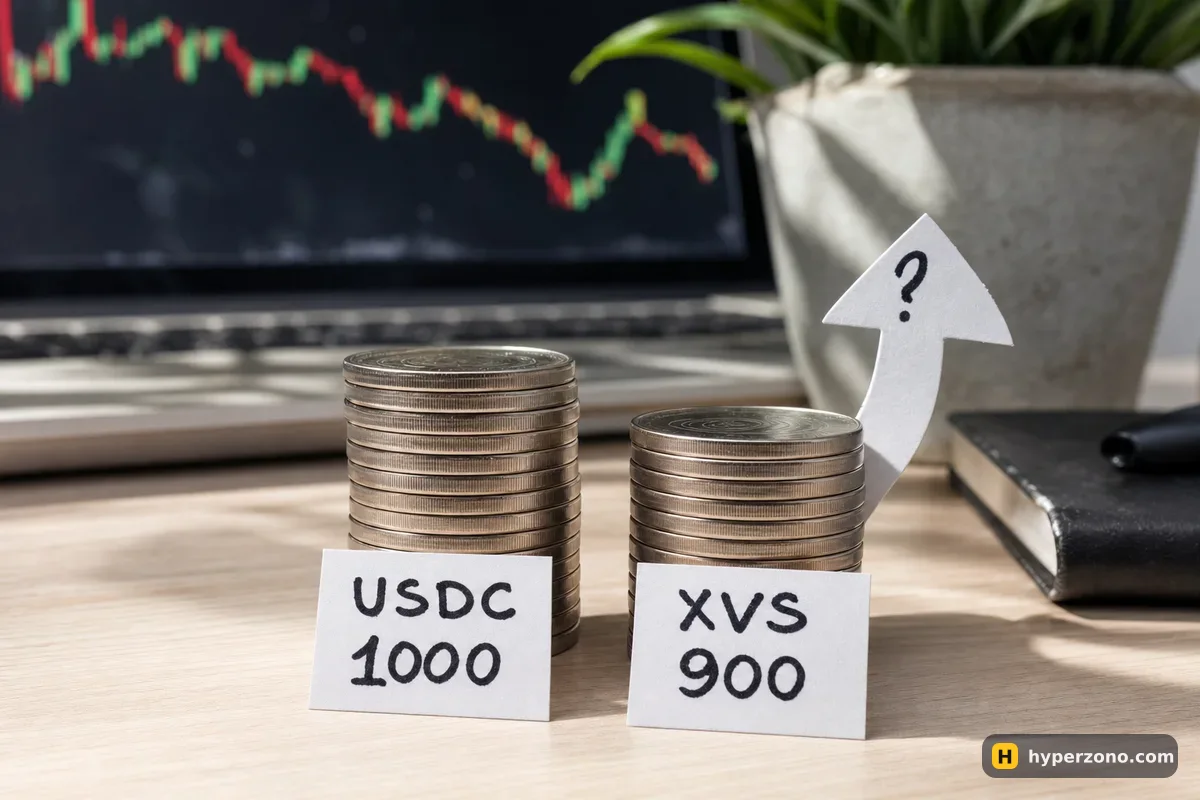
There is also a detail nobody puts in the headline: the exchange doesn't count XVS at full face value. The docs describe around 90% of it counting as margin, so 1,000 USDC in the vault would back about 900. Check the figure your account shows before you size a trade.
Where the yield actually comes from
Extended says the Vault will be the main lender once the planned lending layer goes live, so part of what you earn would be interest paid by other traders who borrow. That is the one source the documentation names. Beyond that, the docs don't break the yield down — if you want to know exactly where each dollar comes from, that detail isn't published yet.
The same section talks about cross-asset collateral in the future tense: later you would be able to post assets such as wBTC, ETH, EURC and XVS as margin, with the Vault lending against them. When the exchange earns, XVS is supposed to earn with it — that's the idea. How that is split, and how much, isn't written down anywhere you can check.
What is missing is the number. No APR, no yield history and no past performance for the vault are published, and there is no promise that the vault's value cannot fall. The return can be negative, so it is possible to take out less USDC than you put in — a different kind of risk from losing on a trade, and one that keeps running while you sleep.
If the idea of getting paid while holding something is what attracts you, it is worth reading how funding payments on a spot-plus-short position work too. That income also comes from other traders, it is also not fixed, and it is a lot easier to see day by day.
A worked example: XVS as margin versus plain USDC
Say you have 1,000 USDC and you want to run a bitcoin position at 5x. Keep the money as plain USDC and your margin is 1,000, so the biggest position you can back is 5,000 USDC worth of bitcoin. Put the same 1,000 through the vault and, at roughly 90%, your margin power is about 900, which backs 4,500.
| Plain USDC | Vault → XVS | |
|---|---|---|
| Money you put in | 1,000 USDC | 1,000 USDC |
| Counted as margin | 1,000 | about 900 (check in the app) |
| Largest position at 5x | 5,000 | 4,500 |
| Does the money earn? | No | Yes, at a rate nobody publishes |
| What can shrink it | Your trades, fees, funding | Your trades, fees, funding — plus the vault's own result |
Now play the trade out with made-up numbers. On the 4,500 position, if you buy at the price that's on screen right now, the fee is 0.025% of the position — about 1.13 USDC to get in and the same to get out, roughly 2.25 in total. If bitcoin moves 2% your way, that is 90 USDC before costs; funding — the small payment traders holding perpetuals pass to each other every few hours (see what funding is) — took, say, another 3 USDC in this made-up example, and let's invent a vault result, since Extended publishes none: say plus 1% on your 1,000, so 10 USDC. You finish about 95 USDC ahead.
The unfavourable version matters more. Bitcoin moves 2% against you and that is 90 USDC gone, plus 2.25 in fees, plus the same invented 3 USDC of funding — and if the invented vault result for that month was minus 0.5%, another 5. You end about 100 USDC down, not 90. The yield is a small side-stream; the position still decides your month, which is why picking leverage you can survive matters more than any collateral feature.
Your margin is no longer a fixed number. When your collateral can earn, it can also lose. The buffer protecting your position today is not the balance you saw yesterday, so look at the current margin figure before you add size.
What a trade costs, and what you can trade
A trade that fills straight away — a taker order, because you take the price already sitting on screen — costs 0.025% of the position. An order that waits in the book until someone else fills it is a maker order, and that one costs nothing. On stock and commodity markets the taker number is lower, 0.010%; check what the market you open shows.
The venue describes itself as a perpetuals DEX built by an ex-Revolut team, with 100+ markets across crypto, equities, FX, commodities and indices. The headline says "up to 100x leverage", but bitcoin and ether sit nearer 50x, with 100x reserved for a currency pair like EUR/USD. The maximum on the pair you actually want is shown in the app, and that is the only number worth planning around.
The network underneath is changing
Your deposits and balances live on a separate network under the hood. Extended has used Starknet for that, and on 22 October 2026 it started moving to Circle's Arc network. What this changes for you is only one thing: the deposit screen may ask for a different chain than any guide says, so send only to the chain and the asset the app asks for right now.
Deposit and withdrawal details can shift while a move like this is in progress, so check the amounts and timings the app shows you on the day rather than any guide, this one included. The team also plans to change how trades are processed behind the scenes. That is a plan, not something you have to understand before your first trade.
Who can use it, and what to check before depositing
Extended's own page is marked "for information only" and says eligibility and jurisdictional restrictions apply, pointing to a separate Restricted Countries page. The United States, the United Kingdom, Canada and Russia are among the restricted places, and the official list is the one that counts — read it before you connect a wallet, and never try to get around a block.
You trade from a crypto wallet rather than an exchange account. What the app asks you for when you connect, and in which countries, is on Extended's own pages — read them before you send money. And if you lose access to that wallet, the money goes with it. If you see people talking about points or a future airdrop, don't count that as income: venues change or cancel points schemes, and nothing is owed to you.
If Extended still interests you, the order is simple: read its Restricted Countries page, open the app, check the margin weighting and the maximum leverage on the pair you want, and start with an amount you can afford to lose. If you'd rather start where funding and market data are public and easy to check day by day, Hyperliquid works the same wallet-first way, and how Hyperliquid works walks through it; Lighter's "zero fees" shows how differently venues define a cheap trade.
Is the yield on Extended's vault guaranteed?
No. You can deposit USDC into the Community Vault to earn yield and receive XVS, but no rate, no history and no guarantee are published anywhere. The return can be negative, which means you can take out less USDC than you put in.
Where does the vault's yield come from?
The one source the docs name is lending: once the planned lending layer is live, the Vault acts as the main lender and the interest borrowers pay goes to XVS holders. Beyond that the yield isn't broken down anywhere you can check, so treat any detailed explanation you read elsewhere with caution.
Can I really use XVS as margin today?
That is exactly the part to verify yourself. One part of the docs says XVS can be posted as collateral, another lists posting XVS and other coins as margin as still in development. Open the deposit and margin screens in the app and see what your account accepts before you plan around it.
Can I lose money just by holding XVS, without trading?
That is the honest reading of it. The vault's value moves on its own while you hold it, and the documentation says the result can be negative. Treat it as a position, not as cash sitting still.
Why would my margin be smaller than the USDC I deposited?
Collateral that is not plain cash is usually counted below face value. The docs describe XVS counting at about 90%, so 1,000 USDC would back roughly 900 of margin power. The app shows the figure that actually applies to your account.
What does one trade cost on Extended?
An order that fills immediately costs 0.025% of the position, and 0.010% on stock and commodity markets; an order that waits in the book and gets filled by someone else costs nothing. On a 4,500 USDC position, entering and exiting immediately is about 2.25 USDC in total, before funding — the payment perpetual holders pass to each other while the position is open.
Which network do I deposit on?
Check in the app on the day. Settlement started moving from Starknet to Circle Arc on 22 October 2026, and guides can lag behind that — read the deposit screen rather than any article, including this one.
Is Extended available in my country?
The overview says eligibility and jurisdictional restrictions apply and sends you to a separate Restricted Countries page; the US, UK, Canada and Russia are among them. Read the official page before you connect a wallet, and do not look for ways around a restriction.
Sources and fact-check
Exchange terms were checked against official documents on October 22, 2026. Terms change — before you trade, check what matters to you in the exchange app and in your contract’s specs.
Extended Docs: Overview & Vision