Contents
So is trading on Lighter really free?One trade from start to finish: where the money actually goesWhat you can trade there, and with how much leverageWho can actually use LighterHow to check all this yourself in ten minutesSo is trading on Lighter really free?
Lighter describes itself as a decentralized trading platform built around a zero-fee trading environment, and that part is not marketing fiction — there is an account type where the exchange charges you nothing per trade. The condition is speed. On the Standard account you pay 0% in fees, but your orders that would fill straight away, and your cancellations, are held back by roughly 300 milliseconds before they reach the order book.
Three tenths of a second sounds like nothing when you place one trade a week, and for that kind of trading it genuinely is nothing. It matters if you want to pull a waiting order the instant news hits, or if you are trying to grab a price that is moving fast. That delay is the price of the free tier. The Premium account removes it and charges 0.028% if your order fills straight away against an order already sitting in the market, and 0.004% if your order waits there and someone else trades into it. The exchange calls the first case taker and the second maker — you will see both words in the fee table.
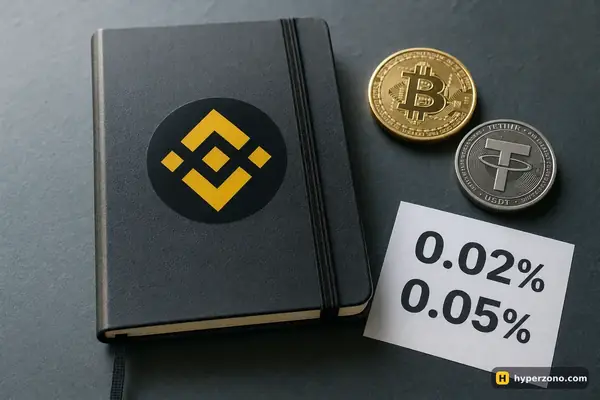
Even the Premium rates are low next to a big centralized exchange — Binance USDⓈ-M futures start at 0.02% maker and 0.05% taker at the base level. So the honest version of the headline is this: on Lighter the trading fee can be zero or close to zero, and the thing worth checking before you deposit is everything that is not the trading fee.
One trade from start to finish: where the money actually goes
Take an illustrative trade. Say you have 1,500 USDC on the venue. You put 1,000 of it behind a long on bitcoin at 5x, so your position is worth 5,000 USDC and the other 500 stays free as a buffer. You plan to hold it for three days. Now count every line of the bill, not just the fee.
Fees first. On the Standard account, entry and exit cost you nothing. On Premium, if both your entry and your exit fill instantly at the price on screen — the taker case — that is 0.028% of 5,000 USDC each way, about 1.40 USDC per side, so 2.80 USDC for the round trip. If instead both of your orders wait in the market as maker orders and someone else trades into them, the round trip drops to around 0.40 USDC. Fees are charged on the 5,000, not on the 1,000 you put behind it. Take the same 1,000 of margin and open a 10,000 position instead, and your fees and your funding double too.
Funding is the line people forget. On Lighter it is settled every hour, so a three-day trade pays it 72 times. The hourly rate is small — but don't compare it with an 8-hour rate from another exchange without multiplying first, and how to compare a 1-hour rate with an 8-hour one walks through that arithmetic. Say the rate sits at an illustrative 0.001% per hour and stays positive the whole time: longs pay shorts 0.072% of 5,000 USDC, about 3.60 USDC over the three days. That is more than the Premium fees would have been. If the rate turns negative, those payments come to you instead — the rate is set by the market, not by Lighter, and you can read the general mechanics in what funding is and who pays it.
| Cost of the three-day trade | Standard account | Premium account |
|---|---|---|
| Entry + exit fee (5,000 USDC position, taker both ways) | 0 USDC | ≈ 2.80 USDC |
| Funding, 72 hours at an illustrative 0.001%/hour | ≈ 3.60 USDC | ≈ 3.60 USDC |
| The 300 ms delay on instant-fill orders and cancels | you accept it | not applied |
Put a price move on top and the picture is complete. If bitcoin rises 2%, your 5,000 USDC position gains about 100 USDC — a 10% return on the 1,000 you put behind it, minus roughly 3.60 USDC of funding on the Standard account. If it falls 2% instead, you are down about 100 USDC and you still pay the funding, so your loss is closer to 103.60, and the 500 USDC you left free is the room that keeps a sharper move from reaching your whole balance at once. Free fees save you a couple of dollars here. The price move is what decides whether you make or lose money.
The deposit and withdrawal cost is the line to check first. Before you send anything, open the deposit and withdrawal screens and read the supported chains, the minimum amount and what the app quotes to send money back out. On a 1,000 USDC test that one line can cost more than all the trading fees above.
What you can trade there, and with how much leverage
Lighter runs as a zk-rollup on Ethereum. In plain words: the matching and the liquidations happen on Lighter's own fast system, and cryptographic proofs of what happened are posted back to Ethereum, so the results can be verified rather than simply trusted. The docs claim it is the first exchange to offer verifiable order matching and liquidations — that is their claim about their own design, not an independent audit result. Collateral is USDC, and you trade by connecting an Ethereum wallet rather than by registering an account.
Lighter isn't only crypto perpetuals — the docs also cover markets built on real-world assets. Which markets are actually live today, and the maximum leverage on each, you read in the app, because both change as markets are added or paused. If the idea of stocks, indices and commodities appearing on a wallet-based venue is new to you, how third-party markets get deployed on Hyperliquid explains the general pattern well.
On the token side, LIT is live and the docs have pages for LIT Fee Credits and LIT Utility. Treat any points, credits or future airdrop talk the way you would treat it anywhere: it is not money until it is in your balance, and venues reserve the right to change the rules. A trading plan that only works because of expected rewards is not a trading plan.
Who can actually use Lighter
Access is restricted in a number of places, including the United States, Canada, the United Kingdom, China, Russia and Ukraine. That kind of list grows more often than it shrinks, and a wallet-based venue can still block an address or a region at the interface level. Check whether you can use it from where you live before you plan anything around it, and never try to get around a block — an account or a position you cannot legally hold is worth less than nothing.
If Lighter is closed to you, Hyperliquid works the same way at the wallet level and shows its fees and funding openly — you can open Hyperliquid and look at one market to see what a wallet-based perpetual really costs. If you are weighing a wallet venue against a normal exchange account, Binance Futures or Hyperliquid compares the two routes side by side.
How to check all this yourself in ten minutes
Read the fee page in the docs, not the homepage
Find the Trading Fees section and confirm the current Standard and Premium conditions, including the delay on the free tier. Rates and account tiers change, so read the current ones on the page itself before you trade.
Look up the funding rate on the market you want
Funding is settled hourly. Multiply the current rate by the number of hours you intend to hold and by your position size — not by your margin — to see what holding actually costs.
Open the deposit screen before you fund anything
Check which chains are supported, what the minimum deposit is, and what the app quotes for sending the money back out.
Send a small test amount and withdraw it again
Deposit an amount you would not mind losing, make one tiny trade, then withdraw. You now know the real round-trip cost and the real waiting time, which is worth more than any fee table.
Only then size a real trade
Decide your position size from your risk, set a stop before you enter, and remember that liquidation on any leveraged venue runs off the mark price — see how liquidation works.
If you trade once or twice a week, the free tier costs you nothing and you will never feel the delay. If you want Premium, ask yourself honestly what you'd do with those 300 milliseconds — faster trading means more fills, more fees and less thinking time per trade. Either way, your whole cost on this venue comes down to funding plus whatever moving money in and out turns out to cost.
Does Lighter really have zero trading fees?
On the Standard account, yes — nothing is charged on entry or exit. The condition is a delay of about 300 milliseconds on orders that would fill straight away and on your cancellations. The Premium account removes that delay and charges 0.004% for a maker order that waits in the market and 0.028% for a taker order that fills instantly against an order already sitting there.
If the fees are zero, what am I still paying?
Funding, settled every hour, whenever you hold a position through a payment. Plus whatever it costs to move USDC onto the venue and back out again. On a three-day trade, funding is usually the bigger of the two.
Is 300 milliseconds a problem for a beginner?
Almost certainly not. It matters for fast scalping and for pulling orders in a sudden move. If you place a trade, set a stop and come back hours later, you will never notice it.
Do I need to register an account on Lighter?
No. It is a wallet-based venue on an Ethereum zk-rollup, with USDC as collateral, so you connect a wallet instead of signing up. That also means you are responsible for your own wallet security, and that access is restricted in several countries, including the US, Canada, the UK, China, Russia and Ukraine.
How much leverage can I use, and what can I trade?
The market list and the leverage limits change over time, so read them in the app for the exact market you want rather than trusting a figure from an article. Open the market details and check the maximum leverage and the minimum order size before you size anything.
Sources and fact-check
Exchange terms were checked against official documents on October 22, 2026. Terms change — before you trade, check what matters to you in the exchange app and in your contract’s specs.
Lighter Docs: IntroductionLighter Docs: page index (llms.txt)