Contents
The short answer, checked 20 October 2026Being able to sign up is not the same as being authorisedWhat the exchanges' own documents say about South AfricaThree checks that take ten minutesWhat happens to an account you already haveWhat one small trade leaves in your recordsThe sensible order for your first stepsThe short answer, checked 20 October 2026
South Africa is not on the restricted-country lists Bybit and OKX publish, and companies offering financial services here are expected to be authorised to do so. Your part is to look the platform up with the regulator and, if you plan to trade often, ask a South African adviser about your own situation. If the mechanics are still new, start with what crypto futures actually are and come back here before you fund anything.
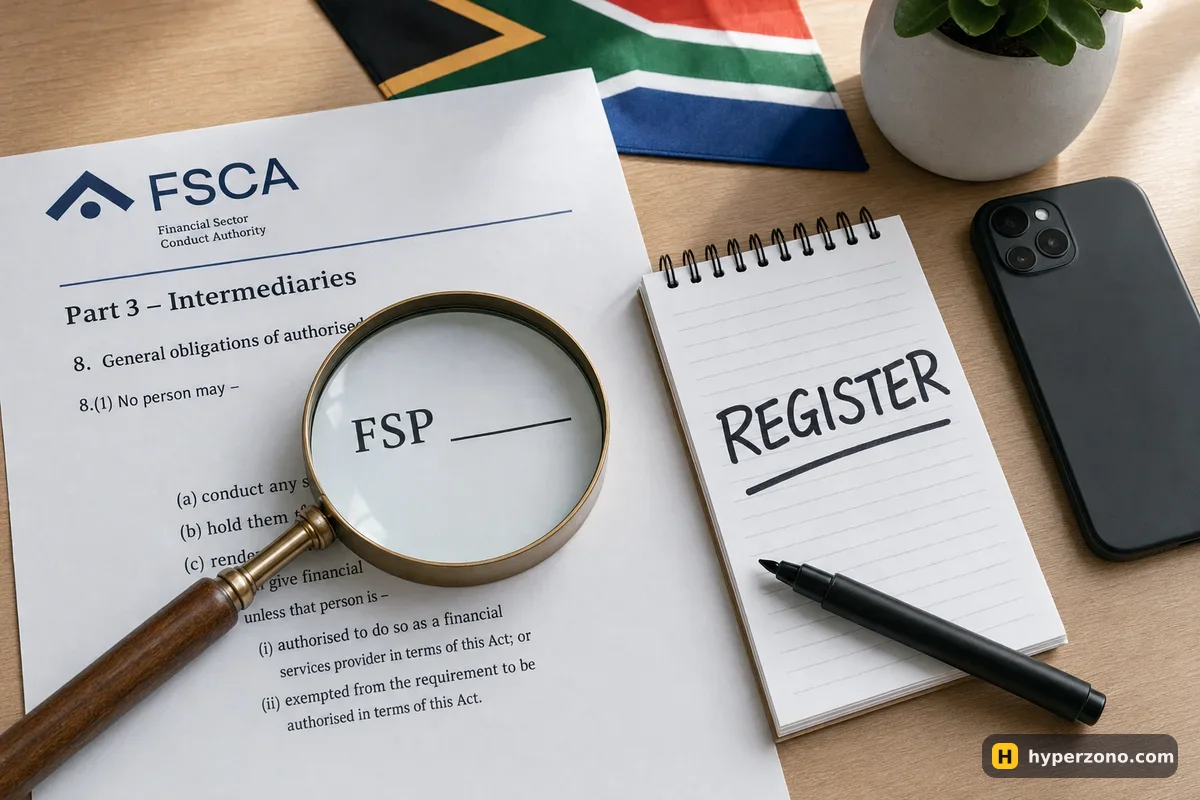
The financial regulator, the FSCA, publishes a public list of the companies it has authorised — search it on the regulator's own website before you deposit. Lists and company arrangements change faster than any guide can, so treat the regulator's site as the source and this page as the method. For the wider picture of which venues block which countries, the overview of regional availability covers that separately.
Being able to sign up is not the same as being authorised
An exchange app letting you through registration tells you one thing only: its systems accept a South African address. Whether that company is authorised to offer you this service locally is a separate question. Those are two different things, and you want to answer both.
The rules here are written for the companies that offer the service, so the useful thing you can do is check the company. Open the exchange's legal or help section and find the name you are actually contracting with. That name is what you type into the regulator's search — and if the page also shows a licence or registration number, search that too.
What the exchanges' own documents say about South Africa
Bybit keeps a list of service-restricted countries, last updated on 16 October 2026, and South Africa is not on it. That same page says plainly that the list is not exhaustive and can change, so read it as "not restricted today" rather than "guaranteed forever". If this is the venue you are looking at, start the sign-up on Bybit and read the terms the app puts in front of you at registration.
OKX publishes a Risk and Compliance Disclosure, last updated 8 July 2026. It names the countries where the service is restricted, and separately the countries where derivatives are not offered in the usual way — the UK, Brazil and South Korea among them, with Australia served by a separate local OKX company on much lower leverage. South Africa is on neither list, so nothing in that document blocks you, and the OKX sign-up screen is where you see what your own account gets.
Binance publishes no notice about South Africa either way. The countries it does name as off limits are Cuba, Iran, North Korea, Syria and the Crimea region, plus the United States, Canada and the Netherlands, and its derivatives are not offered in the UK, Brazil, Australia, South Korea, New Zealand and Hong Kong. South Africa is in none of those groups. Not being on a list is not the same as being allowed — so check the company yourself and let the sign-up screen answer the rest.
Three checks that take ten minutes
Find the company you are contracting with
In the help centre or the legal section, open the terms of use and look for the entity name. It is usually in the first clauses, sometimes with a licence or registration number next to it.
Search that name with the regulator
The financial regulator publishes a public list of the companies it has authorised. Search it on the regulator's own website, by company name or by the number printed in the terms. If nothing comes up at all, that is your answer.
Read what the authorisation covers
An authorisation can cover some products and not others, and it can lapse or be suspended. Check that it is active and see which products it mentions. While you are on the regulator's site, search the same name in its warnings and public notices.
This is the same habit that protects you from outright fake platforms, and the checklist for spotting a scam exchange covers the other warning signs worth knowing.
Never fake your country. Signing up from a place you do not live in, or using someone else's documents, puts your withdrawals at risk far more than any regulation does. If a platform will not serve South Africans, that platform is simply not for you — there are others that will.
What happens to an account you already have
When an exchange adds terms for your country, they normally start applying as soon as you keep using the account, so read the terms-update emails instead of swiping them away. Those emails take two minutes to read. Your money is sitting in that account, so it is worth knowing what changed.
Arrangements also end. If an exchange withdraws from a market, the usual pattern is notice, then a period where you can only reduce or close positions, then withdrawals only. Knowing what close-only mode means in advance saves a panicked afternoon later.
What one small trade leaves in your records
Say you put in 100 USDT and open a trade worth 500 USDT — that is 100 of your own money with 5x leverage. The fee is charged on the 500, not on your 100: at a 0.05% taker fee that is about 0.25 USDT when you open and the same again when you close, as an illustration. If the contract is a perpetual, it can also pay you or charge you a small amount every few hours while the position stays open. The page on what fees you pay walks through both sides.
Those three lines — fee in, fee out, funding — are exactly the data you want saved. Export your trade history, fee and funding reports from the exchange once a month and keep them in one folder, because rebuilding a year of trades afterwards is miserable work. On tax, read the crypto assets guidance on the tax authority's own website rather than taking it second-hand, and if you plan to trade often, a short session with a South African tax practitioner costs far less than sorting out a mess later.
The sensible order for your first steps
Check the provider first, then practise before you fund anything. Demo futures accounts cost nothing and let you make your first mistakes with fake money — the list of exchanges with demo trading shows where to find them, and the demo contract list is not always identical to the live one, so confirm your chosen pair is there. A week in demo also puts you ahead of most people, because what usually goes wrong for beginners has nothing to do with regulation and everything to do with rushing.
Is crypto futures trading legal in South Africa?
This page cannot give you a legal opinion, and no page should. What can be checked is that South Africa is not on the restricted-country lists Bybit and OKX publish, and that companies offering financial services here are expected to be authorised. Look your platform up on the regulator's public list, and if you plan to trade often, ask a South African adviser about your own situation.
Can my exchange account be frozen because of South African rules?
The thing that actually goes wrong for people is not a personal freeze — it is a platform turning out to be unauthorised, or pulling out of the country while their money sits on it. Keeping only your trading budget on an exchange handles most of that. Withdraw what you are not using instead of letting a balance build up.
Does Binance offer futures in South Africa?
Binance publishes no notice about South Africa either way, and the country is not on the lists it does publish of places where it does not operate or does not offer derivatives. Start the sign-up in the app and see whether the futures section opens for a South African account. Whatever the app shows during onboarding is the real answer for you.
Do I have to pay tax on futures profits in South Africa?
Assume yes and plan for it. Read the crypto assets guidance on the tax authority's own website, export your exchange reports every month, and get local advice if you trade regularly. Deciding this before your first trade is far cheaper than reconstructing it a year later.
What if an exchange does not accept South African users?
Then pick a different one. Hiding where you live or using someone else's documents breaks the exchange's own terms and usually surfaces at verification or withdrawal, when your account is already holding money. Platforms that accept South Africans openly exist, and with one of those you never have that conversation.
How do I find the company name an exchange trades under?
Open the terms of use in the app's legal or help section and read the opening clauses — the contracting entity is named there, often with a registration or licence number. Search that name with the regulator rather than the brand name on the app icon. The two are not always the same.