Contents
How to use this self-checkThe ten questionsWhat your score meansKnowing the rules is only half of being readyWhat to do nextHow to use this self-check
Answer each question in your head before you read the explanation under it, with no search tab open and no chart in front of you. Count an answer as correct only if you could explain to a friend, in one or two sentences, why it is correct. If the explanation under the question is news to you, mark that one as missed and put it on your study list.
On Binance you pick an experience level, accept the futures agreement and verify your identity before the futures tab opens. Other exchanges ask for their own things — you will see the exact steps during sign-up. Clicking through all of that gets you the button; it does not tell you what happens when your position is 10 USDT away from liquidation at 3 a.m., and that is the part that costs money. The experience level you choose on Binance also sets your starting leverage (Beginner 2x, Experienced 5x, Advanced 20x), and leverage above 20x is not available during the first 30 days of a futures account.
A lucky guess is the expensive kind. A wrong answer you notice costs you nothing — you go and read about it. A guessed right answer tells you that you already know something you don't, and that is the version that shows up later as an unexpected liquidation.
The ten questions
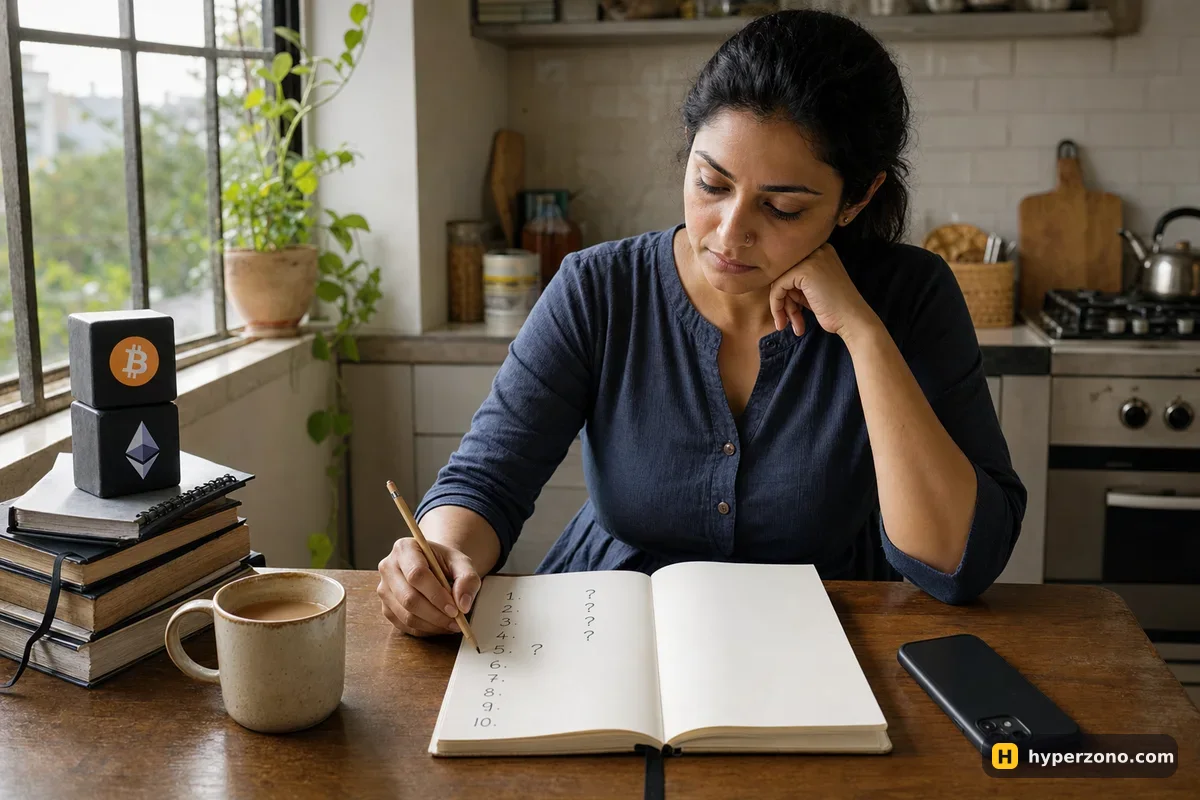
Here they are. Say your answer out loud or write it down, then read the line underneath. Keep a running count of the ones you got right on your own.
You set aside 100 USDT and open a position at 10x. Bitcoin moves 1% in your favour. How much did you make?
About 10 USDT. Your 100 USDT of margin is holding a 1,000 USDT position, so 1% of that position is 10 USDT — a tenth of your money from a move you would barely notice on spot. The same number appears with a minus sign if the price goes the other way.
That same trade goes against you. Roughly how far does the price have to move before your margin is gone?
Around 10%, and usually a bit sooner — the exchange needs a small part of your 100 USDT to stay untouched as a cushion, and the entry and exit fees come out of it too. When the cushion is gone, the exchange closes the trade for you. That is liquidation, and your 100 USDT is spent.
Which price decides that liquidation — the last trade blinking on your screen, or something else?
Something else: the mark price, a fair price built from an index of several markets. A quick spike in the last traded price does not necessarily touch you, and a calm-looking chart can still liquidate you if the mark price moves. The difference is explained in why a contract shows several prices.
You have 500 USDT in your futures wallet and you put 100 USDT into one trade. How much of that 500 is at risk?
It depends on the margin mode you chose. In isolated margin only the 100 USDT assigned to that position is at risk, unless you switched on automatic margin top-up. In cross margin your free balance stands behind the trade, which is how one bad position takes the rest with it — see cross vs isolated.
Your stop-loss sits at 60,000 and the price jumps straight from 60,100 to 59,400. What price do you get?
This is the one almost everyone is confident about — and most people have it wrong. A stop has a trigger price and a fill price, and they are two different numbers: a stop-market fills at whatever is available after the trigger, so here it fills near 59,400, while a stop-limit might not fill at all. Read does a stop loss guarantee your loss if that surprised you.
You open a 2,000 USDT position and close it an hour later. How many times do you pay a fee, and on what amount?
Twice, and each time on the full 2,000 USDT, not on your margin. On Binance USDⓈ-M futures at the base level a taker pays 0.05%, so that is about 1 USDT to enter and about 1 USDT to exit — small per trade, heavy if you trade all day.
You hold a perpetual overnight and see a funding charge on your account. Who received that money?
The traders on the other side. Funding is a payment between longs and shorts, the exchange does not keep it, and only someone holding the position at the settlement moment pays or receives it. Binance settles every 8 hours by default, and some contracts more often.
You think bitcoin is going down and you own no bitcoin. Can you make money on that?
Yes — that is a short, and it is the whole reason futures exist alongside spot. You never hold the coin; your profit or loss is simply the price difference, settled in USDT.
You decide you can lose 10 USDT on this trade and your stop sits 2% below your entry. How big should the position be?
500 USDT, because 2% of 500 is your 10 USDT. The size comes from your risk and your stop distance, not from dragging the amount slider until it feels right — the method is in how to work out position size.
You are long and you tap the Sell side to get out. What happens?
It depends on your position mode. In one-way mode it closes or reduces the long; in hedge mode it opens a second, opposite position, so you now pay fees and funding on two trades that cancel each other out. Check which mode your account is in before your first real trade.
What your score means
| Score | What it says about you | Your next step |
|---|---|---|
| 0–5 | You are guessing on the parts that decide how money is lost | Read up on every miss, then come back in a few days and answer the ten again from memory. No real money yet, not even a tiny amount. |
| 6–8 | You know the shape of it but miss details that cost money | Practise on a free demo account with a written plan for each trade — entry, stop, size, reason. Twenty planned trades is a sensible minimum before you think about real money. |
| 9–10 | You understand the mechanics of a futures trade | One small real trade: isolated margin, modest leverage, stop set before you confirm, liquidation price checked in advance, and an amount you can afford to lose completely. |
Ten out of ten still proves only one thing: you know the rules. It says nothing about whether you will move your stop when the candle comes close, whether you will double your size after two wins, or whether you will stay calm at 2 a.m. That side of it is covered in why beginners lose money, and it is the side that decides most results.
Knowing the rules is only half of being ready
Four things matter as much as the ten answers. The money you trade with has to be money that can disappear completely without changing your month — rent, school fees and emergency savings are not trading capital. You also need a daily loss limit decided before you open the app, in plain numbers, and a rule that you stop for the day when you reach it.
Beyond that, you need time to watch an open trade, or stops and alerts that watch it for you while you are at work or asleep. And you need the discipline to never trade to win back what you just lost, because that is where a small loss turns into the whole balance.
What to do next
Start with the misses: read properly about every question you guessed or got wrong, then work through the ten again in a few days with nothing open in front of you. After that, practise where mistakes are free — demo mode lets you repeat the whole flow, open a trade, set a stop, close it, check the fees, without risking anything. Binance has Demo Trading, though it is not available in all countries, and Bybit offers one too; learning futures without real money walks through both.
Check whether you can trade futures at all where you live, since they are unavailable or limited in some countries and on some exchanges — confirm it during sign-up and on the exchange's own country pages, and see availability by country. When the demo trades are done and the amount is one you can lose, you can open a Binance Futures account, switch the position to isolated margin, place the stop together with the order, and look at the liquidation price before you confirm.
Can I just read the answers below without trying first?
You can, but then you only learn that the sentence sounds sensible. The ten situations here are the ones that empty a futures account — a gap through your stop, margin running low overnight — and a guessed answer is still a gap. Answer first, read second.
What do I have to do before Binance gives me access to futures?
You choose an experience level, accept the futures agreement and verify your identity, and the exact flow is best checked in the app on the day you sign up. What is certain is that the level you choose sets your default leverage, and that leverage above 20x is not available during the first 30 days of a futures account.
I got all ten right — can I start with real money?
You can start small. Knowing the mechanics removes one whole category of losses: the surprises. It does nothing about emotions, growing position sizes or revenge trading, so treat your first real trades as paid practice with a stop loss and money you can afford to lose.
How many demo trades should I do first?
Enough that nothing in the terminal surprises you — twenty planned trades is a reasonable target, each with a written entry, stop, size and reason. Quality matters more than the number: twenty random clicks teach nothing.
How small can a first real trade be?
That depends on the contract. On Binance the smallest bitcoin position is 0.001 BTC, most altcoin contracts start from about 5 USDT of position size, and every contract has its own minimum — check the contract specification in the app before you plan the trade.
I missed most of the ten. Does that mean futures are not for me?
It means you found out on a free page instead of with your deposit, which is the best possible outcome. Every one of the ten mechanics can be learned in an evening or two, and the questions are here to be answered again later.