
Contents
Why a feeling is not a signalWhat to look at in your journal, and what to ignoreThe soft switch: start at a fraction of your planned sizeRules for your first month with real moneyWhen to step back to demo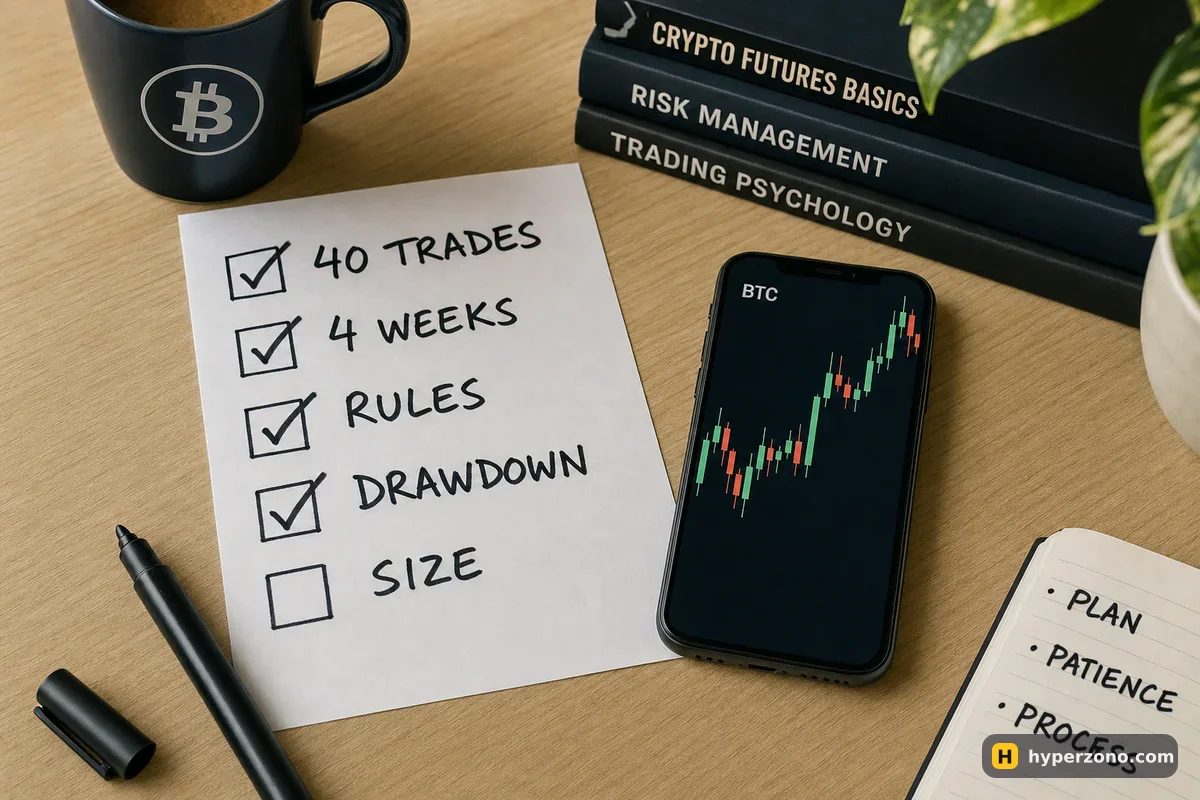
Why a feeling is not a signal
Most people decide they are ready right after a winning demo week. That is exactly the wrong moment, because a few good trades in a row tell you nothing about your habits — markets go quiet, then wild, and a week only shows you one of those moods. What you want instead is a boring, countable record: enough trades, over enough time, that you can see your own pattern in it.
The minimum sample worth trusting is about 40–50 trades spread over four weeks or more. Not 50 trades in two days out of boredom, and not five careful trades over a month. If you are still building that record, keep going on demo for now — the practice itself is covered in learning to trade without real money.
What to look at in your journal, and what to ignore
Win rate is the number everyone checks first and it is the least useful one. You can win 8 trades out of 10 and still end the month down. Eight wins of 5 USDT give you 40 USDT; two losses of 25 USDT take 50 USDT away — you were right most of the time and still lost 10 USDT, plus fees.
First, how often did you actually follow your own plan? Same entry you wrote down, stop-loss where you said it would go, and no extra money poured into a trade that was already losing. Count it, don't guess.
Second, find your deepest dip. From the highest point your demo balance reached, how far down did it go before it recovered? You want to know that number now, on fake money, rather than discover it with your own savings on the line.
Third, compare your average win to your average loss in plain money. If your typical loss is 5 USDT and your typical win is 10 USDT, you can be wrong more often than right and still come out even. That comparison says far more about your trading than the percentage of winners does.
| What to check | What you want to see before going live |
|---|---|
| Number of trades | About 40–50, written down, over four weeks or more |
| Following your plan | You did what you wrote down in at least 9 trades out of 10 |
| Deepest dip in the balance | You know the number, and you could live with it on real money |
| Average win vs average loss | Your typical win is at least as big as your typical loss |
| Win rate | Interesting, but not a criterion on its own |
You do not need a big demo profit to start with real money. A flat month where your wins and losses were about the same size, and you followed your rules almost every time, is a better base than a jumping balance that came from one lucky high-leverage trade.
The soft switch: start at a fraction of your planned size
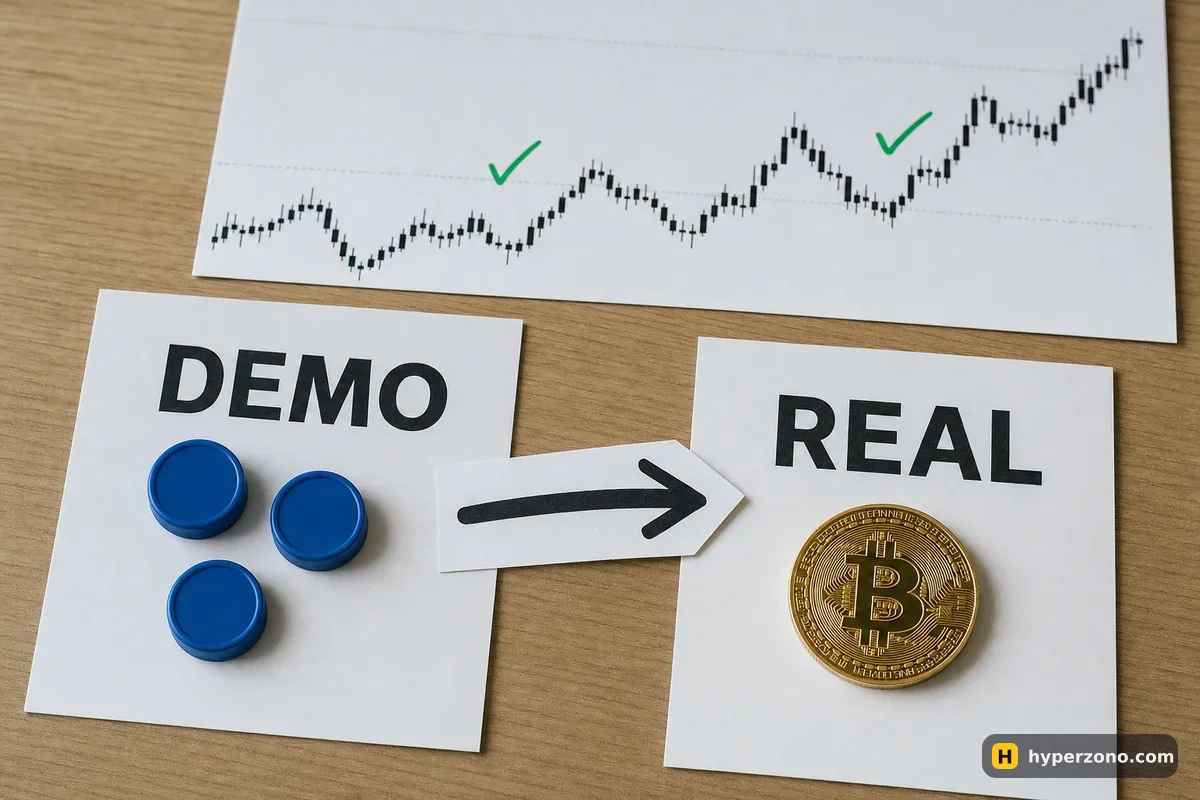
Do not jump from demo straight to the size you have been practising with. Take the risk you eventually want to run per trade and cut it to a tenth or a fifth for the first weeks. If your plan is to risk 10 USDT per trade later, risk 1 or 2 USDT now. The trades will feel almost pointless in money terms, and that is the point: you are checking whether your hands still do the right thing when the loss is real.
There is a limit on how small you can go. Each contract has a minimum size, so a very small risk per trade may not fit. On Binance the smallest bitcoin position is 0.001 BTC — at a price near 83,500 USDT that is about 83.5 USDT of position size, and with a stop placed 2% away from your entry that smallest possible position already risks around 1.7 USDT. If that is more than you wanted to risk, use ETH or another contract with a smaller minimum, and check the minimum in the order window before you size the trade. How much to keep on the account in total is a separate question, answered in how much money you need to start.
Keeping demo and real trading in the same app helps, because the order window, the stop-loss field and the buttons sit in the same places. The account is marked as demo, and on real money your order can be filled at a slightly worse price than you expected, but you are not learning a new screen on the day you start risking your own money. If you sign up on Bybit you can run the demo account and the live one from the same place — check during sign-up that futures and demo trading are available where you live, since that varies by country, and the demo setup itself is covered in opening a Bybit demo account.
Real money changes you, not the chart. The same setup that you took calmly on demo will make your heart beat faster when it is your own 20 USDT. That gap is normal and it is the whole reason for starting tiny — more on what else differs in demo versus live trading.
Rules for your first month with real money
Keep the first month deliberately narrow. Fewer moving parts means that when something goes wrong, you can actually tell what it was.
- One pair only — usually BTC or ETH, because they move more smoothly than small coins; check the minimum order size of the one you pick.
- One strategy, the same one you practised, with the same entry and exit conditions.
- A fixed risk per trade in money, decided in advance; how to work out that amount takes five minutes.
- A stop-loss on every single trade, placed when you open it, not later.
- The same journal you kept on demo, filled in right after each trade.
If you open a Binance Futures account for this first month, you will also find that leverage above 20x is not available during the first 30 days of a futures account. For a month of tiny positions that costs you nothing — low leverage is what you want at this stage anyway.
Give yourself a monthly loss limit too — for example, you stop trading for the month once total losses reach a set amount you chose while calm. Writing it down beforehand is what makes it work.
When to step back to demo
Going back is a normal move, not a failure. Do it if you break your own rules twice in a row, if you ever increase your size right after a loss to win the money back, or if you hit that monthly loss limit. Those three things are the warning signs that show up long before a serious loss does.
Back on demo, you are not starting over — you are rebuilding one specific habit for a couple of weeks, then returning to the small real size again. Plenty of people go round that loop two or three times, and it costs far less than learning the same lesson at full size.
How much money should be on my account if I risk 1 USDT per trade?
Work backwards from the stop. Risking 1 USDT with a stop 2% from entry means a position of about 50 USDT, and the margin you set aside for it is smaller still, depending on leverage. A balance of roughly 50–100 USDT is enough to carry a run of small losses and the fees without the account feeling fragile — these are illustrative numbers, so put in only money you can afford to lose.
Should I use the same leverage on real money as I used on demo?
Yes. The thing you shrink when you go live is the risk per trade, not the mechanics you spent a month learning, so changing leverage at the same time just adds a second experiment. On Binance, new futures accounts cannot go above 20x in their first 30 days anyway, which suits a careful start — see what leverage a beginner should use.
How long should I stay at the tiny size before increasing it?
Give it at least a month, or around 20–30 real trades, and look at the journal before you touch the size. If you followed your plan and your losses stayed inside the amount you set, step up in one move — double it, not ten times it — and watch the same numbers again. Any rule break sends you back down a step; that is the whole discipline.
Am I ready if I am winning most of my demo trades?
Win rate alone does not answer it. Check whether your losses stayed inside the size you planned, how deep your worst dip was, and whether you ever moved a stop-loss because you did not want to be wrong. Those tell you much more than the percentage of winners.
What if I lose my first three real trades in a row?
At 1–2 USDT of risk each, three losses cost you the price of a coffee, which is exactly why you started there. Open the journal and ask one question: did you follow the plan each time? If yes, that's just the normal run of ups and downs and you keep going; if you broke your rules twice, go back to demo for a couple of weeks and fix that one habit.
Can I skip demo and just start with very small real money?
Some people do, and with 1–2 USDT of risk the lesson is cheap. The downside is that your first mistakes will be the clumsy ones — wrong direction tapped, stop forgotten, size typed in the wrong field — and those are free to make on demo. A sensible middle path is a few weeks on demo for the buttons, then small real money for the nerves; note that demo trading is not offered in every country, so check in the app.