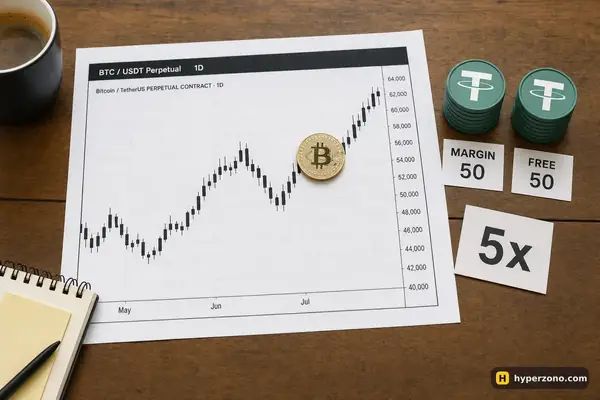
Contents
What a put actually does for your longA worked example: 0.1 BTC long plus one putStep by step: how to set it upThree scenarios in numbersThe mirror image: a short protected by a callWhat goes wrong, and how to avoid itWatching it, and when to close
What a put actually does for your long
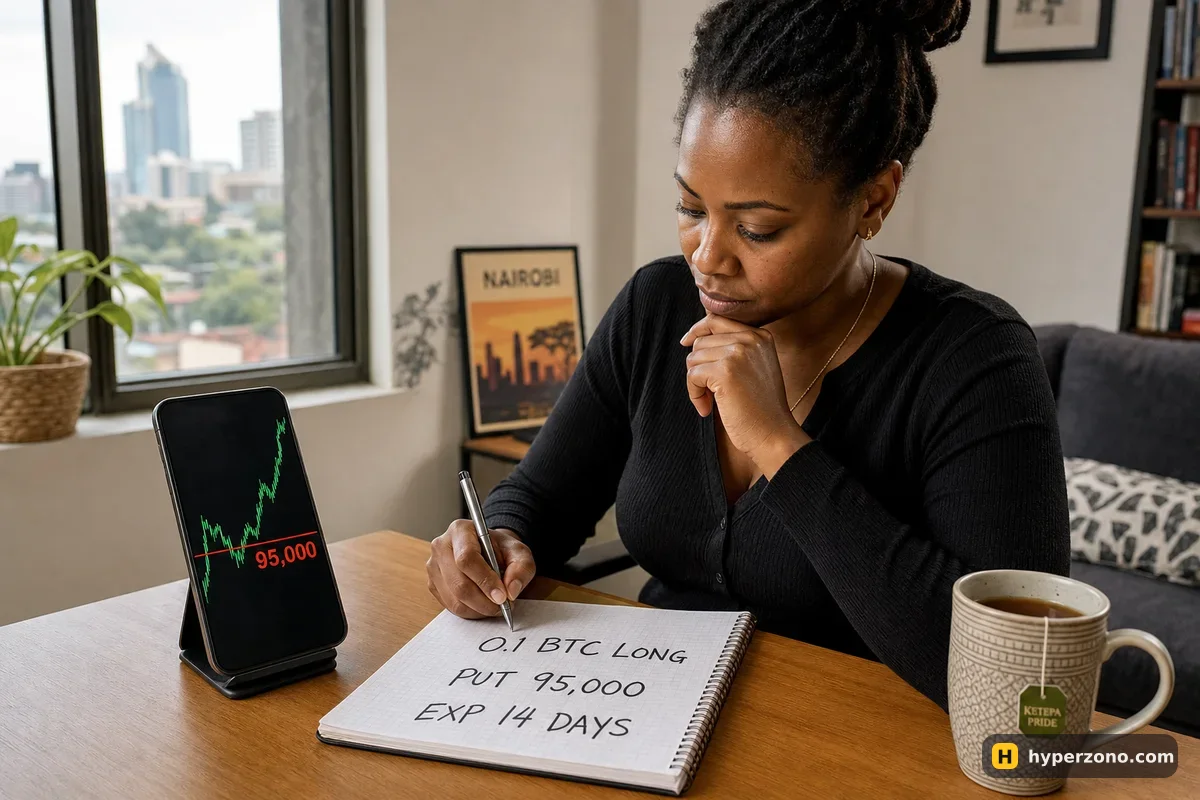
Say you are long 0.1 bitcoin futures from 100,000 and you are happy to hold for about two weeks, but a sudden crash would hurt more than you can accept. A put option on bitcoin gives you the right to sell bitcoin at a price you choose — 95,000, for example — up to a date you choose. If price drops to 80,000, that right is worth real money: 15,000 per bitcoin, so 1,500 USDT on your 0.1. The money arrives exactly while your futures long is losing.
You pick three things: the strike (the price level your protection starts at), the expiry (the date your protection runs out) and the quantity (how much bitcoin you are covering). The price you pay for all that is called the premium, and it is charged once, when you buy. When you buy an option rather than sell one, the premium is also the most you can lose on the option — your trade now has two parts, the futures and the option, and traders call each part a leg. If options as a product are still fuzzy for you, the short comparison on futures and options for beginners covers the ground this page skips.
This is a different kind of protection from a stop-loss. A stop costs you nothing up front, but it is an order that has to be filled, and in a fast gap it can fill well below your stop price — more on whether a stop-loss really caps your loss. A put costs money whether or not you ever need it, but a gap cannot jump over it: the payout is arithmetic, not an order sitting in a book.
A worked example: 0.1 BTC long plus one put
All the numbers below are made up for teaching, with round figures so you can follow the arithmetic. You are long 0.1 BTC from 100,000, which is 10,000 USDT of position. You use 2x leverage, so 5,000 USDT of your money sits as margin — deliberately low, and the section on mistakes explains why that matters here.
Be honest with yourself about the size first. This is a tool for a position of a few thousand dollars and up — the smallest option contract usually covers more bitcoin than a 100 USDT trade holds. If you are trading 50 or 100 USDT, your protection is a stop-loss and a smaller size, not a put; the pages on setting a stop-loss and working out your trade size are the practical version of this page for a small account. If leverage itself is new, start with what leverage is.
You buy a put with a strike of 95,000, about 5% below your entry, expiring in about two weeks. The screen quotes the premium as about 1.5% of the bitcoin price, so covering 0.1 BTC costs you 150 USDT. Real premiums move every minute with the time left and how nervous the market is; the screen quotes you the number of the moment, and your job is to turn it into the amount for your own quantity before you agree to it.
| BTC price | Futures | Option | Together |
|---|---|---|---|
| 80,000 | −2,000 | +1,350 | −650 |
| 90,000 | −1,000 | +350 | −650 |
| 100,000 | 0 | −150 | −150 |
| 110,000 | +1,000 | −150 | +850 |
| 120,000 | +2,000 | −150 | +1,850 |
Long 0.1 BTC from 100,000, put with strike 95,000 for a premium of 1,500 USDT per BTC (150.00 USDT in total). Table amounts are in USDT, before fees and funding; practice figures, check the live premium on the exchange.
Read the flat part on the left: that is the whole point. The loss stops at the gap from entry to strike (5,000 × 0.1 = 500 USDT) plus the premium (150 USDT), so 650 USDT, no matter how far bitcoin falls while the option is alive. On the right, your long still earns, just 150 USDT less than it would have unhedged.
Step by step: how to set it up
Write down what you are protecting
Size, entry price and the loss you refuse to exceed. In the example: 0.1 BTC long from 100,000, and a maximum loss of around 650 USDT. Without these three numbers you cannot judge whether any premium is worth paying.
Open the futures position with modest leverage
Your margin has to survive the fall that the option is there to cover. At 2x on a 10,000 USDT position you have 5,000 USDT of margin behind it; at 20x you have 500, and a 20% drop ends the position long before expiry. Check your liquidation price in the position panel before you go looking for an option — how to find it in advance.
Find out whether options exist where you are
Options are not part of the futures screen — they sit in their own section of the app, and not every exchange offers them. Look through the trading sections to see whether options are listed where you are, and on which coins. The only way to know is to look inside the app yourself — you can open a Binance account and check which derivatives sections are available to you where you live.
Pick the expiry first
You will see a row of dates. Choose one that covers the whole period you plan to hold, plus a few days of slack. An option that expires on Friday does nothing for you during next Tuesday's crash, and this is the single most common way beginners waste a premium.
Pick the strike
Then you get a list of strike prices with a buy and a sell price next to each. A strike close to the current price costs more and leaves almost no gap; a strike further below is cheaper and leaves a bigger piece of the fall for you to carry. The buy price and sell price next to each strike can sit quite far apart on quieter options — what you pay is the buy side, so read that number, not the one in the middle. Around 5% below your entry is a sensible starting point to look at — not a rule, just a place to begin comparing.
Work out the real cost before you buy
Turn the quoted premium into the amount that will leave your balance for the quantity you are covering, and compare it with the loss you are capping. Also check the contract size in the specification: how much bitcoin one contract covers decides how many contracts match your 0.1 BTC. If the smallest tradable size is larger than the position you want to protect, this hedge is not for that trade.
Buy the put and check both legs
After the fill, the two legs of your trade — the futures position and the option — sit in different parts of the account. Note them down together with the expiry date: you now have two things to manage, not one, and the option will not remind you that it is about to expire.
Three scenarios in numbers
Here is the same hedge through three different weeks. Everything is the illustrative trade above: 0.1 BTC long from 100,000, a 95,000 put bought for 150 USDT, held to expiry.
| What price does | Futures long, 0.1 BTC | The put (cost 150) | Together |
|---|---|---|---|
| Falls 20% to 80,000 | −2,000 USDT | pays 1,500, net +1,350 | −650 USDT |
| Falls 5% to 95,000 | −500 USDT | expires worthless, −150 | −650 USDT |
| Stays around 100,000 | 0 | expires worthless, −150 | −150 USDT |
| Rises 10% to 110,000 | +1,000 USDT | expires worthless, −150 | +850 USDT |
Two things stand out. The floor at −650 USDT arrives at 95,000 and never gets deeper, so a 20% crash and a 5% dip cost you exactly the same. And in the boring weeks — the sideways ones — insurance costs you 150 USDT and gives you nothing back, which is how insurance works everywhere else too. If you buy a put over and over on quiet markets, those premiums are a steady leak; this tool is for the trade you genuinely want to hold through something risky, not for every position you open.
The mirror image: a short protected by a call
If you are short, your pain is upward, so you buy a call: the right to buy bitcoin at a fixed price. Short 0.1 BTC from 100,000, buy a 105,000 call at the same illustrative 1.5% of the price — 150 USDT on 0.1 BTC — and your worst case is the 5,000 gap on 0.1 BTC plus the premium, 650 USDT again, no matter how violent the squeeze.
| BTC price | Futures | Option | Together |
|---|---|---|---|
| 80,000 | +2,000 | −150 | +1,850 |
| 90,000 | +1,000 | −150 | +850 |
| 100,000 | 0 | −150 | −150 |
| 110,000 | −1,000 | +350 | −650 |
| 120,000 | −2,000 | +1,350 | −650 |
Short 0.1 BTC from 100,000, call with strike 105,000 for a premium of 1,500 USDT per BTC (150.00 USDT in total). Table amounts are in USDT, before fees and funding; practice figures, check the live premium on the exchange.
Shorts are where this matters most, because a short's loss has no natural ceiling — price can keep climbing. A bought call puts a ceiling on it in advance. The same logic sits behind every other use of hedging, which is covered more broadly in what hedging with futures means; the option version simply replaces "another position" with "a paid-for right".
What goes wrong, and how to avoid it
The expensive mistake is paying too much for the protection. If a two-week put costs 3% of your position and your whole trade idea is worth maybe 4%, the hedge has eaten the trade. Compare the premium with the loss you are capping: in the example you paid 150 USDT to turn an unlimited-looking downside into a known 650. When the premium starts creeping towards the size of the risk itself, either take a lower strike, a shorter expiry, or simply trade smaller.
The second mistake is a date mismatch. Options die on their expiry date, and a hedge that expires on the 14th does nothing on the 15th. Put the expiry date in your phone's calendar on the day you buy, and decide in advance whether you will roll into a new option or close the futures when that date arrives.
The put does not save your position from liquidation. These are two separate things in two separate places. If your futures margin runs out, the exchange closes the position at the mark price and your option is still sitting there, alive, waiting for expiry — you end up holding a lonely bet on a further fall instead of a hedge. Keep leverage low enough that your liquidation price is well below the strike you bought, and use isolated margin so the hedge and the rest of your account do not pull on each other.
One more practical trap: order size. If the smallest option contract on the exchange covers more bitcoin than your futures position, you are covering more bitcoin than your position holds. The extra part is no longer protection — it is a separate trade betting on a fall, and it can lose money on its own. And if options are not available on the coin you trade, which is normal outside the biggest names, this whole approach simply does not apply there; a stop-loss and a smaller position do the job instead.
Watching it, and when to close
While both legs are open, check two numbers rather than one: your futures margin and the time left on the option. The futures side also pays or receives funding every few hours, which slowly shifts the result of a long hold; the option side does not, because it was paid for once.
Closing is usually cleanest when you close both legs at the same time. If the market crashed and you want out, you can sell the put back before expiry while it still has value, and close the futures in the same minute. If the market rose and your put is now far from the strike — price is nowhere near 95,000 — selling it back may return only a couple of dollars, and many traders simply let it expire. The one thing to avoid is closing the futures and forgetting the option: what is left is no longer protection, it is a fresh position betting on a fall that you did not plan. Whether an option is settled in cash at expiry, and whether it can be exercised only on the expiry date, is in its contract specification — read that page once before your first hedge, not after it.
If this is all new and you have not placed a futures order yet, do the plain version first: one small long, a stop-loss, a close, and only then think about adding an option leg on top. The step-by-step start guide walks through that part, and if you want to see for yourself what your exchange actually offers, you can sign up on Bybit or any venue you already use and read through its trading sections without buying anything.
Is buying a put cheaper than using a stop-loss?
A stop-loss costs nothing up front, so in money terms it is always cheaper to place. The difference shows up in a crash or a weekend gap, where a stop can fill far below your price and a put cannot be skipped. Think of the premium as the price of removing that uncertainty, and only pay it when the uncertainty is worth removing.
Can I hedge a 100 USDT futures trade with an option?
Usually not. The smallest option contract on most venues covers more bitcoin than a 100 USDT position holds, so you would be paying to protect a size you do not have. On a small account the same job is done by a smaller position, lower leverage and a stop-loss placed the moment you open the trade.
Which strike should I choose for my first hedge?
Start by writing down the loss you refuse to exceed, then work backwards. A strike about 5% below your entry on a long leaves you carrying that first 5% yourself and costs less; a strike right at your entry costs more and leaves almost no gap. Compare two or three strikes on the screen and pick the one whose premium you would still be happy to pay in a quiet week.
How long should the option run?
At least as long as you plan to hold the futures trade, plus a few days of slack. Longer options cost more because you are buying more time. Buying one that expires in the middle of your trade is the most common way to pay a premium and get nothing for it.
Can I hedge an altcoin futures position with options?
Only if options exist on that coin where you trade, and where options are offered at all the list of coins is usually much shorter than the futures list. Check inside the app before you build a plan around it. If there is nothing listed, your tools are a smaller position, lower leverage and a stop-loss.
What happens at expiry if bitcoin is below my strike price?
The value is settled according to the contract rules for that specific option — normally in cash, against a settlement price on the expiry date. The exact mechanics, the settlement time and whether anything is required from you are in the contract specification on the exchange, so read that page before your first expiry rather than during it.
Can I sell an option to collect the premium instead of paying it?
You can, and it is a completely different risk. A bought option can only cost you the premium; a sold one takes in a small premium and can lose far more if the market moves against you. Treat selling options as an advanced topic and leave it alone while you are learning.