Contents
A planned add-on is not the same as averaging downThe number that changes first: your average entryRecalculate the whole position, then decideWhen the add simply does not fitTest the rule on past moves before you use real moneyA planned add-on is not the same as averaging down
Adding to a trade that is going your way and adding to a trade that is going against you look similar on the screen — same button, same order window — but they do opposite things to your risk. When you add while price moves in your favour, part of the position already has a cushion of unrealized profit, and you still have room to place one stop that limits the whole thing. When you add while price falls through your plan, you are buying more of something that has already proved you wrong, and the stop usually gets dragged further away to make space.
Decide the price where your idea is simply wrong before you enter. Changing size or the stop halfway through, while the candle is moving, is how most people quietly break their own rules. A scale-in is only safe if all three numbers were written down in advance: at what price you add, how much you add, and where the combined stop goes.
The number that changes first: your average entry
An exchange does not keep your two entries separate. It merges them into one position with one average entry price: total money spent, divided by total quantity. You bought 0.02 BTC at 100,000 and later another 0.02 BTC at 101,000. The exchange merges them: 4,020 USDT spent on 0.04 BTC, so your entry price is now 100,500 for the whole lot. Your profit and loss from that moment on are measured from 100,500, not from the price you first got excited about.
That is why the second entry quietly eats part of your cushion. The first piece is still in profit, but the average moved up towards the current price, so the distance between your average entry and your old stop got bigger — and you now have more coins travelling that distance. Both factors push the loss up at the same time. You can try your own numbers here:
Recalculate the whole position, then decide
The check takes about a minute on paper, and it is one sum. Take the money you allow this idea to cost you — say 20 USDT — and divide it by the distance from your entry to your stop, counted per coin. In the example below that distance is 500 USDT per BTC, so 20 ÷ 500 = 0.04 BTC. That is the most you may hold in total, first piece and add together. A stop further away means fewer coins; a stop closer means more. Run the sum on the combined position rather than on the first entry, and you have your answer.
Write the add into the plan before you enter
Price level, size, and the stop the position will have afterwards. If you cannot name all three now, the add is not planned.
Work out the new quantity and the new average entry
Add the coins together, add the money together, divide. The exchange will show the same figure on the position line after the add.
Choose one stop for everything
A combined position has only one price where you admit the idea was wrong — and that is where the single stop goes. Put it where the idea is actually wrong, not where the maths would be convenient.
Multiply the total quantity by the price distance to that stop
0.04 BTC × 500 USDT per BTC = 20 USDT. That is your loss in money if the stop fills. Compare it with the budget you set before the first entry.
Subtract fees and leave room for slippage
Entry fee, add fee, exit fee and any funding you have paid all come out of the same budget, and a stop can fill a little worse than its trigger price.
Here is what that looks like with round illustrative numbers. Your account is 1,000 USDT and you decided before the trade that no single idea may cost you more than 20 USDT. Bitcoin is at 100,000, you go long 0.02 BTC — a position worth 2,000 USDT — with a stop at 99,000. Price moves to 101,000 and you want to add another 0.02 BTC.
A 2,000 USDT position on a 1,000 USDT account means you are using leverage — your margin is only part of that amount. When you double the position you need margin for the second half too, so check your free balance before the add, or the order will simply be rejected.
| Stage | Quantity | Average entry | Stop | Loss if the stop fills |
|---|---|---|---|---|
| First entry only | 0.02 BTC | 100,000 | 99,000 | 20 USDT |
| After adding, stop untouched | 0.04 BTC | 100,500 | 99,000 | 60 USDT |
| After adding, stop moved up | 0.04 BTC | 100,500 | 100,000 | 20 USDT |
The middle row is the mistake almost everyone makes once. The bottom row is the add done properly. The stop sits at 100,000 because that is where the move you were trading failed — price back below your first entry means the push never held. It also happens to bring the loss back to 20 USDT. If that price were not a real level, the honest answer would be a smaller add, not a convenient stop.
Fees still have to come out of the same budget — at Binance's base taker fee of 0.05% the two entries and the exit cost about 4 USDT together, so the honest thing is to plan the add around 16 USDT of price risk, not 20. On Bybit the base taker fee is 0.055%, so check the rate on your own exchange. The exchange also recalculates your liquidation price when the position grows, so glance at it after the add rather than assuming it stayed put.
When the add simply does not fit
Sometimes the arithmetic refuses, and that is useful information rather than a problem. If the only honest stop for the combined position sits far below — because the nearest level where your idea breaks is a long way back — then there is almost no room left: take your loss budget, divide it by the price distance per coin from the new average entry to that stop, and you get the biggest quantity the whole position may hold. Subtract what you already hold, and what's left is all you can add; sometimes it's nothing, and sometimes it's less than the exchange's minimum order size, which comes to the same thing. If price has already run so far that the only stop your budget allows sits a few dollars below where price is right now, you are not managing risk, you are hoping the next five minutes are quiet.
There is one more trap worth naming. A stop at your first entry price is often called break-even, but after two entry fees, an exit fee and any funding you paid, it closes the trade at a small real loss. Call it what it is and keep it inside the budget. And if you want the add to barely move your average entry, make it smaller than the original piece — half the size moves the average half as far, which leaves you more room for the stop. None of this depends on a special order type; it is the same long you already know how to open, and if you are still unsure about that part, the walkthrough on opening a long position covers it.
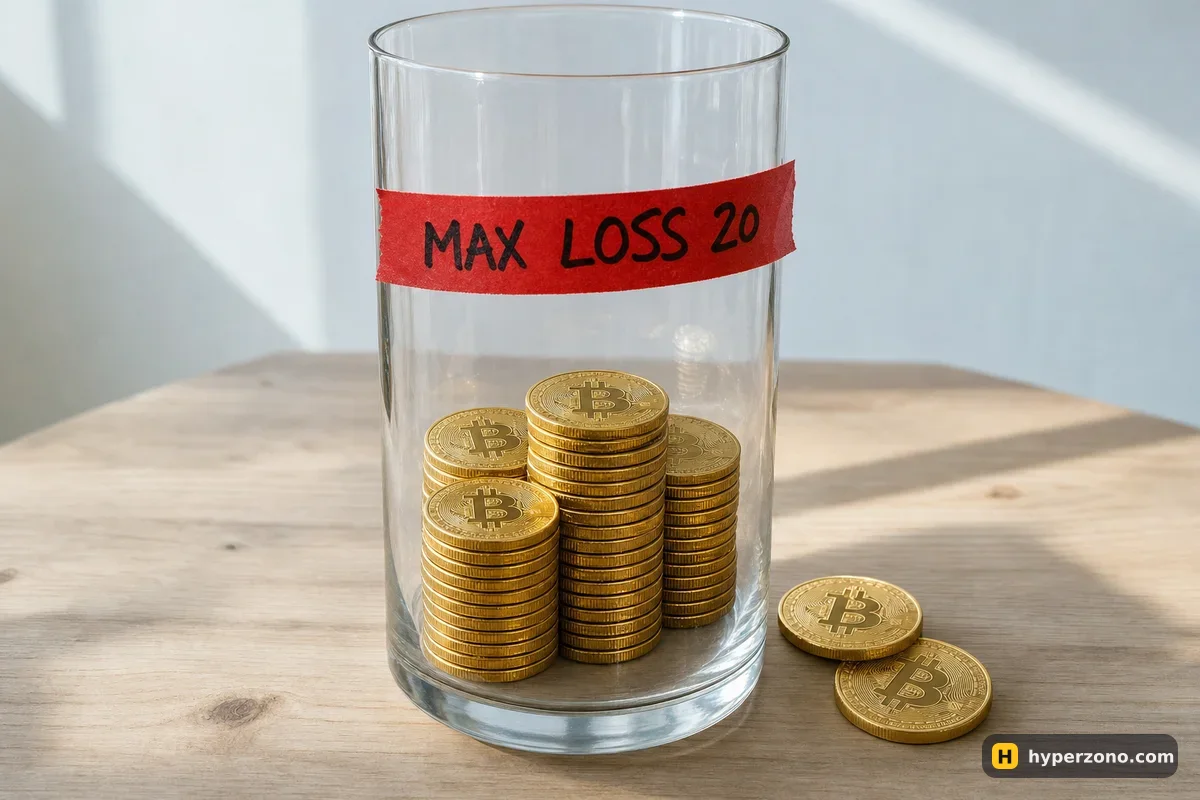
Decide the maximum size of the whole position before the first entry. Write one line in your plan: "this idea may cost me 20 USDT and may grow to 0.04 BTC in total". Then an add is just filling in a slot you already reserved, instead of a new decision taken while the price is moving.
Test the rule on past moves before you use real money
This is a rule you can check without risking anything. Pull up a chart of a move you remember, mark where you would have entered, where the add would have gone, and where the combined stop would have sat; then follow what happened next and write down the result honestly, including the times the add got stopped out for a loss that the first entry alone would have avoided. After a dozen of those on paper, repeat them in demo mode so the order window, the average entry line and the fee line do the arithmetic in front of you. You can sign up on Bybit and switch to demo for that, and our step-by-step on opening a Bybit demo account shows where the switch is.
Two related pages fill in the parts this one leans on: how to size a position from your risk and how to place and move a stop loss. Keep both numbers — size and stop — in the same sentence of your plan, and adding to a winner stops being a gamble on your own excitement.
Does adding to a position change my entry price?
Yes. The exchange merges both fills into one average entry price: total money in, divided by total quantity. You bought 0.02 BTC at 100,000 and later another 0.02 BTC at 101,000 — 4,020 USDT spent on 0.04 BTC, so your entry price becomes 100,500 for the whole lot. Everything after that — unrealized profit, the distance to your stop, the liquidation price — is measured from the new average.
Should each add be smaller than the previous one?
There is no rule that says so, but a smaller add moves your average entry less, which leaves more room between the average and your stop. The real test is still the same: the total number of coins multiplied by the price distance to your stop, compared with the money you allowed yourself to lose on this idea.
Can I just move my stop to my first entry and add as much as I want?
No. That stop still has to be a price where your idea is genuinely wrong, and after two entry fees and an exit fee it closes the trade at a small loss rather than at zero. Run the multiplication for the full combined size before you decide how much to add.
What if I don't want to touch my stop at all?
Then the add has to be small. Take the money you are still willing to lose, divide it by the price distance per coin from your new average entry to that fixed stop, and that is your maximum total quantity. Subtract the quantity you already hold to see what you may add. Often the answer is less than you hoped, and sometimes it is nothing — which is a valid outcome.
Do I need extra free money in the account to add?
Yes. The second piece needs its own margin, just like the first one did. If your free balance is already working in other positions, the exchange will reject the order, so check the available balance before you plan the add rather than after.
Is this the same as averaging down?
No. Averaging down means buying more while price moves against your plan, which usually ends with a wider stop and a bigger loss budget than you agreed to. A planned scale-in happens while the trade is working and only if the combined risk check still passes.
Sources and fact-check
Exchange terms were checked against official documents on November 6, 2026. Terms change — before you trade, check what matters to you in the exchange app and in your contract’s specs.
Binance Academy: How to Calculate Position Size in TradingBybit: P&L Calculations (USDT Perpetual and Expiry Contracts)