
Contents
Why write anything down before you clickThe six lines to write downThe hardest line: "if price does this, I'm wrong"Turning the plan into a position sizeYour checklist before you tap the buttonAfter the trade: read your own plan again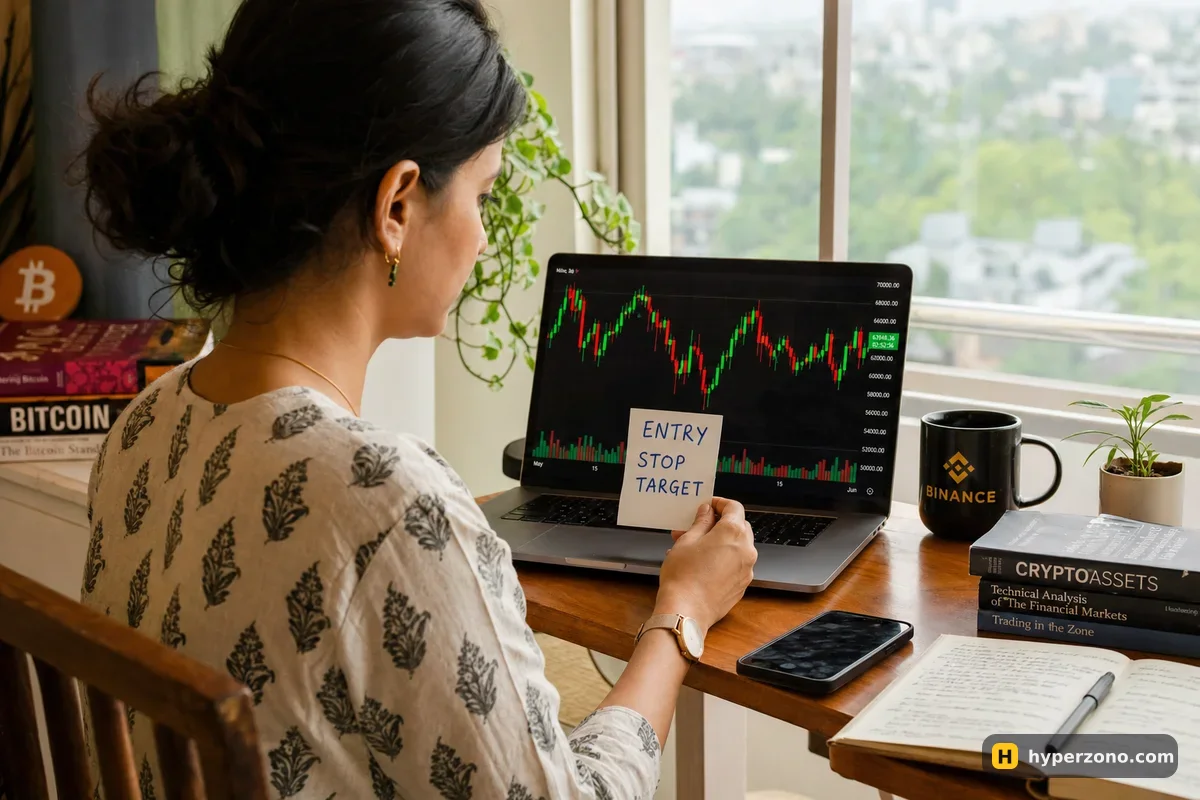
Why write anything down before you click
You are about to put real money on one trade. The plan is a short note you write while you are still calm, about this trade only: where you get in, where you get out, how much you can lose. A strategy is the bigger question of when to buy at all, and that belongs on a different page — which approach suits a beginner covers it. Your note just pins down what you will do once this position is live.
Here is why this matters for your money. The moment your position is open, your brain starts negotiating: maybe the stop is too tight, maybe I'll give it a bit more room, maybe I'll close early because this candle looks scary. Every decision you make in advance is a decision you don't have to make with money on the line. That is the whole trick, and it works just as well with 10 USDT as with 1,000.
The six lines to write down
You can keep this as a template in your notes app or a spreadsheet and copy it for each new trade. Fill in all six fields — if one of them stays empty, you don't have a plan yet, you have a hunch.
| Line | What you write | Example |
|---|---|---|
| 1. Coin and direction | The contract and whether you go long or short | BTCUSDT perpetual, long |
| 2. Entry | The price you want to get in at, market or limit | Limit 84,000 |
| 3. Stop | The price where you accept you were wrong and get out | 83,160 (1% below entry) |
| 4. Target | Where you take profit and close | 85,680 (2% above entry) |
| 5. Risk | The money you are ready to lose on this one trade | 4 USDT (2% of a 200 USDT account) |
| 6. Invalidation | The condition that kills the idea, in words | "If BTC closes below 83,500 on the 1-hour chart, the reason is gone" |
Notice what is missing: there is no line for "how much I hope to make" and no line for leverage. Leverage is not something you choose first and then build the trade around — it comes out at the end, once the size is settled. You'll see how a bit further down, where we turn the plan into a position size — and if leverage still puzzles you, leverage and profit walks through it slowly.
The hardest line: "if price does this, I'm wrong"
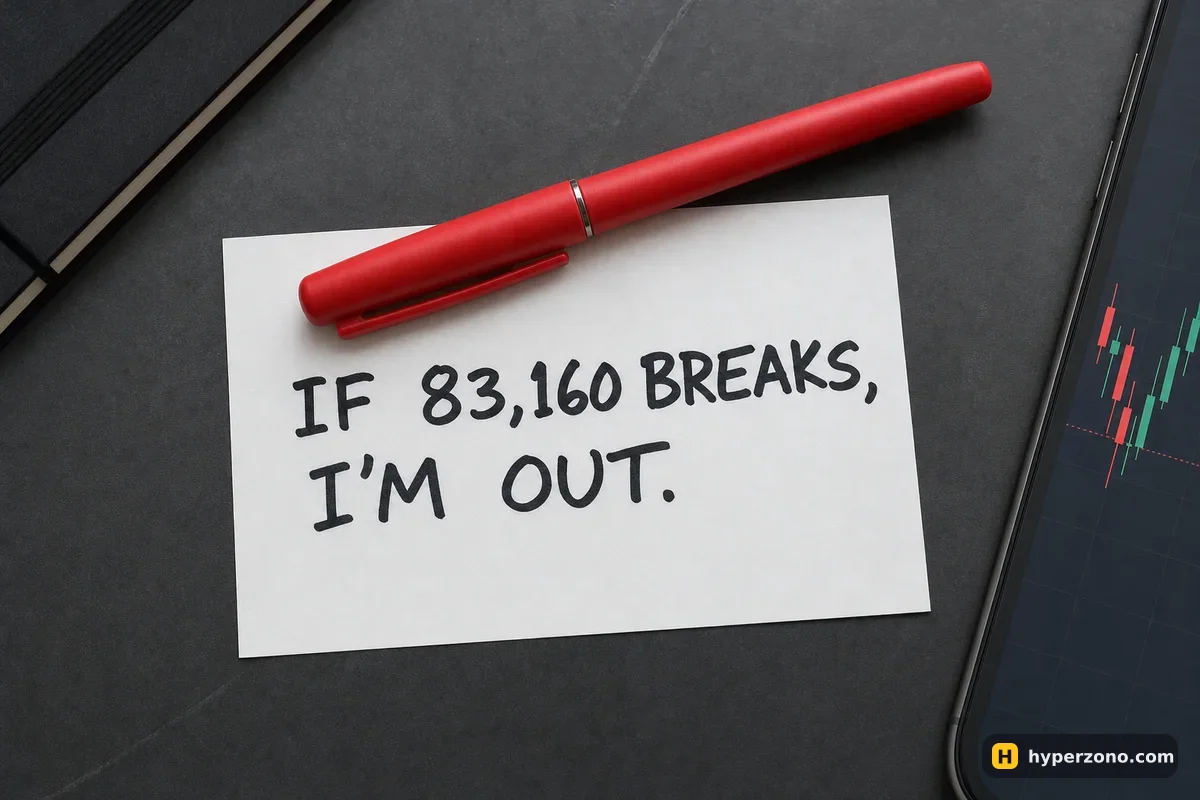
Most beginners can name a price where they want to buy. Far fewer can say out loud what would prove the idea wrong, and that is exactly the line that saves accounts. Say you go long because bitcoin bounced off 83,500 twice in the last two days and you expect a third bounce. If price closes clearly below 83,500, your reason has disappeared — the level you were betting on didn't hold. That is your invalidation, and your stop sits a little below it, at 83,160, so that a short dip below the level — the kind that lasts a minute and comes straight back — doesn't close your trade while the idea is still alive.
Invalidation can also be about time. "If the price is still sitting at my entry four hours from now, I close and look for something better" is a perfectly good line, because money tied up in a trade that isn't working is money you can't use. Write the condition in plain words before you enter, and then set the stop in the app so the exit happens even if you are asleep — the mechanics of that are on the page about setting a stop loss.
Turning the plan into a position size
Once you have an entry, a stop and a risk amount, the size is simple arithmetic: the money you are willing to lose divided by the distance to your stop in percent. In our example you accept losing 4 USDT and your stop is 1% away, so the trade is 4 ÷ 0.01 = 400 USDT in size. At a price of 84,000 that is 400 ÷ 84,000 ≈ 0.0048 BTC.
A 400 USDT trade on a 200 USDT account means you need leverage, because the trade is bigger than your balance. The exchange then holds part of your money aside as a deposit while the position is open — 80 USDT of your balance at 5x, or 40 USDT at 10x, and the rest stays free for fees and for the position to move before anything is forced. That deposit is your margin, and it changes nothing about the trade itself: either way the loss at your stop stays 4 USDT. Never lock your whole balance into the margin of one position — at 2x this same trade would reserve all 200 USDT and leave nothing behind it.
Higher leverage just means less of your balance is tied up while the trade runs. The trade-off is that with less margin behind the position, the price where the exchange closes it for you sits closer to your entry — so before you confirm, check that your stop at 83,160 is well in front of the liquidation price the app shows. If that number is new to you, how leverage works and where your liquidation price comes from explain it in order.
Check what the plan gives you both ways. If the stop is hit, you lose 0.0048 × 840 ≈ 4 USDT, which is exactly what you planned. If the target at 85,680 is hit, you make 0.0048 × 1,680 ≈ 8 USDT — twice the risk. The exchange also charges a fee when you open and when you close, on the 400 USDT size: at a taker rate of 0.05% that is about 0.20 USDT each way, so roughly 0.40 USDT off the result. Small, but on a 4 USDT risk it is not nothing — the rates are on the fees page and in your app. If you want the size formula in more detail, including what to do when your stop is far away, read how to work out how much to put into one trade.
One practical check: very small accounts sometimes run into the exchange's minimum order size, so your calculated size may be below what the contract allows. If that happens, either pick a contract with a smaller minimum or accept that this particular trade isn't for your account today. Don't fix it by widening the risk.
Your checklist before you tap the button
Write the six lines first
Notes app, spreadsheet, paper — anywhere you can see them while the trade is open. If you can't fill in the invalidation line, you don't take the trade.
Work out the size from the stop, not from excitement
Risk in money divided by the stop distance. Put that number in the amount field, then set leverage and look at the margin the exchange reserves before you confirm.
Set the stop and the target with the order
In the order window you can attach both at the same time, so the exit exists from the first second. Here is how that works: stop loss and take profit together.
Say what you will not do
No adding to a losing position, no moving the stop further away, no second trade on the same idea. One line is enough.
Leave the screen
The orders are in. Watching every candle only tempts you to interfere with a plan you already made properly.
Moving your stop is rewriting the plan after the exam has started. Dragging a stop further away always feels reasonable in the moment, and it turns a 4 USDT loss into a 30 USDT one. Moving a stop closer to lock in profit after the price has gone your way is a different thing and is fine — just decide in advance which of the two you allow yourself.
After the trade: read your own plan again
When the position is closed, open the note and answer three questions in one line each. Did I enter where I said? Did I exit where I said? Did I change anything while the trade was running, and why? Keep the answers next to the result in USDT, and after twenty trades you will see your own patterns far more clearly than any indicator will show you.
Separate the result from the quality of the plan. A trade that followed every line and still lost 4 USDT is a good trade — that is what the stop is for, and a stop can also fill a bit worse than the trigger price in a fast market, which is covered in does a stop loss guarantee your loss. A trade that made 20 USDT because you removed the stop and got lucky is a bad trade, and it will cost you later. The honest review is the part most beginners skip, and it is one of the main reasons beginners lose money.
The fastest way to build the habit is to run the same six lines on money that can't hurt you. Write a plan, place it in a demo account, review it the next day, repeat for a week — you can sign up on Bybit and switch to its demo mode to do exactly that, or compare the options on the page about exchanges with demo trading. By the time you move to real USDT, the template will already feel normal.
How long should a trading plan for one trade be?
Six lines, maybe ten words each. If it takes a page, you will stop writing it after three trades. The point is not the writing, it is that the exit decisions exist before the position does.
Do I need a plan for a tiny trade of $10?
Yes, and a small trade is the best place to practice it. The habit is what you are building, not the profit. A plan you only use on big trades is a plan you will never actually have ready when it matters.
Should leverage be in my trade plan?
Not as a starting choice. Write the risk and the stop first, work out the position size from those, and only then see what leverage lets you open that size with the margin you have. The number you pick decides how much of your balance is locked up and how close your liquidation price sits to your entry, not how much you lose at your stop.
What risk-to-reward should I put in the plan?
A common starting point is a target at least twice as far as your stop, so one winner covers two losers. It is not a rule of nature — it just means you don't need to be right most of the time to stay even. Set the target where the chart gives you a reason, then check whether the ratio still makes sense.
Can I change the plan while the trade is open?
You can, and that is exactly why you wrote it down — so you can see what you are changing. Closing early because the market clearly changed is a decision; widening the stop because you don't want to accept a loss is not. Note any change in the plan and look at it again a week later.
What if the price never reaches my planned entry?
Then you don't take the trade, and nothing bad has happened. Chasing a price that ran away from your entry means your stop and your size no longer match the plan you wrote. Cancel the limit order and wait for the next setup.