Contents
Why a coin falls when nothing happened to itCompare the two over exactly the same time windowWhen your coin goes its own wayThree altcoin longs can be one bet repeatedWhat you actually have to check on each projectHow to test this on a live chart this week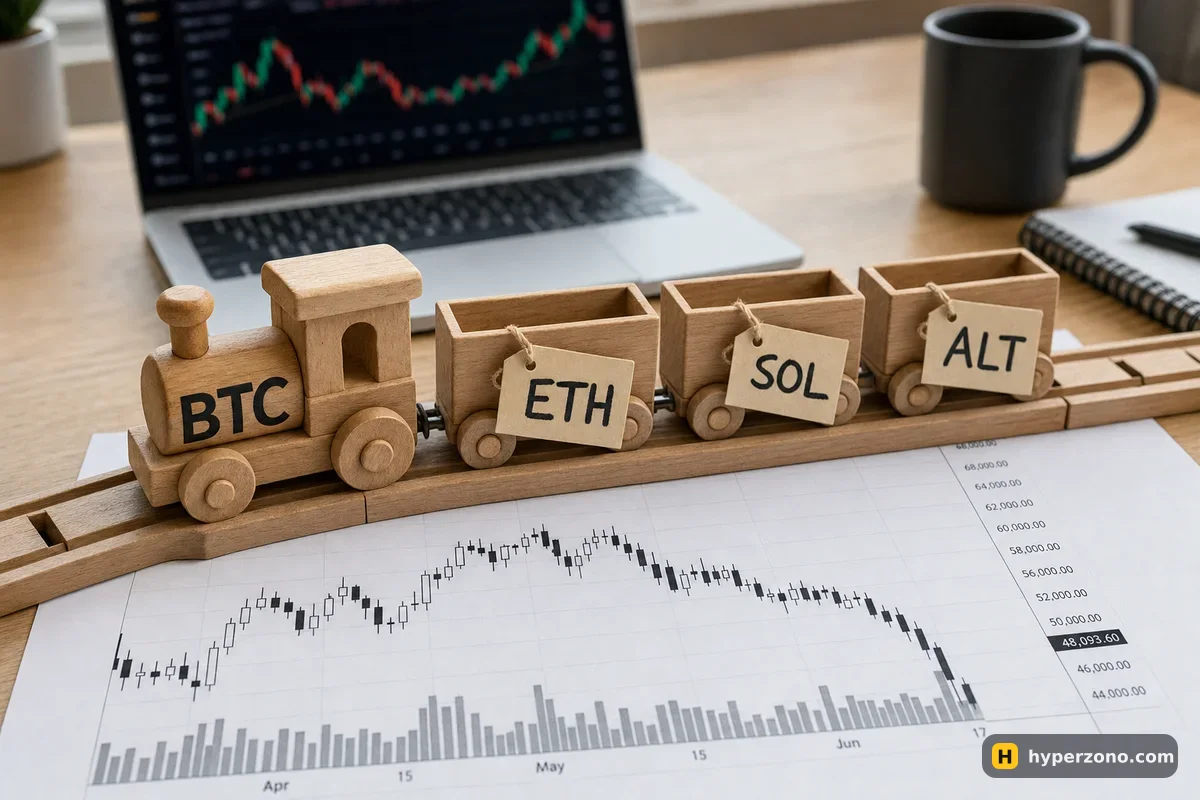
Why a coin falls when nothing happened to it
Think about who is actually selling. It is rarely someone who read the project's roadmap that morning. It is a trader who decided to hold less crypto today — and the fastest way to hold less crypto is to sell whatever is open, starting with the markets that are easiest to get out of. Bitcoin has the most buyers and sellers sitting there at any moment, so it moves first, and everything else follows within minutes.
Borrowed money makes the link tighter. When Bitcoin drops a few percent in an hour, altcoin longs that were sitting close to their liquidation price get closed by the exchange, which means forced selling in coins where nothing at all has changed. Those forced sales push the altcoin down further, which closes the next set of positions. That is why an altcoin can fall twice as much as Bitcoin on a day with zero project news — fewer buyers and sellers in that coin, plus a lot of borrowed money that gets closed out at the worst moment.
Bitcoin doesn't move on its own either. It responds to the same headlines as stock markets, so a bad morning for stocks can reach your altcoin through Bitcoin, with nothing happening to the project at all. One decision made far away from crypto ends up on your chart three steps later.
Compare the two over exactly the same time window
The most common mistake here is comparing numbers that cover different periods: a "24h change" on one site starts at midnight UTC, on another it is a rolling 24 hours, and your chart might be showing the last 12. Open both charts in the same app, set the same interval, and read the move from the same candle to the same candle. Then subtract Bitcoin's percentage from the coin's percentage. Whatever is left is the only part that could possibly be about the project.
| Contract | Change over the same 6 hours | Minus Bitcoin's move |
|---|---|---|
| BTCUSDT | −6% | — |
| ETHUSDT | −7% | −1% |
| A mid-cap altcoin | −12% | −6% |
| An altcoin with new tokens reaching the market this week | −18% | −12% |
Read it like this: the first two rows need no explanation beyond "the market fell", and hunting for news about Ethereum that day would waste your evening. The last row is different — a coin that fell three times as much as Bitcoin has something of its own going on, and that is where you go and look. The easiest way to practise this is to open a Binance Futures account, put the Bitcoin chart and your coin's chart side by side on the same interval, and do the subtraction on a few red days before you risk anything.
Do the same check on green days. If your coin rises 9% while Bitcoin rises 8%, you did not pick a winner — you held a slightly faster version of the same trade. Keeping that habit for a couple of weeks tells you more about a coin than any amount of reading.
When your coin goes its own way
Most days your coin just follows Bitcoin — but not always, and the exceptions are things you can check in advance. A batch of new tokens reaching the market, an exchange announcing a listing or a delisting, a hack or a halted network, a big protocol upgrade, a rebrand or a migration to a new token: each of these moves one coin while the rest of the market stands still. Money rotating into one theme does the same thing in groups, which is the part people call altseason.
For a futures trade this is a short calendar check, not deep study. Is more token supply due to reach the market in the next few days? Is an upgrade or a vote scheduled? Has the exchange posted anything about this contract? Three minutes of that catches most of the surprises that make one coin behave unlike the rest, and there is a simple way to put those facts on one page in a fact sheet on an unfamiliar token.
Three altcoin longs can be one bet repeated
This is where following Bitcoin costs real money. Say your account is 300 USDT and you decide to risk 6 USDT — 2% of it — on each trade. You open three altcoin longs, each 100 USDT in size, with a stop about 6% below your entry. At 5x each 100 USDT position holds about 20 USDT of your money as margin, so all three together tie up around 60 USDT — but the loss if all three stops hit is still 18 USDT. Each trade on its own looked like a small, sensible risk, and yet one red hour on Bitcoin can take out all three stops and cost you 6% of your account in an afternoon, for what felt like three separate ideas.
Changing the leverage does not change that 18 USDT at all; it only changes how much of your balance sits as margin while the three trades are open. The fix is also arithmetic rather than discipline: before you open the third position, add up what all your open trades lose together if Bitcoin falls 5%, and treat that total as your real risk for the day. Many beginners find it easier to hold one position in the coin they understand best and size it properly than to hold four small ones that move as a block — there is a fuller walkthrough in how to work out your position size and in total risk on BTC and ETH trades.
One question before the next position. Ask yourself what single price on the Bitcoin chart would stop every trade you have open at once. If the answer is one number, you are holding one trade in several pieces, and your risk is the sum, not the average.
What you actually have to check on each project
You do not have to track hundreds of coins. One Bitcoin chart explains most of what you see; the rest is a short check on the few coins you actually trade: is new supply about to arrive, has the team or the exchange announced anything, is an upgrade or a vote scheduled, and are there enough buyers and sellers in that contract for you to get out quickly in a fast market.
One number never explains a coin, and forgetting the dates when new tokens reach the market is one of the mistakes people repeat most often. For a trade that lasts a day or two, the calendar matters most; the deeper study starts to matter when you plan to hold for several weeks.
If you are still choosing which contracts to trade at all, the separate guide on picking your first coins handles that by liquidity and risk, so it is worth reading once and then not repeating.
How to test this on a live chart this week
Pick one Bitcoin contract and one altcoin contract
In the futures section of your exchange, open BTCUSDT and the altcoin you are curious about. Use the same chart interval for both — 1 hour is enough to see a day's story.
Write down both moves over the same hours
Note the percentage change from the same starting candle to the same ending candle. Keep a small list for five or six days.
Subtract and look only at the difference
If the gap is a percent or two, there is nothing to research. If the coin moved far more, go and check its announcements, token release dates and exchange notices for that date.
Check the contract and your country before any real money
Check the contract specification in the app for minimum order size, leverage and funding, and see which exchanges are available in your country before you deposit anything.
Run the first version in demo
Place one small trade on the altcoin and watch what happens to it on the next Bitcoin move. Demo futures accounts let you do this with no deposit, although not every contract exists in demo — check your ticker there first.
Do all altcoins fall with Bitcoin?
Most of them, most of the time, and usually by more than Bitcoin, because a smaller coin has fewer buyers and sellers and carries more borrowed money. But it is a tendency, not a law: new token supply, listings, hacks, upgrades and money rotating between themes regularly push one coin away from the pack for days at a time.
Is it safer to hold several altcoins instead of one?
Not automatically. If they all take their direction from the same Bitcoin chart, several positions in the same direction behave like one larger position, and your stops get hit together. Add up what every open trade loses on a 5% Bitcoin drop and judge from that total.
Why did my coin fall 12% when Bitcoin only fell 4%?
Part of it is the market-wide move, and part is that your coin has fewer buyers and sellers, so forced closing of leveraged positions pushes it further. Subtract Bitcoin's move, then check that date for new token supply, exchange announcements or project news — the leftover 8% is where an explanation might exist.
Does this mean project research is pointless for futures?
No, it just has a smaller job than people expect. Research explains the part of the move that Bitcoin does not, and it matters most for supply changes and anything scheduled during the days you plan to hold. Short trades need the calendar; longer holds need the deeper reading.
Can I just trade Bitcoin instead?
Many beginners do, and it is a reasonable choice: it has the most buyers and sellers of any crypto market, it is the one all the others follow, and you only have to track one story. If you later want altcoin trades, you will already know how much of their movement was Bitcoin's doing.
Sources and fact-check
Exchange terms were checked against official documents on October 31, 2026. Terms change — before you trade, check what matters to you in the exchange app and in your contract’s specs.
Binance Research: Bitcoin: From Pizza to PortfolioBinance Academy: A Guide to Cryptocurrency Fundamental Analysis