Contents
What you are actually trading in each caseHow much the price moves, and what that does to your stopWhat moves the price, and whenSo which is easier for a beginner?How to try both with a small amountWhat you are actually trading in each case
Nobody delivers barrels to your door. A gold contract on a crypto exchange is just a contract that follows the gold price. No metal ever reaches you — when you close the trade, the exchange pays you the price difference in USDT, or takes it from your balance. It has no end date, so you can hold it as long as you keep enough margin.
OKX describes its commodity contracts exactly like that: crude oil, gold, silver and copper, with no expiry, held for as long as you want. While the trade is open you also pay or receive funding, the small regular payment that runs between the people holding longs and the people holding shorts.
These contracts live in your normal trading account, right next to the BTC perpetual — no separate account, the same isolated or cross margin, the same order types. On Binance, gold, silver, WTI and Brent are part of the USDⓈ-M futures list, and there is a gold pair inside Binance Wallet as well, where you open a long or a short on the same screen as a crypto pair. So the real question is not which market to join, but which contract to pick inside the account you already have.
How much the price moves, and what that does to your stop
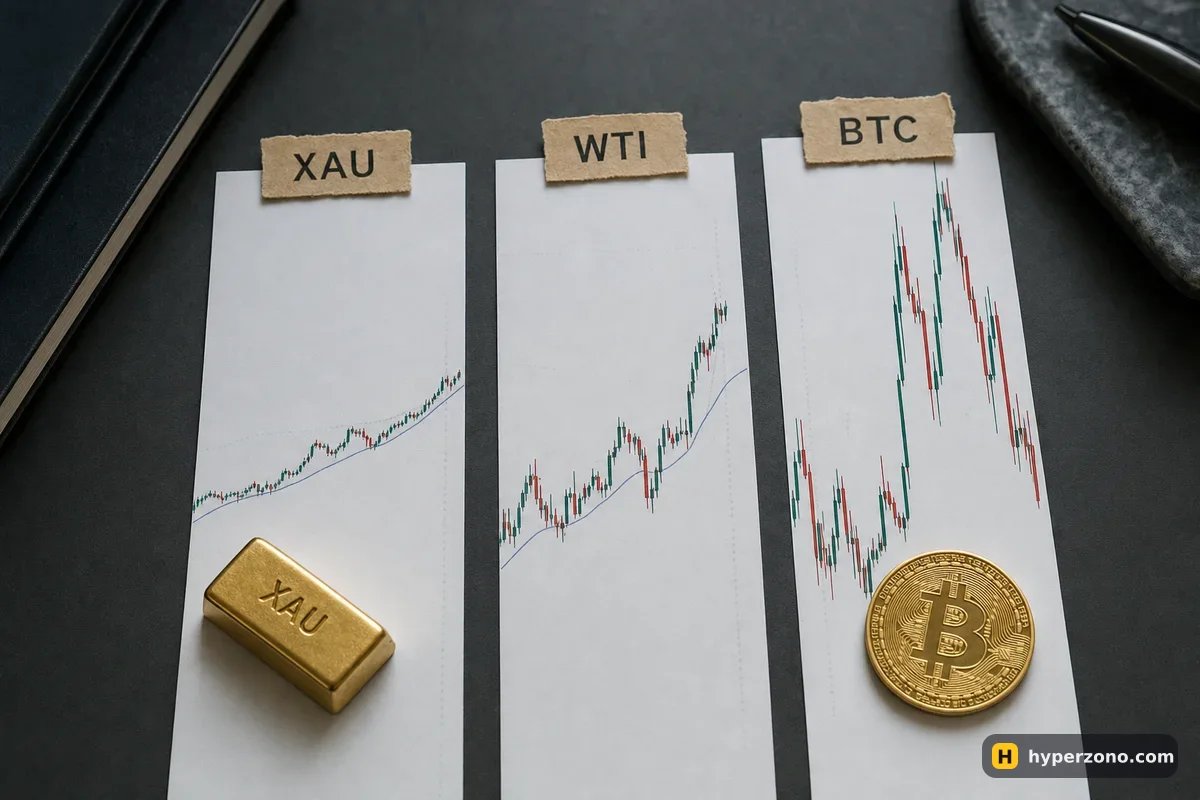
The money part is identical for all three. Your result is the size of your position multiplied by the percentage the price moved. On a 500 USDT position a 2% move is about 10 USDT, whether that 2% came from bitcoin, from gold or from oil (illustrative numbers). Nothing about gold makes the dollars smaller — it is the frequency of those moves that differs, and bitcoin usually moves more in a day.
The two charts here make that difference easy to see: set both to 7 days, then to 30 days, then to All history, and watch how much wider the bitcoin line swings than the gold one over the same window. Each chart also has an "If you had put 100 USDT" line, which turns that swing into money you can picture before you risk any.
You can measure that difference yourself in two minutes. Open each contract's chart, switch to a daily view and look at the last seven days: find the lowest and the highest point in that window and work out how far apart they are in percent. Put in 100 USDT with no leverage and a 3% move is about 3 USDT either way. Use that same 100 USDT as margin at 10x and your trade is 1,000 USDT, so the same 3% is about 30 USDT either way.
Here is where it matters for a beginner. On a quieter market your target of "a few percent" may take days, so the temptation is to raise leverage to make the waiting worth it — and higher leverage pulls your liquidation price closer to the entry, as explained on the page about leverage. A market that reaches your target in a day also reaches your stop in a day. That is the trade-off, and the only thing that keeps it manageable is a small position.
What moves the price, and when
Bitcoin never pauses. The price reacts at 3 a.m. on a Sunday to something posted on the other side of the planet, and the move that matters to you may happen while you sleep. That is convenient if your free time is irregular, and uncomfortable if you need a market that stands still while you are at work.
Gold and oil react to news you can see coming. People watching gold follow interest-rate decisions, inflation reports and central bank buying; people watching oil follow production decisions by the big producers and the weekly inventory reports. Those dates are published in advance, which many beginners find easier to prepare for than crypto headlines that appear out of nowhere.
The contracts themselves are not identical either. OKX says its gold and silver perpetuals follow the spot price of the metal, but oil works a little differently. The oil price on your screen comes from a normal oil contract that traders use on the big commodity exchanges, and those contracts have an end date. So once a month the exchange quietly moves to the next one, a fifth at a time over five steps. You do nothing, your position stays open.
The old contract and the new one rarely cost exactly the same, so around that switch the price on your chart can shift slightly, and you will see it in the profit or loss on your open trade. If the different prices on the screen confuse you, the page on why a contract shows several prices explains which number is which.
Funding works the standard way on all of these contracts. If the contract is trading above the price it follows, longs pay shorts, and only someone holding the position at the payment moment pays or gets paid — the funding page shows how to read the rate and work out the amount.
Every exchange writes these rules down in the contract specification, and that is the page to read before you open anything. If you want to see what one looks like, open an OKX account and pull up the spec of the gold or the oil pair.
Weekends are thinner on gold and oil. When the gold or oil market behind the contract is closed, the exchange works out a fair price from its own data instead, and OKX limits how far that price can drift from the last traditional close (±10%). Fewer people trade at weekends, so the gap between the buying price and the selling price gets wider and both your entry and your exit can be a little worse than the price on screen. Trade smaller then, or wait for Monday.
| Contract | What the price follows | One thing to know |
|---|---|---|
| BTC perpetual | The crypto market itself, around the clock | One continuous price, the largest daily moves of the three |
| Gold perpetual | The spot gold price | Runs around the clock on the exchange, but its home market closes |
| Oil perpetual (WTI, Brent) | An oil contract with an end date, swapped monthly | The exchange moves to the next one a fifth at a time; you do nothing |
So which is easier for a beginner?
Neither is a shortcut to profit, and anyone who tells you gold is "safe" is not being honest with you. Crypto gives you the simpler contract — one price, one source, always open, and plenty of movement to learn on with tiny sizes. Commodities give you news you can read on a calendar, but the contract has more moving parts: a monthly switch you did not choose, a different way of pricing when the home market is shut, and fewer traders at weekends.
A practical way to decide is to ask what you can actually follow. If you already read crypto news every day, bitcoin will feel natural and your main job is keeping position size small. If you follow rate decisions or oil supply headlines, or you just want to watch a different market from the coins you already hold, gold is a calmer chart to practise on — just remember the warning above and trade smaller at weekends.
You will not be alone in the main commodity pairs either. The gold pair inside Binance Wallet, which is a separate place in the Binance app, traded about 330 million dollars in a day on 21 October 2026, and the WTI oil pair there about 50 million. More trading means the buying price and the selling price sit closer together, so your entry and exit land nearer the number you saw on screen.
How to try both with a small amount
Open an account and check what is available to you
Futures and commodity contracts are not offered everywhere, and some exchanges serve your country through a separate local entity with a different product list. You will see the real answer during sign-up and in the contract list — if you want to look, open a Binance Futures account and check which contracts appear for your region.
Find the three contracts and open their specifications
Search the futures list for BTC and for gold or oil tickers. Open the contract specification of each and look at the minimum order size, the leverage limits and the funding schedule before you plan anything.
Measure the typical move yourself
On the same chart interval, note the low and the high of the last week for each contract and turn the distance into a percentage. Write the three numbers down. That one note tells you more about these markets than any article.
Open one small position with a stop-loss
Use isolated margin and the smallest size the contract allows, with low leverage. Set the stop at the moment you open the trade, not later, and let it sit for a day.
Check the costs the next morning
Look at the entry and exit fee and at any funding payment that was taken or paid. Those three lines turn your "price went up 1%" into the number that actually landed in your balance.
Before you commit real money to either market, it helps to run the numbers for the exact position you have in mind. Put in your size, your entry, your target and your leverage, and see what a 1% and a 5% move does in both directions.
If any of this is still fuzzy — margin, liquidation, why a stop matters more than a forecast — the step-by-step starting guide walks through it in order, and the gold page covers the metal contract in detail. There is no rush: the contracts are not going anywhere.
Is gold really less risky than bitcoin on futures?
Gold usually has a smaller daily range, but risk on futures comes mostly from your position size and leverage, not from the asset's name. A 20x gold position with no stop can liquidate just as completely as a bitcoin one. Compare the weekly range of both charts first, then size your trade to that range.
Can I trade gold and oil on the same exchange as bitcoin futures?
Yes, on exchanges that list them. OKX offers commodity perpetuals on gold, silver, copper, crude oil and natural gas in the same trading account as crypto perpetuals, and Binance lists gold, silver, WTI and Brent among its USDⓈ-M futures. Availability depends on your country, so check the contract list in the app during sign-up.
Do gold and oil contracts trade at weekends?
On a crypto exchange they keep running, even though the traditional markets behind them close. During those hours the exchange works out a fair price from its own data, and OKX caps it at ±10% of the last traditional close. It also warns that fewer people trade then, so the gap between the buying price and the selling price gets wider and your fills can be worse. Trade smaller at weekends, or wait.
What is this monthly switch on oil contracts, and does it cost me money?
The oil price your contract follows comes from a normal oil contract on a big commodity exchange, and those contracts have an end date. Once a month the exchange moves to the next one — OKX does it automatically, a fifth at a time over five steps, and you touch nothing. It is not a fee, but the old and the new contract rarely cost exactly the same, so your chart can shift slightly and you will see that in the profit or loss on your open trade.
Which one should I start practising on with 100 USDT?
Start with whichever market you already read about, because understanding the news is half the work. Keep the position small enough that a stop-loss costs you a few dollars, and run the same routine on both for a couple of weeks: open, stop, close, write down the result. After that you will know which chart you are comfortable watching rather than guessing.
Sources and fact-check
Exchange terms were checked against official documents on October 21, 2026. Terms change — before you trade, check what matters to you in the exchange app and in your contract’s specs.
Binance Wallet: XAUUSD1 Perpetuals