Contents
What the law actually says about a futures tradeSo does the one-year rule save me? Probably notThe 20,000-euro loss cap is goneWhat still limits your lossesWhere fees and funding fit inStart keeping records today, not in AprilTwo things to check before you fileWhat the law actually says about a futures trade
Say you close a BTCUSDT trade and 40 USDT lands on your balance. You never held a bitcoin — the exchange paid you the price difference. German law has a name for a deal built like that: a Termingeschäft, a forward or futures-style deal, and § 20(2) sentence 1 no. 3 EStG puts the gain from such a deal in the capital-income box.
The wording in that paragraph — a cash settlement (Differenzausgleich), or an amount set by a price that moves — describes what happens when you close a futures trade. That is why most people reading the law put futures here. It has not been confirmed for perpetuals.
If you bought bitcoin and it is sitting in your wallet, one set of rules applies. If you opened a futures trade and the exchange only ever paid you a difference in USDT, that is a different box — and the one-year stories do not belong to it.
So does the one-year rule save me? Probably not
When you hold coins in your own wallet, a holding period makes sense: you own a thing, time passes, you sell the thing. A futures position gives you nothing to hold. You post margin, the exchange tracks the price, and when you close, money is added to or taken from your balance. There is no coin that could age for a year in your hands, which is why building a tax return on the one-year rule for futures is a risky assumption.
From here the law stops giving a clear answer. The text of § 20 EStG does not mention crypto, and it does not mention perpetual contracts — contracts with no expiry date at all. Whether a perpetual on a crypto underlying counts as a Termingeschäft in the legal sense is not something the statute settles. Take that exact question to a Steuerberater or your Finanzamt, in those words, rather than assuming either answer.
The 20,000-euro loss cap is gone
Many English articles still warn that futures losses can only be set against futures gains, with a ceiling often quoted as 20,000 euros a year. That restriction no longer exists. The Bayerisches Landesamt für Steuern, in a notice dated 2 December 2024, states that the Jahressteuergesetz 2024 abolished the loss-offset restriction for Termingeschäfte and the restriction for losses from uncollectibility, worthless assets and other default losses in capital income — § 20(6) sentences 5 and 6 EStG were repealed. The notice says the change affects all open cases (alle offenen Fälle), not just future years.
The current text of § 20(6) matches that: there is no futures-specific loss rule and no 20,000 figure in it any more. If an article you are reading still describes the cap as current, check its date before you act on anything else in it.
What still limits your losses
The general rules for capital income did not go anywhere, and they matter more to a beginner than the repealed cap. Say you finish the year 300 euros up on one contract and 500 euros down on another. The two meet inside your capital income, so you are 200 euros down for the year, and that 200 waits to reduce capital income in later years. What it never does is reduce the tax on your salary, and you cannot push it back into an earlier year to claw back tax you already paid — § 20(6) EStG rules out both. Share sales have their own separate corner, which does not touch your futures either way.
The bigger limit is usually the paperwork. Where tax was already withheld at source on your capital income, the law only counts certain losses if you hold the written certificate for them from the bank or platform that withheld it — the withheld tax is Kapitalertragsteuer, and the certificate is the one named in § 43a(3) sentence 4 EStG. In practice: no paper, no loss. Nobody at the Finanzamt will reconstruct your trading year from memory, so what survives into your return is whatever you can show.
Where fees and funding fit in
Your gain on such a deal is the money you received, minus the costs that sit in direct factual connection with that one deal (§ 20(4) sentence 5 EStG). The trading fees you pay to open and to close the position are the obvious candidates, since they are charged on that exact contract and nothing else.
There is also a saver's allowance (Sparer-Pauschbetrag) under § 20(9): 1,000 euros a year, or 2,000 euros for a jointly assessed couple. It is a flat amount — the law does not let you deduct your actual costs instead of it. Worth asking when you file: whether your trading fees can be deducted on top of that 1,000-euro allowance, or only instead of it.
The statute does not mention funding payments — the small amounts that move between longs and shorts while a perpetual stays open. Whether they belong to those "direct factual connection" costs or are treated some other way is open too. Either way, you need the numbers, so make sure you understand how fees and funding build your real result and when funding is charged or paid to you before you try to summarise a year of trading in one line.
Start keeping records today, not in April
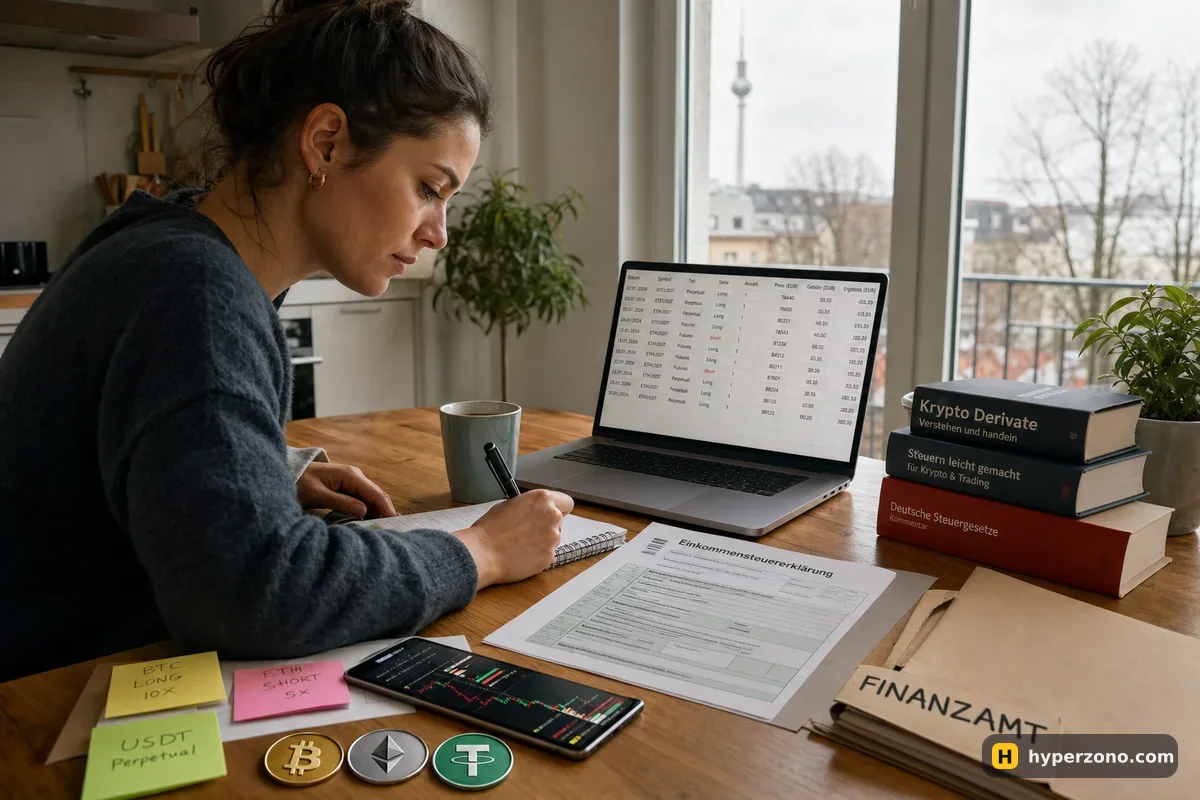
Everything above only becomes usable if you can show what happened. Exchanges keep history for a while, change their export formats, close accounts in some countries and occasionally disappear altogether, and the gap is your problem, not theirs. Download now, store it somewhere boring and permanent, and repeat it on a fixed day each month.
- Full trade history: every entry and exit, with date, time, contract, direction, size and price.
- Realised profit and loss per closed position, straight from the exchange's own report.
- All fees charged on entry and exit, and every funding payment made or received.
- Deposits and withdrawals, including the wallet or bank account on the other side.
- The euro value on each relevant date, since your return is in euros and your account is in USDT.
The practical side of this — which exports to pull, how to name files, what to do when an exchange only gives you 90 days — belongs on its own page: which futures records to keep for a tax report. Before any of this matters, you need an exchange that actually offers futures to people in Germany. That is a question of its own, and we answer it in can you trade crypto futures in Germany.
Two things to check before you file
The tax rate is not written in the paragraph this page is about, so settle it for your own situation before you file: which rate and which surcharges apply to your capital income. The answer decides what a profitable year actually leaves in your pocket.
The second one: has your foreign exchange already deducted anything German on your behalf? Do not assume it has, and do not assume it has not. The law wants a certificate before some losses count, so the answer decides how much paperwork you need and which of your losses survive the year.
This is a guide, not tax advice. German tax rules change — the repeal of the futures loss restriction in 2024 is proof of exactly that. Read the current text of § 20 EStG yourself, ask your Finanzamt in writing, or pay a Steuerberater for an hour of their time; it is cheap compared with a return you have to correct. This page is updated when the rules move.
Is crypto tax-free after one year in Germany if I trade futures?
The one-year rule people quote is about coins you buy, hold and later sell. A futures contract never puts a coin in your hands — it pays you a cash difference, which looks like the kind of deal described in § 20(2) sentence 1 no. 3 EStG. Planning your futures around a holding period is a weak assumption; get it confirmed for your own case.
Is the 20,000-euro cap on futures losses still in force?
No. The Bayerisches Landesamt für Steuern states that the Jahressteuergesetz 2024 abolished the loss-offset restriction for Termingeschäfte, repealing § 20(6) sentences 5 and 6 EStG, and that this applies to all open cases. Articles still describing the cap are out of date.
Can I offset my futures losses against my salary?
No. Capital losses cannot be set against income of other kinds, and they cannot be carried back into an earlier year either (§ 20(6) EStG). They wait and reduce your capital income in later years instead, which is why carrying good records forward is worth the effort.
What tax rate applies to futures gains in Germany?
The rate is not written in § 20 EStG, so get it answered for your own situation before you file: which rate and which surcharges apply to your capital income. Keep § 20(9) in mind at the same time — the saver's allowance is 1,000 euros a year, or 2,000 euros for a jointly assessed couple.
Do I have to declare futures income myself if I trade on a foreign exchange?
Assume nothing was handled for you and check before you file. Where tax was withheld at source on capital income, the law counts certain losses only if you hold the written certificate for them, so whether anything was withheld changes the paperwork you need. Bring your full export to that conversation.
What if my exchange closes and I lose the trade history?
Then you are the one holding the gap, and a loss you cannot evidence may not count. Export your trade history, fees, funding and transfers on a fixed day each month and keep copies outside the app — it takes ten minutes and saves a year of guessing.
Sources and fact-check
Exchange terms were checked against official documents on October 26, 2026. Terms change — before you trade, check what matters to you in the exchange app and in your contract’s specs.
gesetze-im-internet.de: § 20 EStG — EinzelnormBayerisches Landesamt für Steuern: Verlustverrechnungsbeschränkungen bei den Einkünften aus Kapitalvermögen