Contents
Start with the honest partWhat the ATO does say about cryptoWhy a perpetual doesn't fit neatlyYour losses: this is where it really mattersWhat one trade actually looks like in your recordsRecords to keep from day one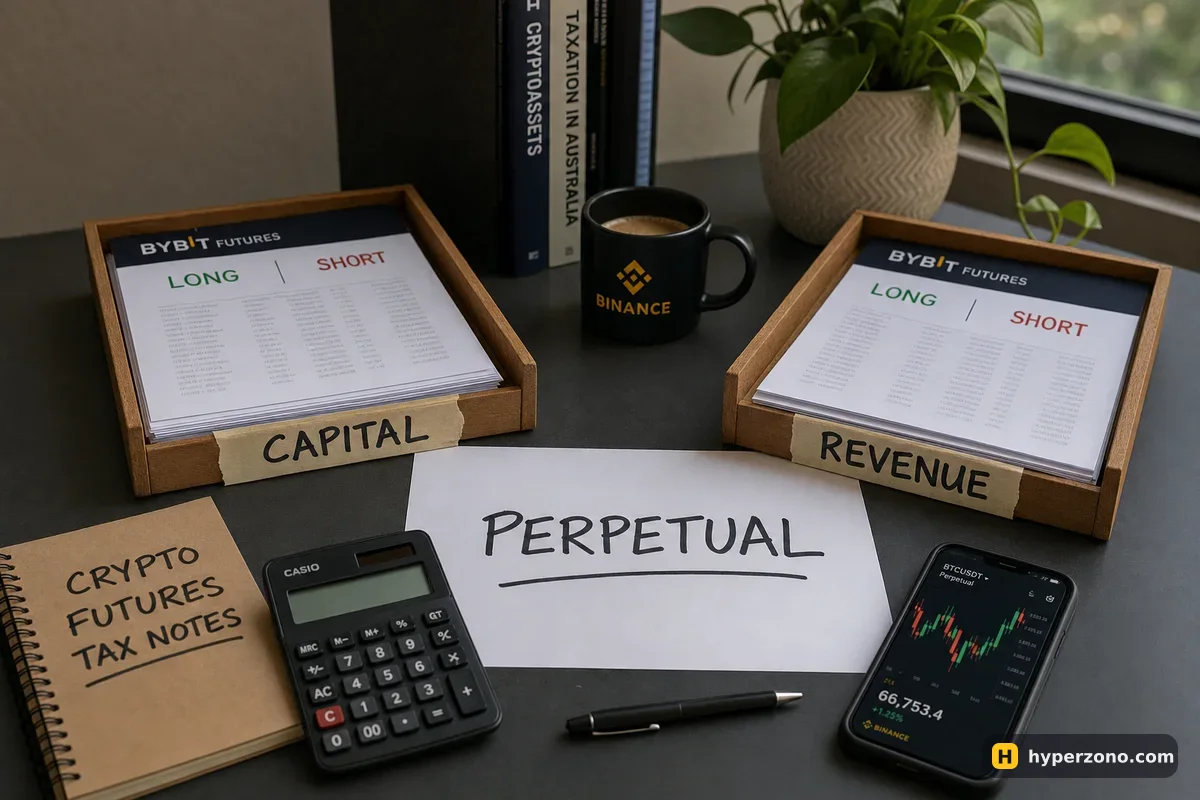
Start with the honest part
The ATO publishes three useful pages for crypto investors: what crypto assets are, how to work out capital gains tax on them, and how to keep records. All three are written around buying, selling and swapping coins, and none of them mentions futures, perpetuals, funding payments, margin or liquidations. So anyone who tells you confidently how perpetuals are taxed in Australia is filling a gap that official guidance has not filled.
That does not mean you are free of tax, and it does not mean you are in trouble. It means that sorting your trading into one box or the other — investor or business — depends on your own situation, and that is work for a registered tax agent, or a question you put to the ATO directly. What you can do today, before your first trade, is understand the two ways crypto is normally taxed and keep records good enough for someone to sort it out later.
What the ATO does say about crypto
The ATO's starting point is that there are no special tax rules for crypto assets: they are taxed under the same rules as assets generally, and the treatment depends on how you acquire, hold and dispose of them. It also says plainly that crypto is not a form of money for tax purposes, and that each crypto asset you hold is treated as a separate asset.
For most people, crypto is an investment. Selling it, gifting it, swapping one coin for another, converting it to Australian or foreign currency, or paying for goods with it all count as moments where the ATO looks at your gain or loss. At the end of the year you add up your gains, subtract your losses, and the tax is worked out on what is left. A losing trade only cancels out a winning one — it does not reduce the tax on your wages, and the ATO's wording is direct: you can't deduct a net capital loss from your other income. If you held the asset for at least 12 months you may be able to use the CGT discount — check the current discount rate on the ATO's own page rather than trusting a number from a blog.
The other path is the business one. The ATO says businesses transacting in crypto may need to account for it as trading stock or ordinary income, so what you buy and sell feeds into your business profit instead of your capital gains. Whichever side you land on, amounts have to be converted into Australian dollars before anything is calculated — and the ATO runs a crypto data-matching program that compares your return against data it collects from crypto exchanges and similar providers.
Staying in USDT is not the same as staying in cash. The ATO says crypto is not money for tax purposes. Moving your profit from a futures balance into USDT and leaving it there is not obviously the same as leaving money in a bank account, so don't assume nothing has happened until you withdraw Australian dollars. Record the date and the AUD value every time, and let your agent decide what each step was.
Why a perpetual doesn't fit neatly
A perpetual contract is settled in cash. You put up margin, you take a long or short position, and when you close it the exchange credits or debits the difference in USDT. You never receive the bitcoin. On top of that there are funding payments every few hours, entry and exit fees, and the possibility of a liquidation closing the position for you. If you are still unsure what makes a perpetual different from a contract with an expiry date, the plain explanation is here.
Your contract is settled in cash and you never own the coin, so it does not look like the buying and selling that the guidance describes. That mismatch is the first thing to raise with a registered tax agent — ask them which set of rules applies to a cash-settled contract like this, and what your own trading pattern makes you. Nobody can answer that from a web page, including this one.
One practical consequence is worth seeing early. The CGT discount needs a holding period of at least 12 months, and leveraged futures trades usually last minutes, hours or days. Even if your trades were treated as capital, the discount would rarely come into it.
Your losses: this is where it really matters
Most beginners lose money on their first attempts, so the loss question is not theoretical. The difference between the two treatments is large enough to change how you feel about a bad month.
| Treated as an investment (capital) | Treated as a business (revenue) | |
|---|---|---|
| A winning year | Adds to the gains you tally up at year end; tax is worked out on what is left after your losses | Goes into your business profit as ordinary income, not into capital gains |
| A losing year | Reduces capital gains only; can't be deducted from your other income | Not covered by the ATO's crypto pages; ask an agent before assuming a loss cuts your tax |
| Holding over 12 months | May bring in the CGT discount | The discount belongs to the capital side |
That bottom-right box is the one that catches people out. Business losses have their own rules in Australia, they are not simple, and nothing in the crypto guidance walks you through them. Ask a registered tax agent about it before you count on a bad year reducing the tax you pay on your salary.
What one trade actually looks like in your records
Here is an illustrative example with round numbers. Say your futures balance is 100 USDT. You open a long on bitcoin worth 250 USDT at 5x, so the exchange sets aside 50 USDT as margin and 50 USDT stays free as a buffer. You also place a stop-loss about 4% below your entry, so you know the worst case before you start.
Two days later price is about 4% above your entry and you close. The price difference gives you 10 USDT; you paid about 0.25 USDT in entry and exit fees and about 0.10 USDT in funding, so your balance ends around 109.65 USDT. If price had gone the other way instead, your stop-loss closes the trade about 4% below entry: you are 10 USDT down plus the same 0.35 USDT of costs, leaving around 89.65 USDT — and that is a record your tax agent needs just as much as the winning one.
What you write down is the date you opened, the date you closed, the result in USDT, the fees, the funding, and what each of those amounts was worth in Australian dollars on the day. That record is the same whichever way your trading is finally classified — which is why you can start keeping it before anyone has answered the classification question.
Five things in your records have no clear home yet: how a funding payment you receive or pay is treated, what a liquidation counts as, how to handle the conversion between USDT and Australian dollars when you never touched AUD, what makes someone a business trader rather than an investor, and what happens to a loss you can't use this year. Write those five down. They are the questions worth bringing to an adviser, and your answers will come from your own records.
Records to keep from day one
The ATO's record-keeping page was written for people buying and selling coins, but the same list works for your futures account. It asks you to keep records of each asset and every transaction, including:
- Receipts for buying, transferring or disposing of crypto
- The date of each transaction
- What the transaction was for and who the other party is (their crypto address is enough)
- Exchange records
- The Australian dollar value of the crypto at the time of each transaction
- Agent, accountant and legal costs
- Digital wallet records and keys
- Software costs related to managing your tax affairs
For futures, add the lines that only exist on a derivatives account: every entry and exit fee, every funding payment in or out, every transfer between your spot and futures balances, and any liquidation. The step-by-step version of this, including what to export and how to store it, is in which futures records to keep for taxes. If you also want to see how your trading result is built up from price difference, fees and funding, that is explained in calculating your real profit — the tax question starts where that calculation finishes.
Export before you need it
Download your trade history, funding history and transfer history from the exchange as soon as you start. The ATO suggests setting a reminder to export at least every 3 months, and exporting your complete history before you close an account.
Write down the AUD value
Note what the amounts were worth in Australian dollars at the time of each transaction, not just in USDT. A reputable Australian crypto tax calculator can do this for you; the ATO points to that option too.
Keep one folder, in English
Records must be in writing — electronic is fine — and in English or translatable to English. One folder per financial year, with the raw exports untouched, is better than a tidy summary you can't prove.
Keep it for 5 years
The ATO asks for 5 years from the later of: when you prepare or obtain the records, when the transactions are complete, or the year the CGT event happens — and long enough to cover the time the ATO can still change your assessment, usually 2 or 4 years.
Separately from tax, check that the exchange you are looking at actually serves retail clients in Australia and what it offers them, since several venues use a local entity with different products and leverage limits. That side is covered in trading crypto futures in Australia.
Do I pay tax in Australia if I never convert my profit to AUD?
Don't assume you are in the clear. The ATO says crypto is not money for tax purposes, and amounts have to be converted into Australian dollars to work out what happened, so sitting in USDT doesn't stop the clock by itself. That conversion is one of the questions for your tax agent — but record the AUD value on the day either way.
Can I use futures losses to reduce the tax on my salary?
It depends entirely on which treatment applies, and you should not plan around it. The ATO is explicit that a net capital loss can't be deducted from your other income — it only reduces capital gains. What happens to a loss you can't use this year, and how the business side works, are both questions for a registered tax agent before you assume a bad year lowers your tax bill.
Does the 12-month CGT discount help with perpetual trading?
Rarely. The discount needs you to hold the asset for at least 12 months, and leveraged futures positions usually last from minutes to days. The ATO's page doesn't state the discount percentage, so check the current rate on the ATO site rather than copying a figure from a guide.
Will the ATO know about my exchange account?
Assume yes. The ATO runs a crypto asset data-matching program that compares what you report in your return against data it collects from crypto exchanges and similar providers. That's one more reason to keep clean exports rather than reconstructing numbers from memory a year later.
How are funding payments taxed?
Keep every funding line with its date and AUD value, and put the question to your adviser along with liquidations and the USDT conversion — it is one of the five questions nobody can answer for you from a web page. Guessing here is how people end up amending returns.
How long do I have to keep my records?
Five years, from the later of when you prepare or obtain the records, when the transactions are complete, or the year the CGT event happens — and long enough to cover the time the ATO can still change your assessment, usually 2 or 4 years. Electronic records are fine as long as they are in English or can be translated.
Sources and fact-check
Exchange terms were checked against official documents on October 24, 2026. Terms change — before you trade, check what matters to you in the exchange app and in your contract’s specs.
ATO: What are crypto assets?ATO: How to work out and report CGT on cryptoATO: Keeping crypto records