
Contents
Leverage on futures is not a loanThe same bet that bitcoin rises, done two waysInterest, fees and funding are three different cost linesWhat you owe if the trade goes against youWhat to check in your account mode before you fund itWhich one to try first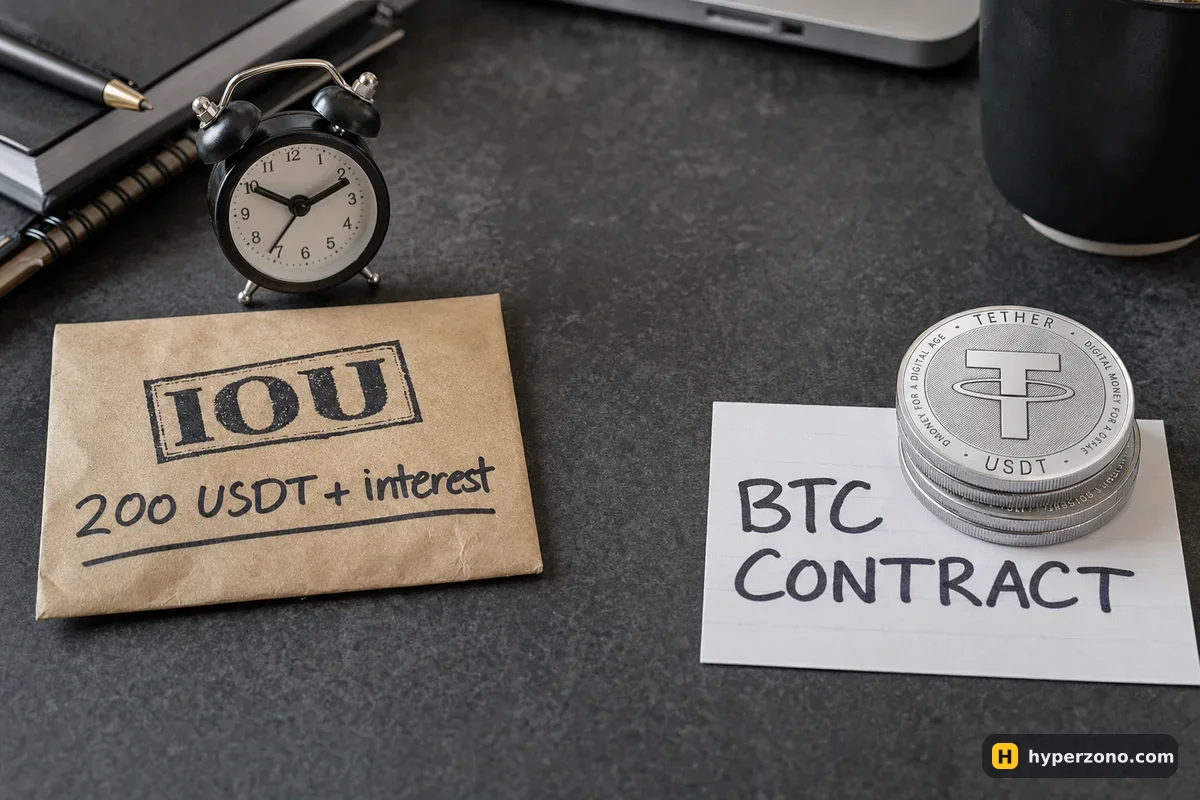
Leverage on futures is not a loan
This is the part that scares most people away, so let's clear it up first. When you open a futures position with 10x leverage, nobody hands you money and nobody writes down a debt in your name. The exchange simply freezes part of your balance as a deposit and lets you control a bigger contract with it. That deposit is called margin, and if the trade goes well it comes back to you together with the profit.
Spot margin trading works the other way round. You actually buy the coin, and part of the purchase is paid with money the exchange lends you. The coin is yours, the debt is yours, and the debt does not disappear when the price moves — it stays until you sell and repay. One of these two gives you a loan to repay; the other gives you a contract on the price difference. If the idea of a contract on the price is still new, our page on futures versus simply buying crypto covers the basics in a few minutes.
The same bet that bitcoin rises, done two ways
Say you have 100 USDT and you think bitcoin is about to rise. With a price of 100,000 USDT per coin (illustrative numbers, to keep the maths easy), you decide you want a trade worth about 300 USDT — three times your own money, whichever route you take.
On spot margin you borrow 200 USDT, add your 100, and buy 0.003 BTC. Those coins sit in your account and you owe 200 USDT back. On futures you open a long worth 300 USDT with your 100 USDT as margin, which is 3x leverage. No bitcoin ever lands in your account; you just hold an open trade, and the exchange counts the result in USDT.
| Spot margin trade | Futures trade | |
|---|---|---|
| What you hold | 0.003 BTC, really yours | A position on the BTC price, no coins |
| What you owe | 200 USDT borrowed, to be repaid | Nothing borrowed; the 100 USDT is your own reserved deposit |
| Running cost while open | Interest on the borrowed 200 USDT | Fee at entry and at exit, plus funding on a perpetual |
| If the price rises 5% | About +15 USDT before interest and fees | About +15 USDT before fees and funding |
| If it goes badly | Your coins can be sold to repay the loan | The position is closed by the exchange — liquidation |
The profit is nearly the same, and that surprises people. Both routes put the same 300 USDT behind the same price move. What differs is what sits underneath — a debt on one side, your own reserved deposit on the other — and the costs you pay while you wait.
Interest, fees and funding are three different cost lines
On Binance you have to pass a test before you can open a margin account, and once you borrow, interest is added every hour. That cost grows with time: hold the borrowed amount for a week and you pay for a week, whether the price moved or not.
A futures trade funded with your own USDT has no interest to pay. What you do pay is a fee on the size of each trade: on Binance USDⓈ-M futures at the base level that is 0.02% if your order waits in the book and 0.05% if it fills straight away, charged once when you open and again when you close. On a 300 USDT position, an entry that fills straight away costs about 0.15 USDT. There is one exception worth knowing about: on some exchanges a single account mode can let an order borrow for you, and how to check that is in the steps further down.
The second futures cost only exists on perpetual contracts: funding, a payment passed between the traders holding longs and the traders holding shorts. The exchange does not keep it. On Binance it is settled every 8 hours by default, every 4 hours on some contracts, and as often as every hour if the rate hits its cap. When the rate is positive, longs pay shorts; when it is negative, the money flows the other way and a long receives it. Contracts with an expiry date have no funding at all — that difference is explained on our page about perpetual or dated contracts, and the arithmetic of the payments is on our page about funding.
For a short trade lasting an hour or two, the two fees usually dominate everything else. For a position held across days, the question becomes which meter runs faster: hourly interest on a borrowed sum, or a funding rate that can be positive one day and negative the next. Try the numbers yourself before you decide.
What you owe if the trade goes against you
Here is where the difference really hits your account. A margin debt is a fixed amount in coins or USDT and it does not shrink when the market falls. If your collateral drops in value, the exchange can sell the coins you bought to get its money back, and whatever is left is yours. The obligation was created the moment you borrowed.
On futures there is no sum to pay back. If the price moves far enough against you, the exchange closes the position itself, using the mark price rather than the last trade, so that the loss stops around the margin you committed — that is liquidation. With isolated margin, the money at risk is the margin assigned to that one position, unless you have switched on automatic margin top-up. With cross margin, your free balance backs the position too. A stop-loss placed before you open is still the cheaper way to end a bad trade.
The fear and the fix. If what worries you is signing up for a debt, futures are the route that creates none: your deposit is the limit of what you committed, and no repayment schedule follows you around. Set a stop-loss, use isolated margin, and start with an amount you can afford to lose.
What to check in your account mode before you fund it
Modern exchanges mix these products in one place, which is convenient and also the main source of confusion. On Bybit, one account mode covers almost everything at once — buying coins outright, borrowing to buy them, and futures — while deposits and withdrawals sit in a separate funding account. So the loan and the futures position can live under the same balance, which is easy to mix up. Check these things before your first deposit.
Find out which account you are actually in
Money arrives in the account used for deposits and withdrawals; trading happens in the trading account. If your balance shows zero in the terminal, the money is probably still in the other one.
See whether borrowing is part of the mode
The same account mode also covers borrowing to buy coins, so a loan and a futures position can sit under one balance. Open the margin or borrowing settings and check whether borrowing is switched on for you, and where repayment is shown.
Check which assets count as collateral
In a unified account, only the assets you have switched on as collateral count toward your margin, and each coin counts at its own value ratio depending on how easy it is to sell. If the account has borrowed something for you, that borrowed amount is counted against you in full — there is no discount on a debt.
Pick your margin mode consciously
On Bybit, your margin balance is what matters in cross margin and portfolio margin modes; if it falls below the maintenance level, the position is liquidated. Our guide to cross versus isolated margin explains which to pick for a first trade.
Look at what you can take back out
The amount the app offers to transfer out is already smaller than your balance — it has taken out the money held behind your open position, anything reserved by pending orders or by what you borrowed, and the running loss on the trade. If the position is using all of your margin, you cannot move anything out until you close it. Trust the figure in the transfer window, not your head.
Confirm the product is available where you live
Futures, spot margin and the account modes above are not offered everywhere, and some countries are served by a separate local entity with different products. Check this during sign-up in the app, not from a list on a blog.
Which one to try first
For most beginners the futures route is the simpler one to reason about: one deposit, two fees, a funding line you can read on screen, and no debt left behind when the position closes. Spot margin makes more sense when you genuinely want to own the coin and are comfortable managing a loan on top of it. If you are still choosing a venue, our comparison of exchanges for beginners is a decent starting point.
The clearest way to feel the difference is to look at the numbers on your own screen. Open the futures section, pick the smallest BTC position the exchange allows and look at the margin it reserves — that number is your own money, not a loan. Then sign up on Bybit and repeat the same steps in demo mode, where nothing is at stake; demo will not teach you how a loss feels, but it will show you exactly where every number sits.
Is futures trading a loan?
No. The exchange does not lend you coins or cash for a futures position. It reserves part of your own balance as margin and lets you hold a larger contract with it. Nothing has to be repaid afterwards — the margin either comes back with profit or is reduced by the loss.
Do I pay interest on a futures position?
On a futures trade funded with your own USDT there is no interest, because there is no debt. What you pay is a fee when you open and another when you close, and on perpetual contracts a funding payment every few hours. Funding goes between traders, so sometimes it is credited to you instead of charged.
Which is cheaper if I hold for a week?
It depends on the two meters. Margin interest is added every hour and only ever costs you money; funding is settled every few hours and can go either way depending on the rate. Check the current funding rate on the contract page and the current borrow rate in the margin section, then compare them for the time you plan to stay in.
Can I end up owing the exchange money?
On a margin trade you owe the borrowed amount by design, and your coins can be sold to cover it. On futures the exchange closes your position by liquidation using the mark price, so the loss is normally bounded by the margin you committed — but in a fast, gapping market the outcome can be worse than the level you expected. Isolated margin and a stop-loss are what keep this small.
Can I use margin and futures in the same account?
On some exchanges, yes. On Bybit one account mode covers buying coins, borrowing to buy them and trading futures in the same place, with a separate funding account for deposits and withdrawals. That convenience is exactly why it pays to check your mode and your borrowing and collateral settings before you fund it.
Should a complete beginner start with margin trading or futures?
Start with whichever you can explain back to yourself in one sentence, in demo mode, with the smallest allowed size. Many beginners find futures easier to track because the result is a single number in USDT, with no loan to repay and no coins to manage on the side.
Sources and fact-check
Exchange terms were checked against official documents on October 20, 2026. Terms change — before you trade, check what matters to you in the exchange app and in your contract’s specs.
Bybit: FAQ — Unified Trading Account (UTA)Binance: What Are the Differences between Margin and Futures Trading?