Contents
So who actually gives you the money?What 100 USDT at 10x looks like inside your accountWhy would an exchange let you do this?How the exchange protects itself from your lossesWhat you actually riskSo who actually gives you the money?
Say you set leverage to 10x and open a position worth 1,000 USDT while you have 100 USDT in your futures wallet. Not a single dollar moves from the exchange to you. Your 100 USDT stays where it is, and the exchange just marks it as unavailable for anything else until the trade closes — that reserved part is your margin, a deposit, the way a rental shop holds a deposit while you have the bike.
The trade itself is an agreement about price between you and whoever took the opposite side. If bitcoin rises, money moves from the people who are short into your account; if it falls, it moves out of yours into theirs. That is why nobody had to hand you 900 USDT — no 1,000 USDT of bitcoin is ever bought, delivered or stored anywhere, and all that gets settled is the price difference. If you want the longer version of that flow, we wrote it out in where futures profit actually comes from.
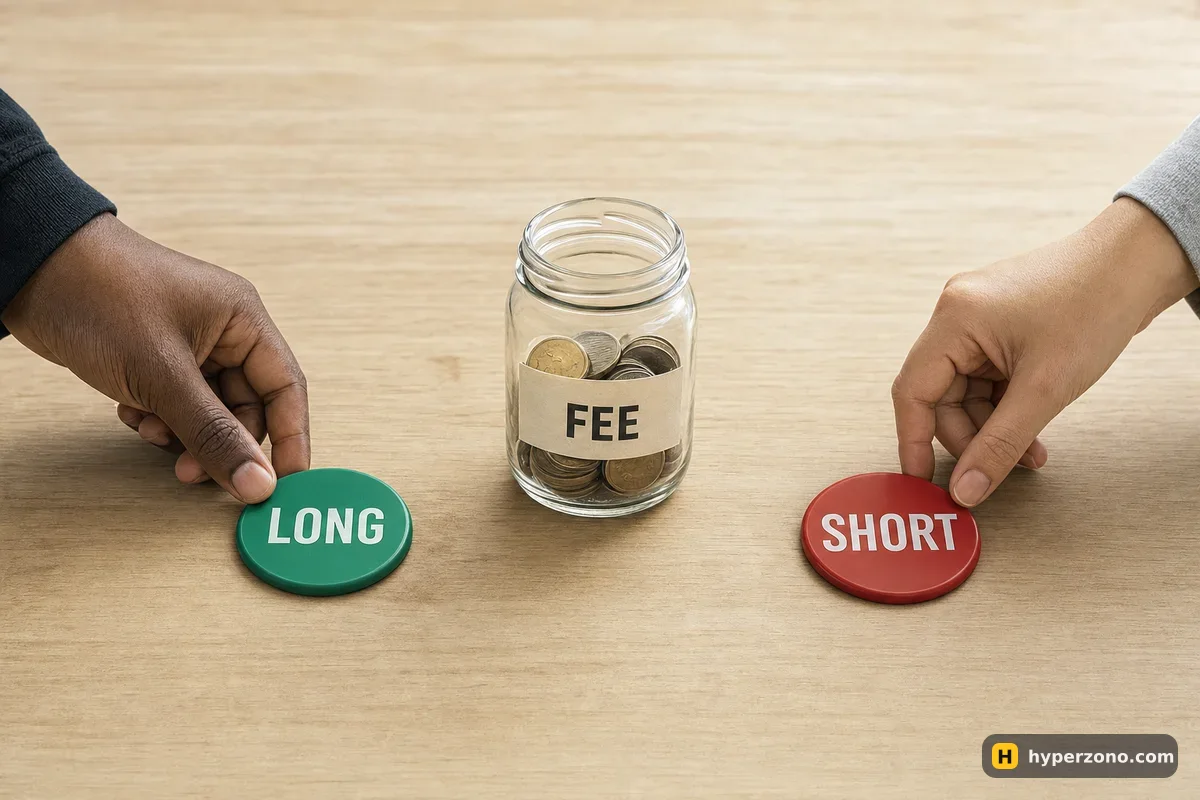
This is the real difference from margin trading on spot, where the exchange genuinely does lend you coins or cash, you genuinely do buy the asset, and interest runs for as long as you hold it — on Binance, margin interest accrues hourly. On futures there is no borrowing line and no interest. The regular holding cost on a perpetual contract is funding, and that payment goes between longs and shorts; the exchange does not take it.
| Margin trading on spot | Futures | |
|---|---|---|
| Where the extra size comes from | The exchange lends you coins or cash | Your own margin; the other side is another trader |
| Cost of holding | Interest for as long as the loan is open (on Binance, charged hourly) | No interest; funding is paid between longs and shorts |
| What you end up owning | The actual coins you bought | An agreement about price — nothing is delivered |
What 100 USDT at 10x looks like inside your account
Here is the same trade with numbers you can check on screen. With an illustrative bitcoin price of 83,500, a 1,000 USDT position is about 0.012 BTC. Your wallet shows 100 USDT, your position shows 1,000 USDT of bitcoin, and the margin field shows that your 100 USDT is tied to it. A 1% move in your favor is 10 USDT — small against the position, 10% against your deposit. A 1% move against you is exactly the same number with a minus sign.
The fee is charged on the 1,000, not on the 100. At Binance's base level for USDⓈ-M futures that is 0.05% as a taker, so roughly 0.50 USDT to get in and 0.50 USDT to get out — about 1 USDT for the round trip. The position size is comfortably above the minimum, too: on Binance the smallest bitcoin position is 0.001 BTC, which at that price is around 83.5 USDT of position value.
Isolated long of 1,000.00 USDT, 10× leverage, maintenance margin 0.50% of position size (example). Simplified model without closing fees, risk-limit tiers or other positions — the exchange will show its own price.
The diagram uses round numbers. Your own liquidation price will be a bit different, and the exchange shows it on the position once it is open — look at that one. It shifts with the maintenance margin required for your position size, your fees, your margin mode and anything else open in the account. If the leverage number itself is still fuzzy, the basics are in what leverage is — this page is only about where the money sits.
Why would an exchange let you do this?
Because the fee follows the size of the position. Your 100 USDT traded on spot with no leverage pays a fee on 100 USDT. The same 100 USDT behind a 1,000 USDT futures position pays a fee on 1,000 — ten times more for the exchange, out of the same money in your pocket. Binance's published USDⓈ-M rates at the base level are 0.02% for a resting limit order that waits in the book and 0.05% when you take the price that is already there, a little lower if you pay fees in BNB.
That is the whole business model: the exchange earns on the size of every trade, not on lending you anything, and it does that across an enormous number of accounts — Binance reports more than 333 million users on its main platform. The easiest way to see your own numbers is to open a Binance Futures account and type a small size into the order window, which shows you the margin and the fee for exactly that size.
How the exchange protects itself from your losses
Since no one lent you money, the exchange's worry is different: it needs your side of a losing trade to be paid to the winner. That is what maintenance margin is for. Once your deposit has shrunk to the minimum the contract requires, the exchange closes the position itself — this is liquidation, and it is triggered on the mark price, a fair price derived from an index, not on the last random trade printed on the chart.
Sometimes the market moves so fast that the position is closed at a price that still leaves a shortfall. The exchange's insurance fund covers that as far as it can; when it cannot, Binance closes a profitable position on the other side instead, at the price where the losing one had run out of margin. That is auto-deleveraging — rare, out of your hands, and explained here: why a position gets closed by ADL.
What you actually risk
You risk the margin behind the position, plus the fees and funding while it is open. There is no repayment schedule, nothing to pay back afterwards, and no interest clock running. What does exist is a price level where the exchange closes the trade for you. So the thing to decide carefully is how much money you put behind the trade.
Two settings do most of the work. Isolated margin ties the position to the margin you assigned to it, so a bad trade on one coin does not reach across the rest of your balance, while cross margin links everything in the account together. And a stop-loss placed when you open the trade closes it long before the exchange has to.
Decide the loss before you decide the trade. Pick the amount you are willing to lose on this position, then work backwards to the size and the stop. In a fast gap a stop can fill worse than the price you set, which is exactly why the size matters more than the leverage number on the slider.
If you would rather walk the whole path in order — account, verification, first deposit, first small trade — the step-by-step route is in how to start trading crypto futures from scratch.
Does the exchange lend me money when I use leverage on futures?
No. Your balance stays yours and part of it is held as a deposit while the trade is open. The position is an agreement about price with another trader, so there is nothing to borrow and nothing to buy — only the price difference gets settled.
Do I pay interest on a leveraged futures position?
There is no interest, because there is no loan. You pay the trading fee when you open and again when you close, and on a perpetual contract you pay or receive funding at each settlement. Funding moves between longs and shorts; the exchange does not keep it.
Who pays my profit when my trade wins?
The traders holding the opposite side of the same contract. Their margin shrinks as yours grows, and the exchange only matches the two sides and charges its fee. That is also why nobody can promise that winning is the normal outcome — one side is always paying the other.
Can I lose more than the margin I put in?
Liquidation is designed to close the position before your deposit is gone, and the insurance fund exists to cover the cases where a fast market makes that messy. Isolated margin keeps the claim on the margin you assigned. Still, do not treat it as a guarantee — read your exchange's own rules on negative balances and size the trade so a bad day stays survivable.
Why is the fee calculated on the whole position instead of on my margin?
Because the fee follows the size of the agreement you opened, not the deposit behind it. A 1,000 USDT position pays the same fee whether you backed it with 100 USDT at 10x or 500 USDT at 2x. Raising leverage does not change the money result of the trade — it changes how much of your own cash is tied up and how fast your deposit moves.
Sources and fact-check
Exchange terms were checked against official documents on October 21, 2026. Terms change — before you trade, check what matters to you in the exchange app and in your contract’s specs.
Binance: What Is Auto-Deleveraging (ADL) and How Does It Work?