
Contents
What the smallest futures position actually isWhy bitcoin pushes you into higher leverageHow much of a 10 USDT account goes to feesWhy a proper stop loss barely fitsWhat 10 USDT is actually good for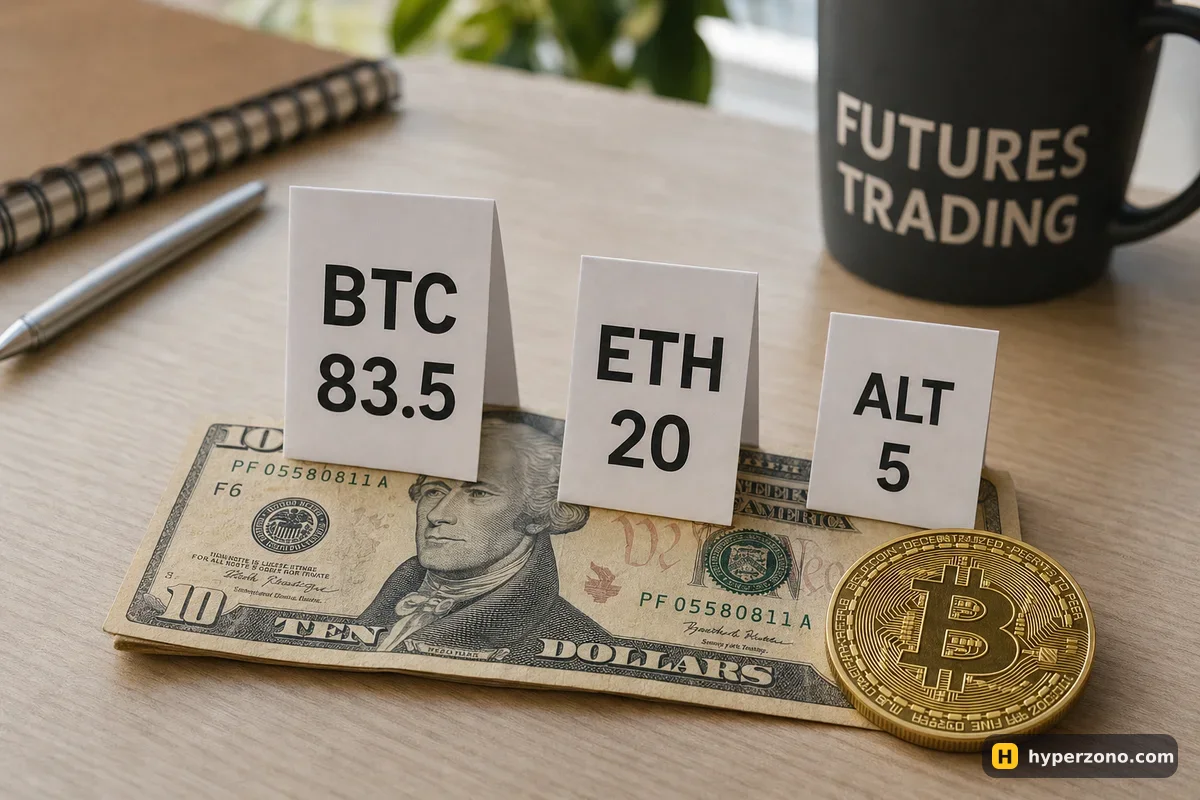
What the smallest futures position actually is
Every futures contract has a minimum order size, and that minimum is set in the contract, not in your wallet. It is the size of the trade that matters, not how much money you hold. On Binance USDⓈ-M futures the bitcoin contract starts at 0.001 BTC — at a bitcoin price near 83,500 USDT, where we last checked it, that is about 83.5 USDT worth of position. Ethereum starts from 20 USDT of position size, and most altcoin pairs from just 5 USDT.
That is why 10 USDT works on some coins and not on others. With 10 USDT set aside as your deposit for the trade — your margin — a 5 USDT altcoin position fits with room to spare, while the smallest bitcoin position needs roughly nine times your money in leverage just to reach the minimum. Other exchanges set their own minimums, so check the contract specification in the app before you assume a pair will take your order.
| Contract | Smallest order | What that means with 10 USDT of margin |
|---|---|---|
| BTCUSDT | 0.001 BTC ≈ 83.5 USDT of position | Needs about 9x leverage or more just to open |
| ETHUSDT | From 20 USDT of position | Fits from about 2x |
| Most altcoin pairs | From 5 USDT of position | Fits even without leverage |
Why bitcoin pushes you into higher leverage
If the smallest bitcoin trade is worth about 83.5 USDT and you only have 10 USDT, the exchange has to let you control eight or nine times your money for the order to go through at all. That is leverage doing its job, and it is not automatically dangerous — but it does mean the thing you probably wanted to trade first is the one that gives you the least choice. On a new Binance futures account, leverage above 20x is not available for the first 30 days anyway, which quietly keeps beginners out of the worst of it.
On ethereum or a liquid altcoin you keep that choice: you can open a 20 or 50 USDT position with 10 USDT and pick the leverage yourself. If the words 5x and 10x still feel abstract, the page on what 5x, 10x and 20x actually mean walks through it with simple amounts, and what leverage a beginner should use covers the first trade specifically.
How much of a 10 USDT account goes to fees
Here is the part most people miss. The exchange charges its fee on the size of the position, not on your deposit — and it charges once when you open and once when you close. At Binance's base level that is 0.05% for an order that fills immediately at the market price. So a 100 USDT position costs about 0.10 USDT to get in and out.
Ten cents sounds like nothing until you compare it to a 10 USDT account: it is 1% of everything you have, gone before the price has moved at all. Push the same deposit into a 200 USDT position and the round trip costs about 2% of your account. The fee did not change as a share of the trade — your account is just small relative to the trade you opened. Try a couple of sizes in the calculator and you will see the pattern straight away.
Trading a handful of times a day at that size means your own fees are the most reliable thing happening to your balance. The full breakdown of futures fees covers how to pay less of them, mostly by using limit orders and trading less often.
Why a proper stop loss barely fits
A stop loss is the order that closes your trade automatically once the price goes against you by a set amount, so a bad trade stays a small trade. Normally you work backwards: decide you will risk, say, 2% of your account, then choose a position size that makes that true. With 10 USDT, 2% is 20 cents — and on bitcoin you cannot shrink the position to match it, because 0.001 BTC is the floor.
So you are left with two uncomfortable options. Either you place the stop so close to your entry that ordinary price wobble triggers it within minutes — and the fees alone have already eaten half of what you were willing to lose — or you accept that one stop-out costs 10% or more of your whole account. Neither teaches you much about trading. It mostly teaches you about minimum order sizes. The proper way to do this calculation, once you have a deposit it works with, is on the page about working out your position size.
Use isolated margin if you do open a trade. In isolated mode the exchange only puts the margin you assigned to that one position at risk, instead of reaching for your whole balance. With 10 USDT that is the difference between losing one trade and losing the account. Set it in the order window before you open, not after.
What 10 USDT is actually good for
Ten dollars is a perfectly good amount for learning what the buttons do — which is a real skill and worth getting out of the way before real money is on the line. You will learn how to switch to isolated margin, where the leverage slider sits, how a limit order differs from a market order, and what your position looks like when it is open and losing a little. None of that needs a big balance.
The cheaper way to do that first week is demo mode, where the exchange gives you fake balance and real prices. Bybit has a demo futures mode, so you can sign up on Bybit, practice the mechanics with no money at risk, and keep your 10 USDT until the clicking is automatic. Check during sign-up that futures are available where you live — the restrictions are real and they vary by country. A list of exchanges with demo futures covers the other options.
After that, the honest move is to top up rather than to grind a 10 USDT account. A deposit big enough to size your trades properly and sit through a few losing ones changes the whole picture — there is a whole page on how much money you actually need to start. And whatever that number turns out to be for you, it should be money you can lose entirely without it changing your month.
What is the minimum amount to trade crypto futures?
There is no single number — it depends on the contract, not the exchange's account rules. On Binance most altcoin pairs accept orders from 5 USDT of position size, ethereum from 20 USDT, and bitcoin from 0.001 BTC, which is far more. With modest leverage, a deposit of 10 USDT can open the smaller ones.
Can I trade bitcoin futures with $10?
Only with around 9x leverage or more, because the smallest bitcoin order is 0.001 BTC — roughly 83.5 USDT of position at a price near 83,500. If you want a calmer first trade, pick a pair with a 5 USDT minimum instead, or wait until your deposit gives you a real choice of leverage.
Can I lose more than my $10?
With isolated margin, the loss on that position is normally limited to the margin you assigned to it, and the exchange closes the trade before it goes further. In fast, gapping markets the close can land worse than the price you expected, so treat the 10 USDT as money you are prepared to see disappear.
Is $10 enough to learn trading?
It is enough to learn the interface and build the habit of setting a stop loss. It is not enough to learn position sizing or to survive a normal losing streak, because fees and minimum order sizes dominate everything at that scale. Demo first, then a deposit you can size trades with.
Why does the exchange reject my order when I have money in the account?
Almost always because the order is below the contract's minimum size, or because your margin does not cover that minimum at the leverage you selected. The simplest fix is to pick a pair with a smaller minimum. Raising the leverage also lets the minimum fit with less margin, but that makes every price move count more against you — so change the pair first and the leverage only if you have to.