Contents
The two prices on Ostium, and which one matters whenWho is on the other side of your tradeWhat you can actually trade thereStocks only trade when the US market is openWhat a trade costs: opening fee, price requests, rolloverThe July 2026 vault loss, and what the points are worthHow this compares with the routes you may already know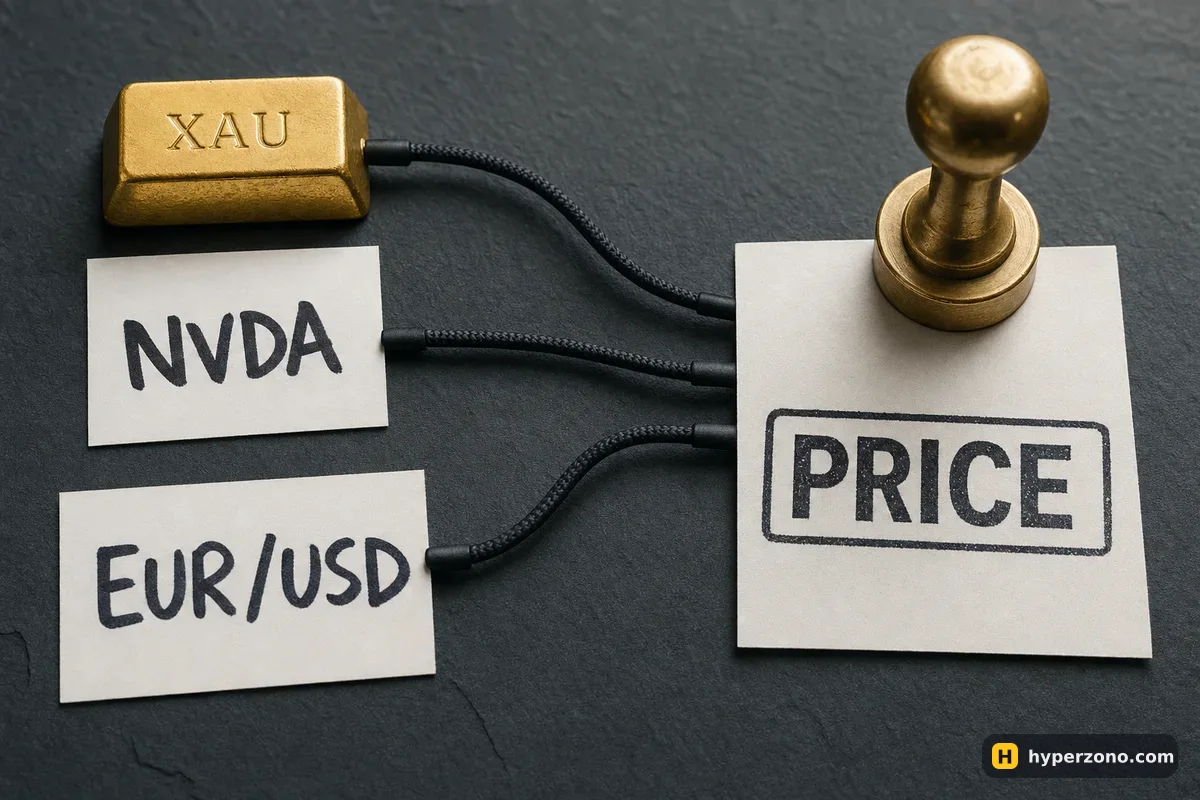
The two prices on Ostium, and which one matters when
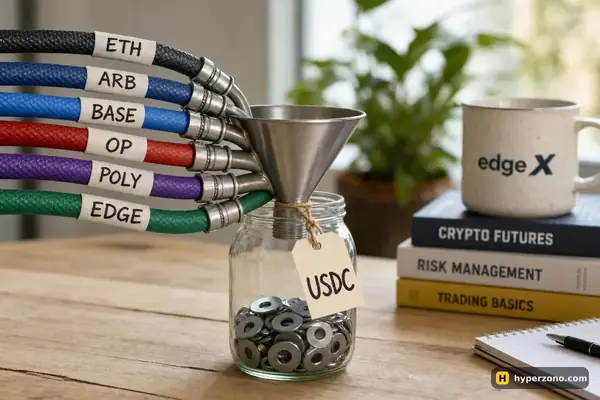
Ostium lives on the Arbitrum blockchain and everything is counted in USDC — the dollar coin you already hold in your wallet. On it you can trade gold, oil, shares, ETFs, indices, currency pairs and the usual coins. There is no order book, so nobody is bidding against you and there is no queue of orders to scroll through.
When you press buy, the protocol asks a network of professional trading firms for a quote on that asset, and the number that comes back is the price your order fills at. You get one price to buy and a slightly different one to sell; the gap between them is the spread, and on crypto and stock pairs it widens with the size of your trade, so a large order starts a little further behind.
Once the position is open, a second price takes over. Ostium publishes its own price for every market on-chain, and that number is what your running profit is measured against, what triggers your stop and take profit, and what decides whether you get liquidated. Crypto prices come from exchange order books; for gold, shares and currencies Ostium buys data from several providers it does not name publicly. A service that pulls outside prices into a blockchain like this is called an oracle, and you will see that word on the fee screen.
So the quote fills your order and the on-chain price governs it afterwards. Both come from outside the blockchain, which means you can say where the price comes from but you cannot cross-check it the way you can read a public order book. Older Ostium documentation, now marked deprecated, described outside feed providers instead — if you find that version in an old article, treat it as history.
Who is on the other side of your trade
If your trade ends in profit, the money comes out of a shared pot of USDC called the liquidity pool. Other users put their money there, take the opposite side of everyone's results, and receive 30% of the opening fees for doing it. When traders lose, the pool gains; when traders win, the pool pays.
There is no company holding your balance. Ostium's own terms name two entities behind the venue — Ostium Foundation, which provides the services, and Ostium Labs Co., which developed the software — and both state plainly that they do not operate an exchange. In practice that means no registration, no account balance and no support desk: your USDC sits in your own wallet on Arbitrum, your margin is locked in the contracts only while the position is open, and it settles back to you when you close. The current documentation says there is no minimum position at all; the small-position figures in older guides come from docs Ostium has since replaced, so go by the minimum the app shows you when you size the trade.
What you can actually trade there
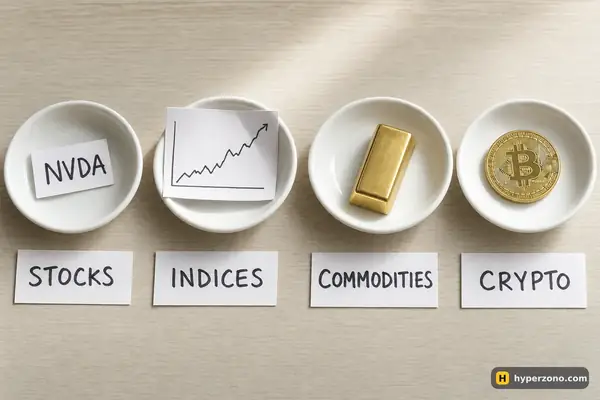
The live market list on 22 October 2026 showed 83 pairs: 43 stocks, 8 ETFs, 7 commodities, 7 indices, 9 currency pairs and 9 crypto pairs. The written documentation still says "50+" in one place and 75 in another, so go by the list you see in the app rather than the text. The maximum leverage is set per pair, so read the cap on the pair you want before you size the trade — the figures here are a snapshot. If gold is what brought you here, the mechanics of a gold contract are explained in how gold futures work on a crypto exchange.
Stocks only trade when the US market is open
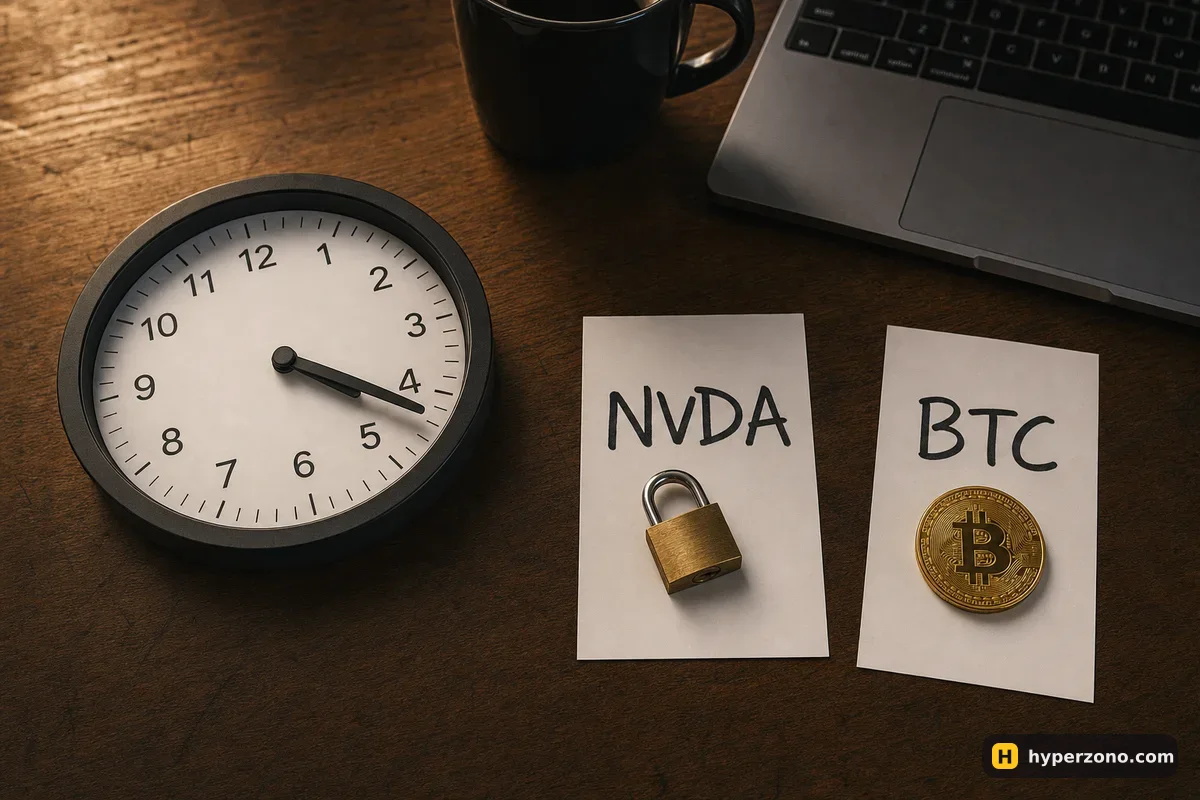
Crypto pairs run around the clock, but a share of Nvidia does not. Stock pairs on Ostium trade only during the US session, 9:30 to 16:00 New York time. Some stock pairs also have extra same-day rules, and Ostium's own documentation is not consistent about which ones, so open the pair in the app and read its rules before you hold a trade into the close.
While a market is closed, a market order is rejected outright. Limit and stop orders are accepted but wait in a queue, and they execute at the first available price once trading reopens, which can be far from the last price you saw. A stop sitting under a stock over the weekend does not hold your price for you. It only means the order goes through at the first price when trading reopens — and that price can be well below your level. The general pattern of which markets run at night and on weekends is worth reading before you hold anything through a closed session.
What a trade costs: opening fee, price requests, rollover
Two of the three costs are easy to picture. You pay a percentage of your position size when it opens, and you pay a flat 0.10 USD every time the protocol has to fetch a fresh price for you — opening, placing or cancelling a stop, closing part of a position. Ostium calls that one the oracle fee, after the price feed it comes from, and you get it back when you close the whole position. The third cost is a daily rollover charged for as long as the position stays open, instead of the funding you may know from other perpetuals.
| Cost | When you pay | How much |
|---|---|---|
| Opening fee | when the position opens | 0.03%–0.10% of position size, depending on the asset |
| Price request (oracle fee) | on each price request: opening, placing or cancelling a limit or stop, partial close, removing collateral | 0.10 USD flat, refunded on a successful full close, capped at 10 USDC per transaction |
| Rollover | daily, while the position stays open | tied to real-world financing rates; no single rate table is published — check the pair in the app |
| Closing | when you close normally | no separate closing fee; the fee page lists an early-close fee, so read it before quick in-and-out trades |
Here is what that looks like with illustrative numbers. You hold 200 USDC in your wallet, put 100 USDC of margin behind a gold position at 10x, so your position size is 1,000 USD. Opening it costs between 0.30 and 1.00 USD depending on where gold sits in the fee range, plus the 0.10 USD price request you get back when you fully close. If gold rises 2%, the position earns 20 USD and your margin comes back as roughly 119 USDC after that opening fee and the rollover for the days you held it. If gold falls 2% instead, the same arithmetic leaves you around 79 USDC. That 2% fall cost you a fifth of your margin because of the 10x — a smaller multiple, or a stop placed at the moment you open the trade, decides how much of that 100 USDC can actually disappear, and on a closed stock market a stop only fires at the first price after the open. Liquidation does not wait for your margin to vanish completely either: the threshold tightens the closer your leverage is to the pair's maximum, and at the maximum the position is closed once the loss reaches 75% of your margin.
The July 2026 vault loss, and what the points are worth
On 15 July 2026 the Ostium liquidity pool lost 23.75M USDC to forged prices fed into the protocol. Traders' collateral was not taken, and trading resumed on 23 July. The post-mortem published at the end of July reported no evidence of a smart-contract flaw or a compromised multisig, and around 1 October the team announced a rebuilt trading stack called Gateway, whose go-live is not confirmed. The lesson is plain enough: on a venue where a price feed rather than an order book sets the price, that feed is the thing to watch, and here the pool absorbed the hit rather than the people with open trades.
Ostium has no token of its own. What it does run is a points programme, now in its second season, with "Boost Windows" that give double points and half fees on selected assets. Points are not money: a venue can change the rules or cancel the programme, and nothing is promised in return — the same caution that applies to trading rewards and points anywhere else.
Check the country rule before anything else. Ostium's terms do not allow trading by people in the United States, the United Kingdom, the European Union, the Philippines, or comprehensively sanctioned territories such as Iran, Syria, Cuba, North Korea and occupied regions of Ukraine. Those same terms forbid trying to get around the restriction, and we never suggest it.
How this compares with the routes you may already know
Binance offers perpetuals on stocks, gold and oil inside a normal exchange account, where the exchange holds your money and publishes its fee schedule in one table. Hyperliquid works the other way round: you connect a wallet instead of registering, and its stock, index and commodity markets are deployed on top by a third party, trade.xyz, which sets the price feed and the leverage — the structure is explained in how HIP-3 markets work, and you can see the live list on the Hyperliquid markets table. Ostium sits in a third spot: on-chain like Hyperliquid, but with one protocol arranging the quotes, publishing the price and running the pool together, which makes the price source easy to name and hard to cross-check. If you want the custodial versus on-chain difference spelled out, see Binance Futures or Hyperliquid.
If Ostium looks interesting and your country is not on its excluded list, the next step is its own app and documentation — read the fee page and the market list there, since the numbers on this page are a snapshot from 22 October 2026. If your country rules it out, or you would rather start somewhere you can connect a wallet and look around first, you can open Hyperliquid and see whether it loads for you before you move any money.
Can I use Ostium from my phone?
Ostium runs in a browser and you trade by connecting a wallet, so a phone works in principle: you open the site in a mobile browser or in your wallet app's built-in browser and connect from there. Whether a particular wallet's browser loads it cleanly is something to test before you put money behind a trade. Keep in mind too that stock pairs only move during US hours, which may be the middle of the night where you live.
What happens if my internet drops while a trade is open?
The position lives in the contracts on Arbitrum, not on your phone, so it stays open and the daily rollover keeps running. Any stop or take profit you had already placed sits with the protocol and can still fire without you. Anything you only planned in your head does nothing at all — which is the practical reason to place the stop at the same moment you open the trade.
Who runs Ostium and where is it based?
Ostium's terms name two entities: Ostium Foundation, which provides the services, and Ostium Labs Co., which developed the software. Both state that they do not operate an exchange, and that shapes what you get: no account, no balance held for you, no support desk to call if something goes wrong. Read those terms before trading — they also list the countries that cannot use the venue.
Which price closes my trade: the quote or the on-chain one?
Both have a role. Your stop, take profit or liquidation is triggered by Ostium's own on-chain price, and when that happens the protocol asks for a fresh quote to actually close the position. So the trigger and the fill are two separate moments, which is why the price you end up with can differ from the level you set — most of all on a market that has just reopened after a closed session.
Is there funding like on a normal perpetual?
Not in the usual form. Instead of longs paying shorts, Ostium charges a daily rollover that it describes as reflecting real-world financing rates. There is no single published rate table, so check what your pair shows in the app before you plan to hold a position for several days.
Sources and fact-check
Exchange terms were checked against official documents on October 22, 2026. Terms change — before you trade, check what matters to you in the exchange app and in your contract’s specs.
Ostium Docs: How Ostium worksOstium Docs: FeesOstium Docs: Terms of Use