
Contents
What to learn first, second and thirdWeek 1: the words you will actually see on screenWeek 2: reading a chart and writing one simple planWeek 3: demo trading with a journalWhich free sources you can trustHow to spot a paid mentor hiding behind free lessonsWhat happens after the three weeks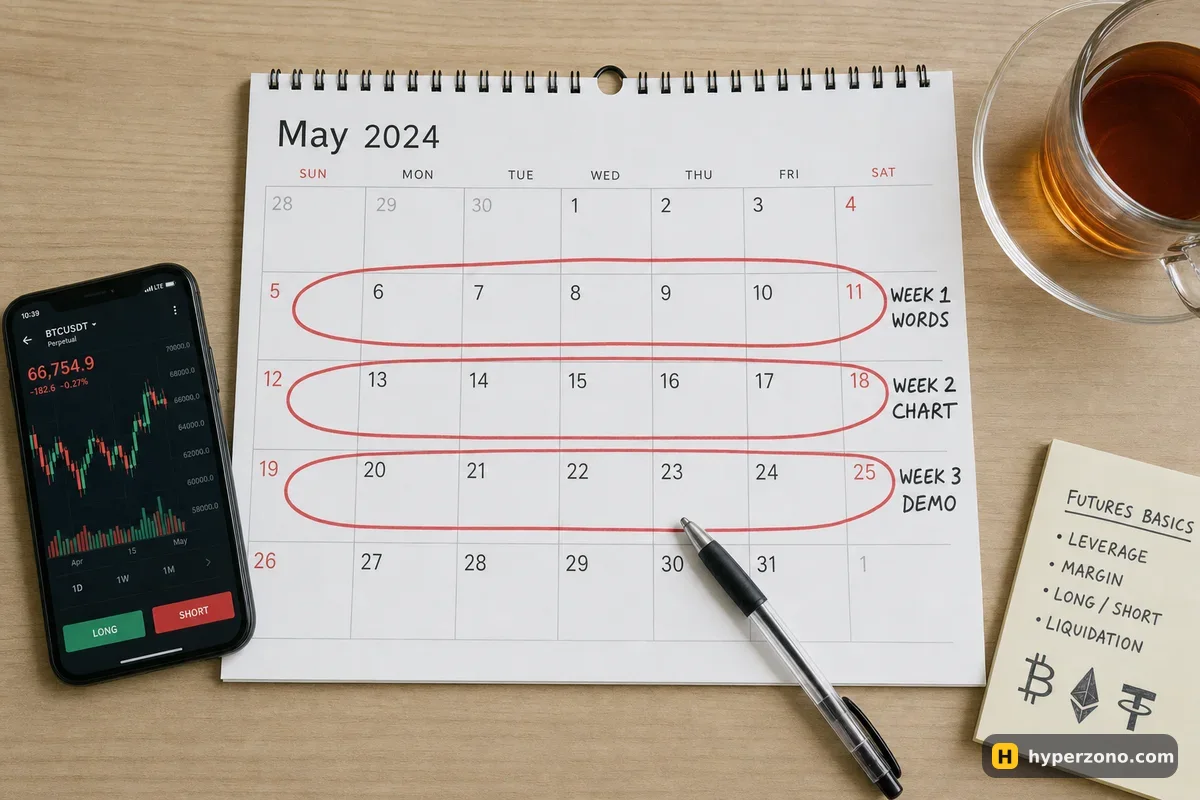
What to learn first, second and third
There is more free futures material online than you could read in a year, and that is exactly the problem. Most beginners start with a video about a strategy, hear the words margin, funding and liquidation, understand none of them, and conclude that they need a paid mentor to explain it all. You don't. You need to learn the same things in the sequence you will meet them on screen.
Learn the words first, the chart second, and only then touch any buttons — even demo buttons. A person who knows what liquidation is will never set 50x leverage out of curiosity, and that one piece of knowledge is worth more than any strategy you could buy.
Week 1: the words you will actually see on screen
Your first week is reading, not trading. Start with what a futures contract actually is and why people use it instead of simply buying coins, then what long and short mean, then leverage and the deposit the exchange holds while your trade is open. Finish the week with the two things that quietly eat money: fees and funding.
Give the scariest word its own evening. Liquidation is when the exchange closes your trade because the margin you set aside has run out, and understanding how close that price sits to your entry changes how you size everything later. Pair it with the stop-loss, which is how you decide your own exit before the exchange decides it for you.
Alongside this site, use the exchange's own help pages — they are free and they are the primary source for numbers. Find the fee page and the contract specification for Bitcoin, and read what the minimum order size is. On Binance's USDⓈ-M futures the standard fee is 0.05% if your order fills straight away — about 25 cents on a 500 USDT trade, and the same again when you close. There is a lower rate (0.02%) if your order waits in the book, and the fees page explains when you get which.
If you want to feel the numbers rather than read them, put a few into a calculator and watch what happens when you change the move or the leverage:
Week 2: reading a chart and writing one simple plan
Week two is where most free courses lose people by dumping twenty indicators on them. Skip all that. Learn what one candle on the chart means, what the thin wicks above and below it are, and which time interval you are looking at — then spend the rest of the week just watching Bitcoin on a one-hour chart for twenty minutes a day.
Use the chart inside the exchange app itself. It is free, it is the same screen you will trade on later, and you can open a Binance Futures account purely to look at the chart and the order window without funding anything. Mark on paper where the price would have to go for your idea to be wrong — that level is your future stop-loss, and finding it is the single most useful chart skill a beginner can build.
By the end of the week, write one plan for one trade and keep it to four lines: which coin, long or short, where you get out if you are wrong, where you take profit. That's it. One simple plan per trade will carry you further than a folder of indicator screenshots, and it costs nothing.
Week 3: demo trading with a journal
Now you open a demo account and trade the plan with money that isn't real. Several big exchanges offer it, and there is a separate page on which exchanges have demo futures if you want to compare them. The practical route is to sign up on Bybit, switch to demo trading and place your first order there — check during sign-up that futures are available where you live.
Do roughly fifteen to twenty demo trades at the same size every time, and write every one down. The journal is the part that turns practice into learning, because without it you remember the wins and forget the rest.
Before you click
Write the date, the coin, long or short, your entry, your stop price and your target. If you can't fill in the stop line, you don't have a trade yet.
After it closes
Write the result in dollars and whether you closed it by plan, by stop, or by hand because you got nervous.
One honest line
Add what you would do differently. After ten trades you will see your own repeating mistake, and nobody could have sold you that information.
Keep in mind that demo fills are kinder than real ones, and your heart rate is not the same when the money is yours. Treat demo as a place to learn the buttons and your own habits, not as proof of future profits.
Which free sources you can trust
Three kinds of free material are genuinely reliable. The exchange's help centre and contract specifications are the primary facts — fees, funding times, minimum order sizes, how liquidation is calculated. The exchange's free learning section, usually linked from the site footer or the help menu, explains mechanics well, as long as you remember it is also marketing. And independent beginner guides, including this one, are useful when they show you the losing side of a trade as clearly as the winning side.
Be honest with yourself about the incentive behind anything you read, including our pages: the buttons here carry a referral identifier, and we may receive a reward from the exchange if you sign up. That does not change the mechanics we describe, but it is a fair thing to know. A source that never mentions how it earns money is not more neutral — it just hasn't told you.
How to spot a paid mentor hiding behind free lessons
The usual funnel looks the same everywhere: a free video or webinar, then an invitation to a closed Telegram group, then a few days of friendly chat and profit screenshots, then the paid signals or the paid course. The free part is real, and it is often decent. It is simply bait, and knowing that lets you take the free part and leave the rest.
- Screenshots of profits, account balances or 90%-win-rate claims, with no losing trades ever shown.
- Urgency — a price that goes up tomorrow, 'only 10 seats left', a countdown timer.
- A promise of a specific income: dollars per day, percent per month, 'replace your salary'.
- Pressure to sign up on an exchange using their code and then immediately use high leverage.
- A request for your API keys, your login details, or money sent to them to trade for you.
Nobody who teaches you needs your keys or your money. Giving someone your API keys or sending them funds to manage is not education, it is handing over control of your account. Real free learning never asks for either, and this site does not accept API keys or hold anyone's money.
Paid courses are not automatically bad. But before you pay for anything, ask what it gives you that the free path doesn't — and after three honest weeks you will usually find the answer is nothing you couldn't have read for free.
What happens after the three weeks
By the end of week three you will know the vocabulary, you will be able to read a chart well enough to place a stop, and you will have a journal with your own mistakes in it. That is a better starting point than most people have when they put real money in. From there the next step is small and real: a tiny deposit, one coin, low leverage, one trade at a time, with the stop price written down before you open anything.
Learning sticks faster when the screen in front of you is the real one. Opening an account, looking at the order window and placing demo orders there costs nothing, and after that the words from week one stop being theory.
Can I really learn crypto futures trading for free?
Yes. The concepts, the exchange help pages, the charts and the demo accounts are all free, and together they cover everything a beginner needs for a first real trade. What money can't buy you is the screen time and the journal — those you have to do yourself.
How long does it take to learn futures trading from scratch?
About three weeks of roughly an hour a day gets you to a sensible first trade: words, charts, demo practice. Becoming consistently profitable is a different and much longer question, and nobody can promise you that timeline or that outcome.
Are paid futures courses ever worth it?
Sometimes, mostly for structure and feedback rather than secret knowledge. Before paying, finish the free path first — if a course can't tell you exactly what it adds beyond that, it is selling hope. Anything promising a specific income is a warning sign, not a feature.
Do I need math or programming to learn futures?
No. The only arithmetic you need is percentages and simple multiplication, and the exchange calculates everything for you anyway. Programming matters only if you plan to build your own bots later, which is not where a beginner should start.
Should I learn on demo or just start with $10 real?
Do both, in that order. Demo teaches you the buttons at no cost, then a very small real amount teaches you how you behave when the money is yours. Keep the real size small enough that losing it changes nothing in your week.
Where do I find the exchange's own free learning material?
Look for the help centre and the learning or education section, usually linked from the footer of the exchange site or the menu in the app. Start with the fee page and the contract specification for the coin you want to trade — those are the facts that affect your money directly.