Contents
The short answer: the person on the other side of your tradeTwo traders, one contract: an example with numbersHow the money actually reaches your balanceWhat if the losing side runs out of money?Then what does the exchange earn, if not my losses?What this changes for your first trade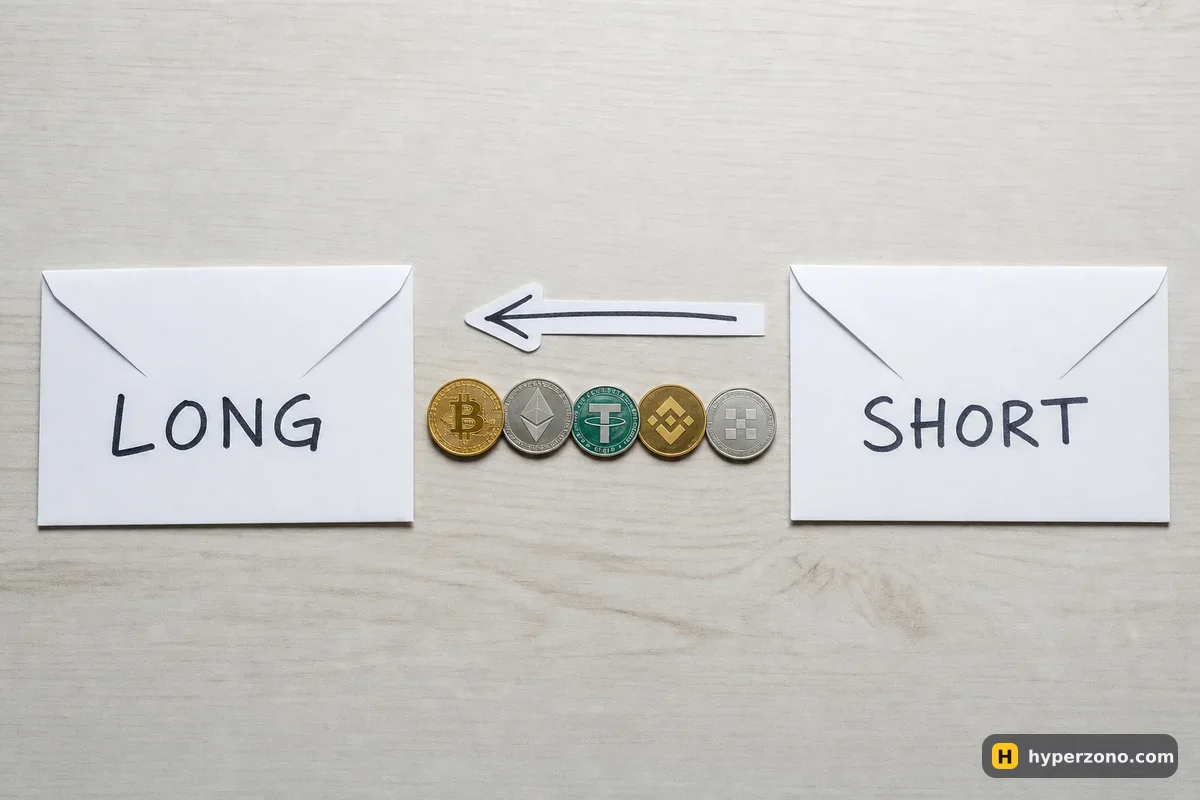
The short answer: the person on the other side of your trade
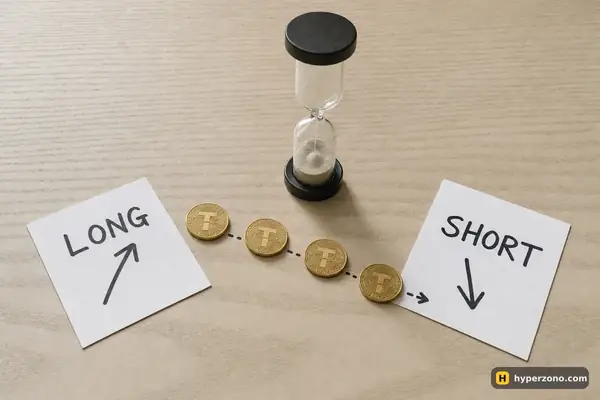
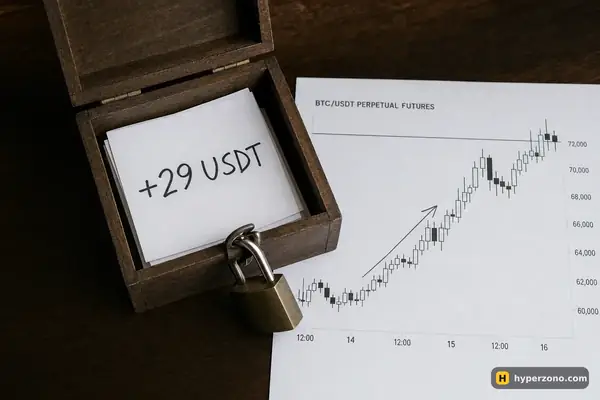
A futures contract is an agreement between two traders about a price difference. One of them is betting the price goes up, the other that it goes down. No bitcoin changes hands and nobody has to own any — you only settle the difference in USDT when the position closes.
So when your trade closes with +20 USDT, that 20 USDT comes out of the margin of the traders who held the opposite side. Your profit is their loss, and their profit would have been your loss. The exchange sits in the middle as the bookkeeper: it holds everyone's margin, recalculates who is up and who is down, and charges a small fee every time you open or close.
Two traders, one contract: an example with numbers
Here are illustrative numbers, not a forecast. Say bitcoin is at 100,000 USDT and you open a long worth 1,000 USDT — that's 0.01 BTC. At the same moment, somewhere else in the order book, another trader opens a short of 0.01 BTC at the same price. You don't know each other and never will.
The price goes to 102,000 and you close. Your result is 0.01 × (102,000 − 100,000) = +20 USDT, minus fees. The short side is down exactly 20 USDT, taken from the margin they set aside when they opened. If the price had gone to 98,000 instead, the 20 USDT would have traveled the other way. Nobody printed anything; the same money simply changed owner.
This is also why the size of your position, and not the leverage number, decides how much money moves. Leverage only decides how much margin you have to set aside for that position — that part is explained in detail on what leverage is.
How the money actually reaches your balance
While the position is open, the profit you see is called unrealized. It is just a running number that moves up and down as the price moves, and it can shrink back to zero or turn negative before you touch anything. Nothing has reached your balance yet.
The moment you close — by hand, by take profit, or by stop loss — the number becomes realized and lands in your futures wallet in USDT. From there you move it to your spot wallet and withdraw it like any other crypto balance; the steps are in how to withdraw profit from futures.
If you want to see this for yourself, open a Binance Futures account and look at the position panel: your unrealized profit sits right next to the margin you put up, and it changes every second the price changes.
What if the losing side runs out of money?
This is the honest part of the question. The trader on the other side only has so much margin. When their loss grows close to it, the exchange closes their position for them — that's liquidation — so the money owed to the winners is still there. The exchange decides that moment on the mark price, a fair price built from several sources rather than the last trade on the chart, and why a contract shows several prices explains how that works. In normal conditions it happens early enough and you never notice.
In a fast crash the exchange sometimes can't close the losing trade before that trader's money is gone. For those moments exchanges keep an insurance fund — a pot of money set aside to cover that gap. Usually that is enough, and the winning side is paid in full.
If even that fund can't take the position, the exchange closes some winning trades on the other side early. This is called auto-deleveraging. Your trade closes at the price where the losing trader's money hit zero, which can be away from what you see on the chart. You pay no fee for it and you get a notice straight away.
Your position panel shows how exposed you are to this. Binance shows a small auto-deleveraging indicator next to each position. The more profit and the more leverage you are carrying, the higher you sit in that queue — one more reason not to run a big position on high leverage. Details: why a position gets closed by ADL.
So no, the exchange is not sitting on a pile of its own cash that could run dry and leave you unpaid in a normal market. On a wild day you can still be closed out at a price you did not pick. It is rare, but it is real — which is why you keep your positions small and keep only money you can afford to lose on the exchange.
Then what does the exchange earn, if not my losses?
Fees, mainly. On Binance USDⓈ-M futures at the starting level, you pay 0.05% when you take a price that is already sitting there waiting for you, or 0.02% if your own order waits in the book for someone else, and it is charged on the size of the trade — once when you open it and once when you close it. On the 1,000 USDT position above that's about 0.50 USDT to get in and the same to get out. Small per trade, and completely independent of whether you won or lost; see what fees you pay on futures.
Funding on perpetual contracts works the same way — it is a payment between longs and shorts, and the exchange does not keep it. Put those two facts together and you get the honest picture: between traders, futures is close to a zero-sum game, and fees come out on top of it. That is why the group of all traders loses a bit more than it wins, and why careless trading drains an account quickly. It also means there is no pyramid here and no hidden sponsor — if you want that compared properly with gambling, read is futures trading real trading or a casino.
What this changes for your first trade
Knowing where the money comes from makes two habits obvious. First, someone competent is usually on the other side of your trade, so a plan beats a hunch. Second, since your loss is paid straight out of your own margin, you decide in advance how much of it you are willing to hand over — that's what a stop loss does for you.
Start with an amount you could lose without changing your month, keep the position small, and check during sign-up that futures are available where you live — rules differ by country and some exchanges serve certain regions through a separate local entity. If you want the whole path from registration to a first small position, the step-by-step start guide walks through it.
Does the exchange lose money when I win on futures?
No. Your gain is paid from the margin of the traders holding the opposite side of the same contract. The exchange earns its trading fee either way, which is why it has no reason to care about the direction you pick.
Can the exchange run out of money and not pay my profit?
The money for your profit is already in the system — it is the other side's margin, held by the exchange. For the rare cases where a liquidation closes at a worse price than the losing trader's margin covers, there is an insurance fund that usually covers the gap, and auto-deleveraging as the final step if the fund cannot take the position. No exchange guarantees a perfect outcome in every extreme market, so keep only trading money on the platform.
Who pays the funding fee on a perpetual contract?
Longs and shorts pay each other. When the rate is positive, longs pay shorts; when it is negative, shorts pay longs. The exchange passes it through and keeps none of it, and only a trader holding the position at the settlement moment pays or receives.
If one side's profit is the other side's loss, can everyone lose?
Between traders the result adds up to roughly zero, but fees and funding costs sit on top of that. So the group of all futures traders ends up slightly negative overall, which is why trading often and in large size without a plan is expensive.
Is my futures profit real money I can withdraw?
Yes. Once you close the position, the profit becomes a realized USDT balance in your futures wallet. Move it to your spot wallet and withdraw it to a bank card, a bank transfer or another wallet, depending on what your exchange supports where you live.
Which price decides how much I made — the chart price or the mark price?
Your realized result is set by the price your closing order actually fills at. The mark price is what the exchange uses to decide liquidation, so a brief spike on the chart does not necessarily close you, and a calm chart does not always mean you are safe.
Sources and fact-check
Exchange terms were checked against official documents on October 21, 2026. Terms change — before you trade, check what matters to you in the exchange app and in your contract’s specs.
Binance: What Is Auto-Deleveraging (ADL) and How Does It Work?