
Contents
The same trade at 5x and at 20xSo what does leverage actually change?Why so many people believe leverage adds profitWhere leverage really does change your resultThink in trade size, not in x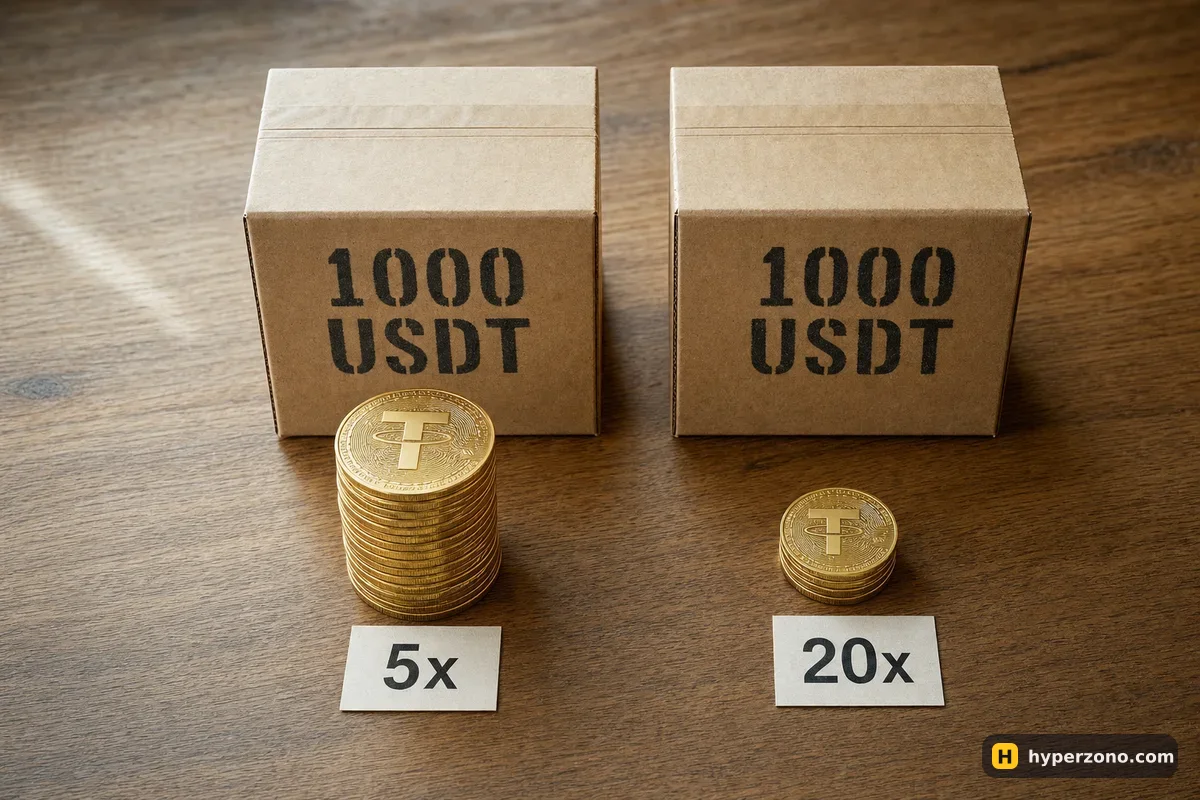
The same trade at 5x and at 20x
Say you want a position worth 1,000 USDT on bitcoin — that's the size of the trade, the amount of bitcoin your profit is calculated on. You open it long, and bitcoin goes up 2%. Your trade earns 20 USDT. Now open the same 1,000 USDT trade at 20x instead of 5x, with the same 2% move: you still earn 20 USDT.
Nothing is hiding here. Your profit comes from the price difference multiplied by how much bitcoin you're holding, and leverage is not part of that calculation at all. If the price had gone the other way, you'd have lost the same 20 USDT in both cases. Even the exchange fee is the same, because fees are charged on the size of the trade, not on the money you put up as margin.
If the price moves far enough against you, the exchange closes your trade on its own so your loss doesn't go past the money you put up. That's liquidation, and higher leverage brings it much closer to your entry price, because you've put up less money for the same position. That's the real trade-off you make when you drag the slider up. If the word is new to you, what liquidation is goes through it slowly.
| With 300 USDT in your account | 5x | 20x |
|---|---|---|
| Size of the trade | 1,000 USDT | 1,000 USDT |
| Your money locked as margin | 200 USDT | 50 USDT |
| Free balance left over | 100 USDT | 250 USDT |
| Profit if the price rises 2% | 20 USDT | 20 USDT |
| Loss if the price falls 2% | 20 USDT | 20 USDT |
| Return on the locked margin | 10% | 40% |
| Rough move against you before liquidation | about 20% | about 5% |
Plug your own numbers in below if you want to see it for yourself — change the leverage and watch the profit line stay where it is.
So what does leverage actually change?
Three things, and all of them are about your account rather than your profit. First, the deposit the exchange holds while the trade is open: 200 USDT at 5x, only 50 USDT at 20x for the same position. That deposit is called margin, and there's a separate page on what margin is and how it differs from the trade size.
Second, your free balance. At 20x you still have 250 USDT sitting unused, which can be a comfort or a trap depending on what you do with it. Third — and this is the one that costs beginners money — the distance to liquidation. A 1,000 USDT position backed by 200 USDT of margin can absorb a much deeper move against you than the same position backed by 50 USDT. On isolated margin that's roughly 20% of room at 5x and roughly 5% at 20x, though the exchange also keeps a small reserve behind the position and charges fees, so the real level is a bit closer than the simple maths suggests — read the liquidation price the exchange shows you before you confirm.
There's one more honest reason to raise leverage, and it has nothing to do with bigger profit: minimum size. On Binance the smallest bitcoin position you can open is 0.001 BTC. If you only have 25 USDT of margin, you need around 5x just to reach that size — leverage is what gets you through the door, not what makes the same trade pay more.
Raising leverage is a margin decision, not a profit decision. If you change the leverage slider and don't touch the size of your trade, the only things that move are how much money is locked and how close your liquidation price sits. Your profit target and your stop-loss stay exactly where they were.
Why so many people believe leverage adds profit
Because in real life almost nobody keeps the size fixed. You have 100 USDT, you switch from 5x to 20x, and the exchange now offers you a position four times bigger — so you take it. The bigger position is what multiplies the result, not the leverage number by itself. Same 2% move, 2,000 USDT position instead of 500, and your profit goes from 10 USDT to 40.
The second reason is the percentage you see in the app. The trade shows the return on your locked margin, so 20 USDT on 50 USDT of margin flashes as +40%, while the identical trade at 5x shows a calm +10%. Same 20 dollars. Percentages feel louder at high leverage; dollars don't care. The easiest way to see it is to open a Binance Futures account and look at the order window: type the same position size, switch between two leverage settings, and watch which numbers move and which stay put.
Where leverage really does change your result
Over a single trade with a tight stop-loss, barely at all. Over a month of trading, quite a lot — through liquidations. Low leverage keeps your liquidation price far away, so an ordinary spike doesn't end the trade before your idea has had time to work. High leverage puts that price within normal daily noise, and a position closed by the exchange is a loss you never chose to take.
There's also the money you don't lock up. With 250 USDT free instead of 100, you have room to add margin if a trade goes against you, or to keep a second position open. What happens to that free money depends on one setting in the order window. With cross margin the exchange will automatically pull from your free balance to keep the trade alive — which also means a bad trade can eat the whole balance. With isolated margin only the money you set aside for that position is at risk, and if it runs out, the position closes. For a first trade, isolated is the calmer choice; the differences are laid out in cross margin vs isolated margin.
Think in trade size, not in x
The practical habit that follows from all this: decide first how much bitcoin you want to be holding, and how much you're willing to lose if you're wrong. A 1,000 USDT position with a stop-loss 2% away risks about 20 USDT, whatever the leverage slider says. Only after that do you look at the slider, and only to decide how much margin gets locked and how much room the position has before the exchange steps in.
That order of thinking is what keeps the leverage number from running your trading. If you're still deciding where to set the slider for a first live trade, what leverage a beginner should use goes into it properly.
Does higher leverage increase profit?
Not on its own. With the same position size and the same price move, your profit in dollars is identical at 5x and at 50x. People earn more at higher leverage only because they open bigger positions with it — and lose more for exactly the same reason.
Why does my percentage return look bigger at high leverage?
The exchange shows your result as a percentage of the margin it locked, and high leverage locks less. Twenty dollars on 50 USDT of margin reads as +40%, the same twenty dollars on 200 USDT reads as +10%. Look at the dollar figure next to it and the illusion disappears.
Do I pay more in fees if I raise leverage?
No. The fee is calculated on the size of the trade, entry and exit separately, so a 1,000 USDT position costs the same to open at 5x and at 20x. Your exact rate is on the fee page of your exchange account.
Does my liquidation price depend on margin mode too?
Yes, and quite strongly. In isolated margin only the money you allocated to that position stands behind it, so liquidation sits close to the rough 1/leverage distance. In cross margin your free balance backs the trade as well, which pushes liquidation further away — but it also means a losing trade can keep drawing on money you meant to keep safe.
Then why use leverage at all?
To hold a position bigger than the money you've put up, and sometimes just to reach the smallest size the exchange will accept. On bitcoin the smallest position is 0.001 BTC; with 25 USDT of margin you need around 5x to open it at all. That's the honest reason to use leverage — and the price you pay is a liquidation level sitting much closer to your entry.
Is low leverage with a bigger position the same as high leverage with a small one?
If the position sizes match, the money result matches. The difference is how much margin is locked and where liquidation sits. Two people with the same 1,000 USDT trade can have very different liquidation prices purely because of their leverage setting and margin mode.