
Contents
What you actually pay forThe trading fee is charged on the trade size, not on your depositFunding: what it costs to keep a trade openThe costs you never see as a feeGetting money in and outWhat one trade really costs, end to endWhere to start in this section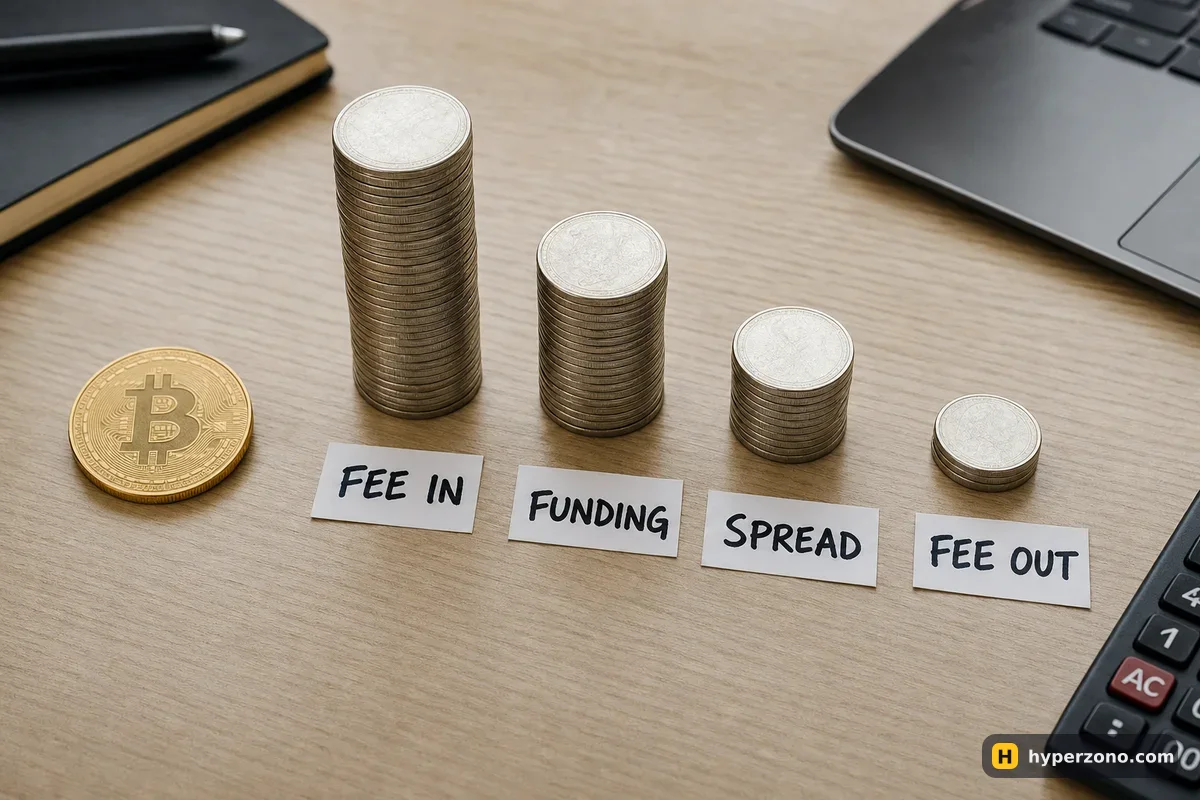
What you actually pay for
There is no monthly subscription on a crypto exchange and no broker taking a cut of your account. You pay a percentage of the size of each trade you make, and that is the bulk of it. On top of that come a few smaller things that most beginners only notice later: funding on positions you keep open, the tiny gap between the buy and sell price, and the cost of moving money in and out.
The biggest of them is the trading fee, so start there. (If a futures trade itself is still new to you, the basics section comes first, and this page will make more sense afterwards.)
| Cost | When you pay it | Roughly how much |
|---|---|---|
| Trading fee | Opening and closing, every time | On Binance at the base level, 0.02% if you wait for your price, 0.05% if you take the market price — each way. Other exchanges are in the same area; check yours in the app. |
| Funding | While a perpetual trade is open, at set times | A small percentage of the trade size; sometimes paid to you |
| Spread and slippage | At the moment your order fills | Tiny on bitcoin, bigger on small altcoins |
| Liquidation | Only if the price runs far against you | The money you set aside for that trade |
| Money in and out | Deposits, conversions, withdrawals | Depends on the method and network; shown before you confirm |
The trading fee is charged on the trade size, not on your deposit
This is the one thing worth understanding before anything else. If you set aside 50 USDT of your own money for the trade — that part is called your margin — and use 10x leverage, your trade is 500 USDT, and the fee is calculated on the 500, not on the 50. On the USDT futures at Binance (the app calls them USDⓈ-M), the base taker fee is 0.05%, so that trade costs 0.25 USDT to open and 0.25 USDT to close. The fee follows the size of the trade, so the bigger the position you open with the same 50 USDT, the more you pay.
Which is not the same as saying that leverage is expensive. Keep the trade at 500 USDT and switch from 5x to 10x, and the fee does not change by a cent — all that changes is how much of your money sits as margin behind it. If I raise leverage but keep the same position size walks through that in more detail.
You will also see two numbers rather than one: maker and taker. That is not a setting you choose — it describes how your order got filled. If you name your price and wait for someone to come to it, you usually pay the lower maker fee; if you take whatever price is on offer right now, you pay the taker fee. On Binance at the base level that is 0.02% against 0.05%, and 0.018% / 0.045% if you pay fees in BNB.
The full story is in what fees you pay on futures, and if you want to compare venues, that belongs in which exchanges have the lowest fees. The quickest way to see your own rate is to open a Binance Futures account and look at the fee line in the order window before you confirm anything.
Funding: what it costs to keep a trade open
Perpetual contracts never expire, so the exchange uses a small regular payment between the two sides to keep the contract price close to the real market price. If the rate is positive, people holding longs pay people holding shorts; if it is negative, the other way around. The exchange does not keep this money — it passes from one group of traders to the other.
On Binance this settles every 8 hours by default, at 00:00, 08:00 and 16:00 UTC, though some contracts settle every 4 hours and the interval can shorten when the rate is extreme. Only a trader holding the position at the settlement moment pays or receives it, so a trade you open and close within an hour may never touch funding at all. How funding works goes through it properly, and the funding calculator will tell you the amount for your own position size.
The costs you never see as a fee
At any moment the best buying price and the best selling price are slightly apart. That gap is the spread, and you pay it simply by entering and leaving — on bitcoin it is tiny, on a small altcoin it can cost you more than the fee. Slippage is the same idea, only bigger: when you send a market order in a fast move, the price you actually get can be worse than the one you saw a second earlier. Picking your order type is how you keep this under control, and market or limit order explains when each one makes sense.
The most expensive thing that can happen is not a fee at all. If the price moves far enough against you, the exchange closes the position itself and the margin behind it is gone — that is liquidation, and it costs you far more than a year of trading fees. Keeping it from happening is the job of the risk section, not this one.
Getting money in and out
Before your first trade you need USDT in the futures wallet, and what that costs depends entirely on how you fund the account. A card purchase or a P2P deal has its own price built into the rate you are shown, sending coins in costs the network fee of whoever sends them, and converting one coin into another has a rate too. Withdrawing to an outside wallet costs a blockchain network fee that depends on the network you pick. Moving money between your spot and futures wallets inside the same exchange account is just an internal transfer — see how to move money to futures and, later, how to withdraw profit.
The app shows the figure on the confirmation screen every time, in both directions. Read it there rather than guessing, especially when choosing a withdrawal network — the same coin can cost very different amounts on different networks. How to buy USDT and your first deposit walk through it step by step.
What one trade really costs, end to end
Here is an illustrative example with round numbers. You put up 50 USDT of margin at 10x, so your trade is 500 USDT on bitcoin. You open and close with market orders at the base taker rate of 0.05%: that is 0.25 USDT in and 0.25 USDT out. You hold it for ten hours and pass through one funding settlement at an illustrative 0.01%, which is another 0.05 USDT. Total cost: 0.55 USDT, or a little over 1% of the money you put up — and the price has to move about 0.11% in your favour before you are even.
The fee does not care how long you hold. Opening and closing ten small trades in a day costs you ten entry fees and ten exit fees. One trade held for three days costs you one of each, plus whatever funding passes by. That is why over-trading drains an account faster than a bad forecast does.
Put your own trade size into the calculator above and the number stops being abstract. When you want to see profit, leverage and all of these costs in one figure, use how to calculate your real profit together with the P&L calculator.
Where to start in this section
Read trading fees first, because it applies to every single trade you will ever make. Then funding, which only matters once you start holding positions for hours or days. Finish with net profit, where everything is added together into the one number that actually lands in your balance. If your balance ever drops while your trades show green, that puzzle has its own page.
How much does it cost to trade crypto futures in total?
For a normal small trade, far less than people expect. On the USDT futures at Binance, the base taker fee is 0.05% of the trade size when you open and the same when you close, so a 500 USDT trade costs about 0.50 USDT in and out. Funding adds a few cents if you hold through a settlement time.
Is the fee taken from my margin or from the trade size?
It is calculated on the trade size — the full position, not the money you set aside as margin. With 50 USDT of margin at 10x your position is 500 USDT, and the fee is a percentage of that 500. Keep the position at 500 USDT and move the leverage from 5x to 10x and the fee is exactly the same; only the margin tied up behind it changes.
Do I pay anything just for keeping a position open overnight?
On perpetual contracts, yes — funding, settled at fixed times (every 8 hours by default on Binance, every 4 on some contracts). Sometimes it is paid to you instead of by you, depending on which side of the market is crowded. Dated futures with an expiry date have no funding at all.
What is the difference between a maker and a taker fee?
It depends on how your order fills, not on a setting. Name your price and wait for someone to come to it and you usually pay the lower maker fee; take whatever price is on offer right now and you pay the taker fee. A limit order that fills immediately counts as a taker.
How much do deposits and withdrawals cost?
What a deposit costs depends entirely on how you fund the account — a card purchase or a P2P deal has its own price built into the rate, and sending coins in costs the network fee of whoever sends them. Withdrawing to an outside wallet costs the blockchain network fee, which varies a lot from network to network. The app shows the figure on the confirmation screen; read it there before you approve.
Does a referral link really reduce my fees?
Some exchange referral programmes include a fee discount and some do not, and the terms change. What a referral link actually gives you goes through it honestly, including how to check your own rate in the app.