
Contents
Three ways to turn local money into USDTHow to buy USDT with P2P in your local currencyBuying USDT with a bank card: fast, but count the real costLocal bank transfer and instant payment systemsP2P safety rules worth memorizingFrom USDT to your first futures trade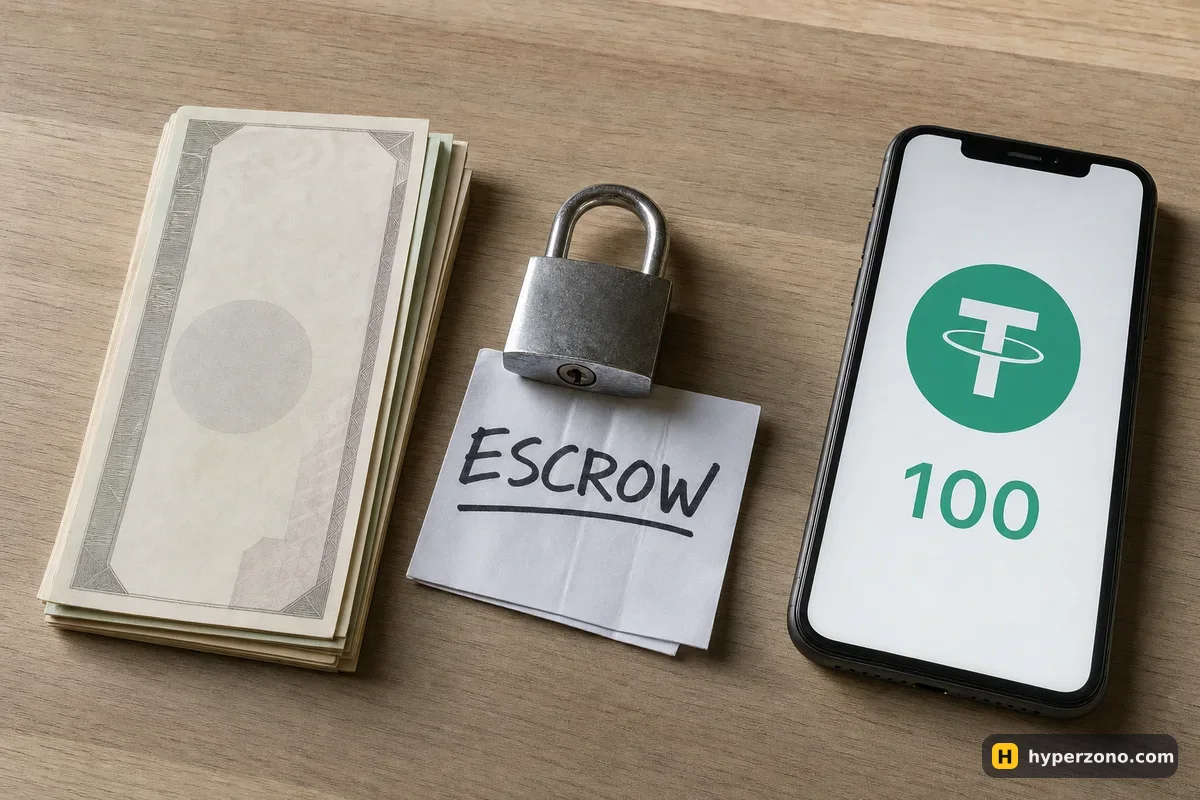
Three ways to turn local money into USDT
Your futures balance is counted in USDT, a token that tracks the US dollar, so 100 USDT in your account behaves like 100 dollars. What it is matters less right now than how you get it, and three routes cover almost everyone: buying from another user on the exchange's P2P board, paying by card through the exchange's payment partner, or sending a bank transfer in your own currency where the exchange supports it. If you want the background on the coin itself, what USDT is and why futures use it covers that separately.
Before any of this works, your account has to be open and verified — buying with local money is exactly the step where an exchange asks for an identity document, and the documents page walks through what that usually means. Which of the three routes you can actually use depends on where you live. The buy and deposit sections list only the currencies and payment methods offered in your country, so if P2P, card purchase or local transfer never appears for you, that route simply isn't available — it is not something to work around, and the rest of this page assumes you pick from what your app does show.
How to buy USDT with P2P in your local currency
On a P2P board you are buying from another user, and the exchange stands in the middle as the referee. The second you place an order, the seller's USDT is locked by the exchange so that neither of you can move it — that locked state is called escrow. You then pay the seller through your normal bank app or payment service, mark the order as paid, and the exchange hands you the coins that were already being held.
Open the local-currency buying section
In the app, look for the part where you buy crypto with money rather than trade coins. Choose the P2P option, pick USDT, and set your own currency if it isn't already selected.
Choose the amount and a seller
Type how much you want to spend or how many USDT you want. You'll see a list of sellers with their rate, their minimum and maximum, how many trades they have completed, and which payment methods they accept. Pick one whose method you actually have.
Place the order
The seller's USDT is locked straight away and a countdown appears on screen — that is how long you have to pay. The payment details you must use are shown inside the order, along with a reference to include.
Pay from an account in your own name
Switch to your bank or wallet app and send the exact amount to the details in the order. Use the reference the order gives you and nothing else, and don't add words about crypto unless you are told to.
Confirm only after the money has gone
Come back and mark the order as paid once your bank shows the transfer completed. Some sellers ask for a screenshot of the receipt — attach it in the order chat, not anywhere else.
Wait for the release
The seller confirms and the escrow releases the USDT into your balance, usually within a few minutes. If they go quiet, use the dispute or appeal option inside the order — the coins are still locked by the exchange, not sitting with the seller.
Most of the cost sits in the rate the seller quotes, which is why two sellers in the same currency can differ by a percent or two. Whether the exchange adds anything on top is shown on the order screen — read it there before you confirm, along with the two numbers that matter: what leaves your account and how many USDT arrive. The fastest way to see the sellers and rates for your currency is to open an account on Binance and look at the buy-with-local-money section.
Buying USDT with a bank card: fast, but count the real cost
A card purchase is the shortest path: enter the amount, enter the card, confirm with the code your bank sends, and USDT appears in your account a couple of minutes later. The exchange usually doesn't process the card itself — a payment partner does, and that partner sets the price. The real cost is rarely one clean number, because there can be a processing fee, a worse exchange rate than the plain one, and sometimes an extra charge from your own bank because it treats the payment like taking out cash.
So ignore the advertised percentage and do one piece of arithmetic instead. Look up the plain currency rate on any currency site, then read the final confirmation screen: how much is leaving your account, and how many USDT are arriving. Here are made-up numbers purely to show the method — the plain rate says one dollar is 40 units of your currency, so 100 USDT "should" cost 4,000; a P2P seller asks 4,080, which is 2% more; the card checkout wants 4,200, which is 5% more. On a first purchase of 100 USDT that gap is three dollars, which sounds small until you notice it is more than several futures trades will cost you in trading fees.
Cards are also the route most likely to be refused outright, since plenty of banks block crypto payments by policy — if that happens to you, paying by card goes through what to try next.
Local bank transfer and instant payment systems
In a number of countries the exchange also accepts a straightforward bank deposit, sometimes through the local instant transfer system your bank already uses, which moves money in seconds. When it's offered, this is normally the cheapest way in, because you pay your bank's ordinary transfer charge and little else. It is also the fussiest: the sending account must be in the same name as your verified account, and transfers from a friend, relative or business account tend to be rejected and can take days to come back.
The very first bank deposit sometimes asks for one extra confirmation step, which funding your account for the first time covers in detail. Timing is the other difference worth knowing: a P2P order can be done at two in the morning, while a bank transfer may sit until your bank's next working day. Across most countries the pattern is the same — bank transfer cheapest where it exists, P2P close behind and far more widely available, card the most expensive but instant.
P2P safety rules worth memorizing
P2P is safe when you stay inside the system the exchange built, and risky the moment you step outside it. Scams on these boards nearly always start the same way: someone tries to move the conversation, the payment or the confirmation out of the app. Keep everything where the exchange can see it and you remove most of the danger.
- Pay only to the account details shown inside the order. If the seller messages you new details, that is a scam, no matter how reasonable the explanation sounds.
- Pay from an account in your own name. A transfer from someone else's card or account can get the order cancelled and the money stuck in a slow refund.
- Never mark an order as paid before the money has actually left your account. Once you confirm, the escrow can release.
- Keep every message in the exchange's own chat. Requests to continue on a messaging app exist to leave no evidence for an appeal.
- Save the receipt until the USDT is in your balance, and use it if you have to open a dispute.
- If you ever sell USDT rather than buy, don't release until the money is in your account and you can actually spend it. A pending notification is not a payment.
The worry everyone has is paying and then watching the seller do nothing, and that is precisely what escrow is for: open the appeal option inside the order, upload your payment receipt, and support decides based on evidence. The coins never left the exchange's hands, so there is something concrete to award you. If you paid after the countdown ran out or sent to the wrong details, don't cancel anything yourself — contact support with the receipt. A dealer or website outside the exchange may quote a better rate, but there is no escrow and nobody to appeal to, so it is not a sensible first purchase.
The real P2P risk is a frozen bank account. When you sell USDT, the money you receive comes from a stranger, and if it turns out to be the proceeds of a fraud, your bank can freeze your account while it investigates. Buying is much safer than selling, which is one more reason to start by buying. Stick to counterparties with a long history of completed trades, never agree to split a payment across several senders, and keep your receipts — they are what unfreezes an account fastest if it ever comes to that.
From USDT to your first futures trade
Whichever way you buy, your USDT lands in the ordinary spot part of your account, not in the futures part. One internal move inside the app puts it where you can trade with it, and moving money to the futures wallet covers that short step. Keep the first amount small — enough to make the experience real and small enough that losing it changes nothing in your week.
Once the balance shows up on the futures side, the rest is ordering: pick a contract, choose your direction and size, and set a stop before you confirm — trading on Binance step by step walks through those screens. If futures themselves aren't offered where you live, check the exchange's own country pages and pick an exchange that does serve your country — not a way around the block.
Do I need to verify my identity to buy USDT?
In practice, yes. Paying with local currency — by P2P, card or bank transfer — is the step where exchanges ask for an ID document and a selfie, because real money is entering the system. It usually takes a few minutes, and the documents page explains what is normally accepted.
Why is the P2P price higher than the official exchange rate?
Because you're buying from a person who wants a margin, and because local demand for dollars pushes the price around. In some countries the gap is well under a percent, in others it's several percent. The fix is simple: compare two or three sellers before you place the order, and ignore anyone whose rate looks far better than everyone else's.
Can I buy USDT with a bank card if my bank blocks crypto?
Often not with that particular card. Banks that refuse crypto payments usually refuse them every time, regardless of the exchange. P2P is the standard alternative, since you are making an ordinary transfer to another person, and card deposits covers the other things worth trying.
A friend wants to send me USDT — what do I need to be careful about?
The network. USDT exists on several blockchains, and your deposit screen gives you a different address for each one. Give your friend the address and the network name together, and make sure they send on exactly that network — coins sent on the wrong one can be very hard or impossible to recover.
How much USDT should I buy for my first futures trades?
Enough to open a position and still have room to be wrong a few times. Contracts have minimum order sizes, so check the one you want to trade in its specification, but for most coins a starting balance of 20 to 50 USDT is workable. Trading with 10 dollars shows what is and isn't possible at the very small end.
Is it cheaper to buy USDT outside the exchange?
Sometimes the quoted rate looks better, but you give up escrow, dispute resolution and any record of the deal. For a first purchase that trade-off isn't worth a percent. Use the exchange's own P2P board, where the coins are locked before you pay a single unit of currency.