Contents
Why an account is still neededDo you need KYC for a demo account?How to get into demo in a few minutesWhat you can't do on demoWhat data you hand over just to try itWhere to try itThe money on a demo account is printed by the exchange itself. It sits in a separate practice wallet that is not connected to your real balance, so if you lose all of it before lunch, nothing happens to your bank card — your card was never part of it. That is the whole idea of the mode: the mistakes are real lessons, the losses are not.
Why an account is still needed
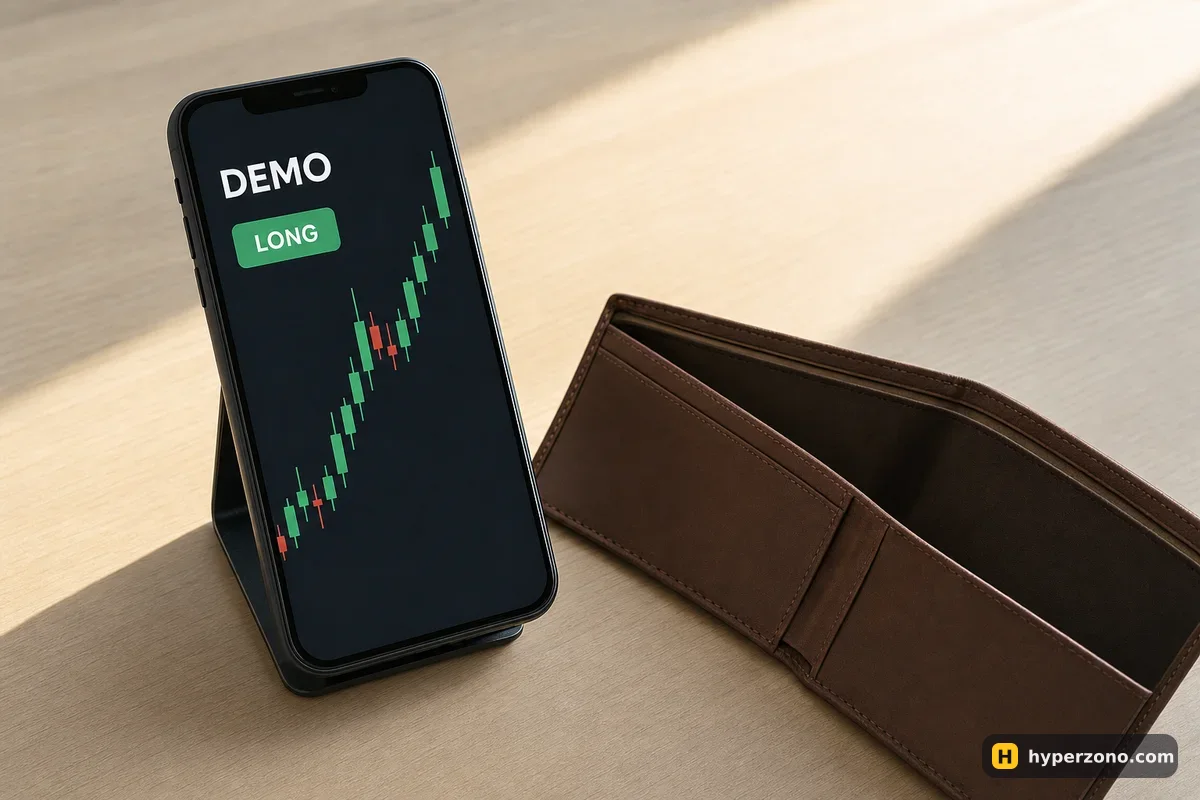
A demo account is a real account on the exchange with a switch flipped. The platform has to keep your virtual balance, your open practice trades and your settings somewhere, and it ties all of that to a login. That is why you cannot usually trade demo futures without registering at all — what you can do is register with an email address and a password, confirm the email, and be inside within a couple of minutes.
Nothing on that screen asks for money. There is no card form, no minimum deposit, no "fund your account to continue" wall before the practice mode. If you ever see one on a site calling itself a demo, close the tab and read how to check that an exchange is not a scam.
Do you need KYC for a demo account?
Usually not for the practice mode itself, but this is the one part that genuinely varies by platform and by where you live. Some exchanges let you into demo straight after confirming an email; others ask for verification earlier, and Binance says plainly that its Demo Trading is not available in all countries. The quickest way to find out is to start signing up and see what the app asks for before it shows you the practice balance — and the rules for real trading are a separate story, covered in do I need KYC to trade futures.
How to get into demo in a few minutes
The whole path from a blank sign-up form to your first practice trade takes about as long as making coffee, and nothing along the way asks for a payment method.
Create the account
Email or phone number, a password, confirm the code. No payment details at this stage.
Find the practice mode
Look in the account or profile menu for a switch between your real account and a demo one. Bybit has a practice mode as well, so you can sign up on Bybit and look for that switch in the profile menu.
Take the virtual balance
The exchange credits practice funds automatically — the amount is shown on the demo screen. If you run that balance down to zero, look on the demo screen for a way to top it up again; some exchanges let you do that, so check in the app.
Open a small practice trade
Pick BTCUSDT, set low leverage, add a stop-loss, and watch what the numbers do. The order window looks exactly like the real one.
What you can't do on demo
Everything works the way it will on real money — you choose up or down, set the leverage, place a stop-loss, and later you can try isolated or cross margin there too. What demo cannot do is touch real money: you are not trading your own funds, so there is nothing to withdraw at the end. Bonuses, copy trading and some bots come later, and the conditions for those are shown in the app once you are trading for real.
For a beginner that is a fair deal. You can spend a week learning where every button is and how profit and loss are counted, and only afterwards decide whether you want to send money anywhere at all.
What data you hand over just to try it
For a demo account the usual list is short: an email address or phone number, a password, your country of residence, and whatever your device and browser reveal — your IP address, roughly where you are, which app version you use. On most exchanges the demo screen never asks for documents. If the one you pick does ask for verification before it lets you in, that is still free — it is the deposit step that never comes, not the paperwork.
Even so, treat it like a real account from the start. Use an email you actually control, pick a password you do not use anywhere else, and turn on two-factor authentication while the account is still empty — if you later move to real trading, that same login becomes the one holding your deposit.
Free money behaves differently from your own. Practice trades tell you where the buttons are and how profit and loss are calculated, but they cannot tell you how you will feel watching 50 real dollars shrink. Read how demo differs from the real thing before you assume your demo results will repeat.
Where to try it
Several large exchanges run a practice mode, and which one suits you depends mostly on availability where you live — that comparison lives on which exchanges offer demo futures trading. You can also open a Binance Futures account and see during sign-up whether demo trading is offered in your country; the lists change and no exchange publishes a complete one.
Is demo trading free on crypto exchanges?
Yes. On the exchanges that offer it, the practice mode costs nothing — no subscription, no deposit, no card. You trade a virtual balance that the exchange credits to you, and the fees shown on your practice trades are simulated too.
Can I do demo trading without registration at all?
On the big centralised exchanges, no — the practice balance and your open trades have to be tied to a login. Registration itself only asks for an email or phone and takes a couple of minutes, with no payment step.
Do I need to pass KYC before using demo?
Often not, but it depends on the exchange and on your country, so check what the app asks for during sign-up. Even if it does ask, verification costs nothing — the part that never comes on demo is the deposit.
What happens if I lose all the virtual money?
Nothing real happens to your own funds — the demo balance is play money. If you want to keep practising, look on the demo screen for a way to top that balance up again; some exchanges let you do it, so check in the app. Losing it quickly is useful information about how big your trades are.
Can I withdraw profit I made on demo?
No, and any platform promising that is lying to you. Demo profit is a number on a practice screen; real money only ever comes from real trades made with your own funds.
How do I know when to stop practising?
When you can open, manage and close a trade without hesitating, and your plan survives a losing streak. That decision gets its own page: how to know you are ready for real money.