Contents
Who holds your money is the real differenceWho can actually use each oneFees, funding and the list of marketsIf something breaks, who helps youWhich one fits your situation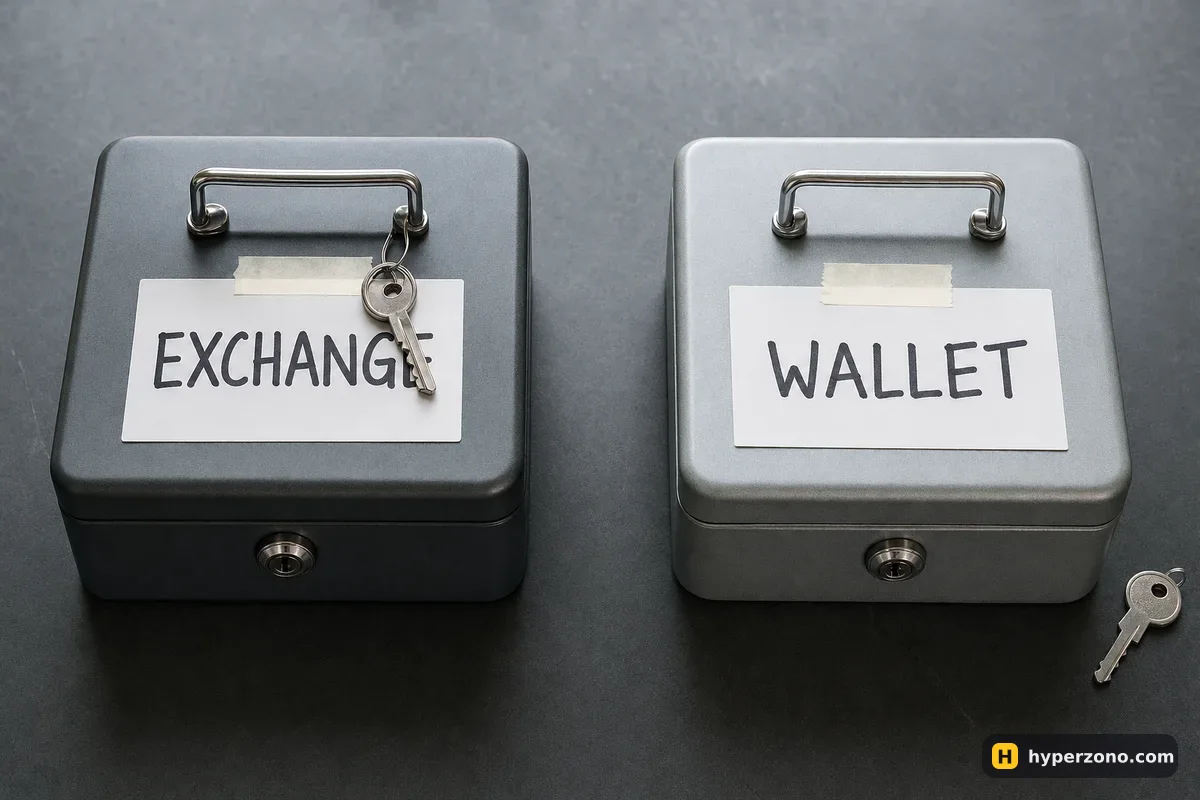
Who holds your money is the real difference
On Binance Futures your USDT sits in a futures wallet inside your Binance account. If you forget your password, you reset it. If you lose your phone, you log in from another one. Your trade lives inside Binance's own system — the exchange handles the trade, holds the part of your money it keeps as a deposit while the trade is open, and works out the price at which it would close you out to stop the loss growing — that's called liquidation.
Binance Wallet works the other way round. The wallet is yours, not Binance's — only you can approve a trade. There are no 12 words to write down (Binance calls this a keyless wallet); instead you make a backup: biometrics, an encrypted copy in iCloud or Google Drive with a recovery password, or a QR code.
If you lose both the device and that recovery password, Binance cannot restore the wallet for you. Without a backup in place, the perpetuals section in the wallet does not even open. How the wallet product is put together is explained in perpetual futures in Binance Wallet through Aster, and setting it up is covered in creating and backing up the wallet.
Who can actually use each one
Both routes start with a verified Binance account — only a verified user can create the wallet, so identity checks come either way. What differs is where each product is offered. Binance's own terms name high-risk countries where the service is not available at all, and derivatives are not offered to users in a number of places, including the United Kingdom, Brazil, Australia, South Korea and Hong Kong; an old notice also covers Germany, Italy and the Netherlands. The lists are not exhaustive and they change, so check what the app shows you during sign-up and read which futures exchanges are available in your country.
The wallet is not a side door around that. Aster's own terms forbid use by people living in or located in Russia, Ukraine, the United States, Canada, the United Kingdom, China and other places. If exchange futures are closed to you, the honest answer is to check whether the wallet product is open to you at all, and if it is not, to leave it alone rather than look for a workaround.
Fees, funding and the list of markets
One word in the table below needs a plain-word translation first. While a perpetual trade is open, traders on the two sides pay each other a small amount every few hours: if more people are betting on the price going up, they pay the people betting on it going down, and the other way round. That payment is called funding, the exchange does not keep it, and how funding works goes through it with numbers.
| What matters | Binance Futures | Futures in Binance Wallet (Aster) |
|---|---|---|
| Who holds the money | Your Binance futures wallet | You, in your own wallet |
| Fees on USDT contracts | Maker 0.02%, taker 0.05% at the base level (0.018% / 0.045% paying in BNB) | Maker 0%, taker 0.04% on crypto; 0.0125% taker on stocks and commodities |
| Funding on perpetuals | Usually every 8 hours, some contracts every 4, and 1 hour if the rate hits its cap | Every 8, 4 or 1 hour depending on the contract |
| Leverage | Up to 20x in the first 30 days of a futures account; higher later, up to 150x on BTC and ETH in small sizes | Not published in Binance's official materials — look at the slider in the app |
| Markets | A long list of crypto contracts, plus 217 stock, gold, silver and oil perpetuals | Crypto and some real-world assets; check the list in the wallet |
| Network | Inside the exchange | BNB Smart Chain only |
On paper the wallet side looks cheaper, and on a single trade the difference is small money anyway: on a 500 USDT position, 0.05% is about a quarter of a dollar to enter and the same to exit. What costs beginners far more is a bad entry, no stop-loss, or funding paid for days on a position that went nowhere. If fees are what you are weighing, what fees you pay on crypto futures breaks them down properly.
The bigger practical difference is what you can actually trade. Binance Futures lists far more contracts, including stocks, gold and oil perpetuals, and most beginner guides — including our step-by-step walkthrough of a Binance futures trade — are written for that screen.
If something breaks, who helps you
This is where the two really part ways. A problem on Binance Futures — a stuck transfer, a liquidation you do not understand, an account you cannot log into — goes to Binance support, with your account history behind it. In the wallet, Binance is not the one on the other side of your trade — the Aster protocol is, and Binance does not stand behind it. Support for the trading part runs through Aster's own Discord, and a trade you approved yourself cannot be undone by anyone afterwards.
Back up first, trade second. If you do try the wallet, finish the backup and store the recovery password somewhere you will still have it in a year — a password manager, or paper kept at home. A lost phone plus a forgotten password means the money is gone, and no support team can change that.
Which one fits your situation
If this is your first futures trade, go with the exchange. Open a Binance Futures account, set your experience level, start in demo if it is offered where you live, then move to a small real position. You will have a password reset, a support channel and a familiar interface while you are still learning what a stop-loss does.
The wallet makes sense when you already know how a perpetual works, you want your coins to stay in a wallet only you control, you are comfortable with transactions on BNB Smart Chain, and the product is open to you where you live. Treat it as a second step, not a first one, and read the risks of trading futures in Binance Wallet before you fund it.
One more honest line: choosing between the exchange and the wallet changes who holds your money and who answers your messages. It does not change the maths of the trade. A 10x position moves ten times faster against you in both places, so size and stop-loss habits from choosing leverage for your first trade apply either way.
Is Binance Wallet the same as Binance Futures?
No. Binance Futures is the exchange's own product: Binance holds your USDT and runs the trade inside its own system. Binance Wallet is a wallet inside the same app that only you can approve trades from, and the perpetuals there are executed by the Aster protocol on BNB Smart Chain. Different people holding your money, different support, different contract list.
Can I use the wallet if futures are blocked in my country?
Do not assume so. Aster's terms block residents of several countries, including Russia, Ukraine, the United States, Canada, the United Kingdom and China. Check what the app shows you, and if a product is closed where you live, leave it — looking for ways around a block puts your whole account at risk.
Do I need identity verification for the wallet?
Yes, indirectly. Only a verified Binance user can create the keyless wallet, so you pass the same checks as for the exchange. More on what that involves is in our page about identity verification for futures.
Which is cheaper to trade?
On paper the wallet route: Aster charges 0% maker and 0.04% taker on crypto, against 0.02% / 0.05% at Binance's base level. On a 500 USDT trade that gap is a few cents. The funding payments you make while the trade is open, and a badly placed entry, will move your result much more than the fee line.
Can I move money between the two?
They are two separate pots — your exchange futures wallet on one side, your own wallet on the other. Check inside the app how moving money between them works and what it costs before you fund anything, so you are not shuffling money while a position is open.