Contents
What Binance Alpha is, in plain wordsMeme coins: where beginners actually get hurtSwaps: the one feature you will genuinely usePrediction markets and airdrop campaignsThe verdict, feature by feature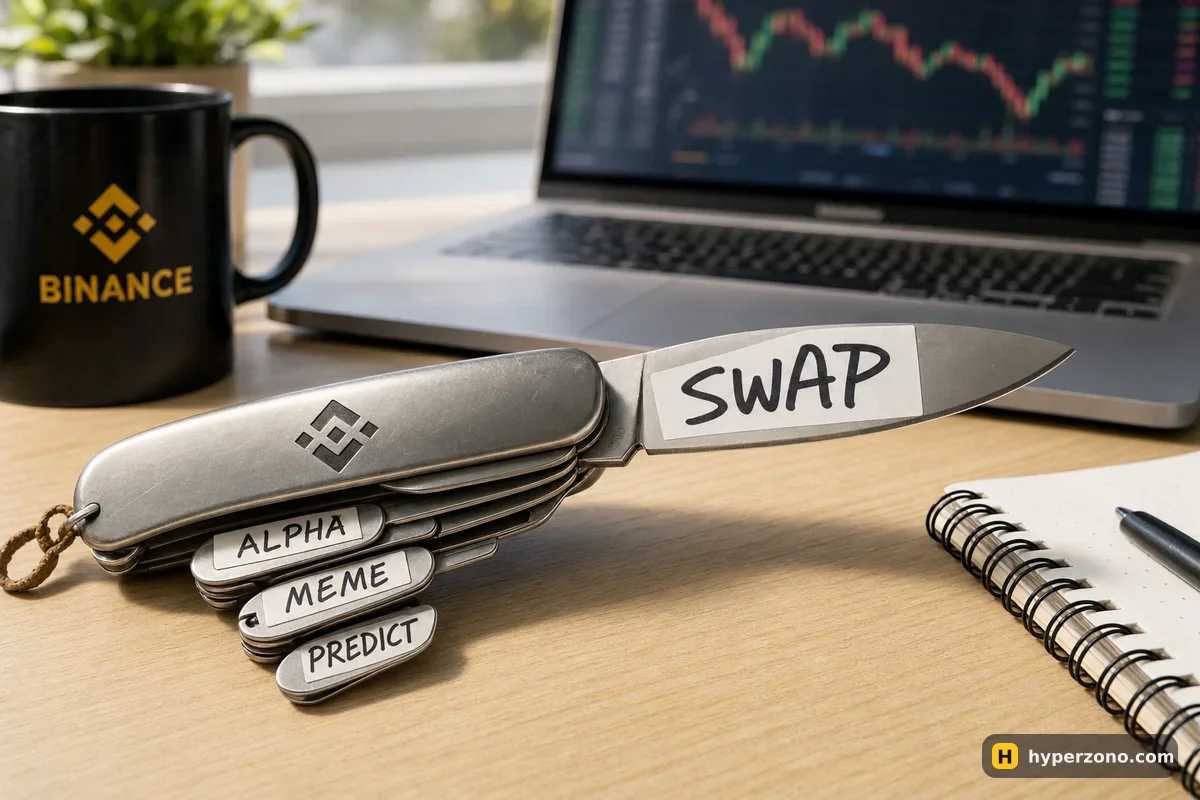
What Binance Alpha is, in plain words
Binance Wallet is a crypto wallet inside the Binance app where you hold the coins yourself, separate from your exchange balance. Alongside that it has a shop window of extras — Alpha tokens, meme coins, prediction markets, swaps and airdrop campaigns. This page walks through them one by one, so you know which ones are worth your time and which ones quietly cost you money.
Alpha is where very early tokens show up — tokens you will not find on the main exchange yet. Some of them later appear there, many do not; there is no promise either way, and the rules for this section change often, so read them in the app before you touch anything. The pitch is obvious: get in before everyone else. The reality is that these tokens usually have very few holders and only a handful of buyers and sellers at any moment, so the price can halve in a few hours, and when you try to sell there may be almost nobody on the other side.
There is a second thing people miss. When you buy an early token in the wallet, the trade happens on a blockchain, and the exchange is not the one selling it to you — check in the app what exactly you are signing before you confirm. If the project disappears, there is no support ticket that brings your money back. The same self-custody logic runs through the wallet's futures, which are executed by a separate protocol called Aster rather than by the exchange itself — that part is covered in how perpetuals work in Binance Wallet. If you want to try an Alpha token anyway, treat the amount as money you have already spent: 10 or 20 USDT, not a tenth of your savings.
Meme coins: where beginners actually get hurt
Meme coins have no product behind them. The price moves on attention, and attention moves fast in both directions. That part most people understand. What catches them out is the mechanics of buying and selling something that almost nobody trades.
When you buy a thin token, your own order pushes the price up, and when you sell, it pushes the price down. The gap between the price you saw and the price you got is slippage, and on a small meme coin it can be a few percent in each direction. So the coin can rise 5% and you can still end up with less money than you started with, once you count the slippage going in, the slippage going out and the network fee on both trades. This is also why beginners are usually told to practise on busy markets first — there is more on that in which coins to trade for your first trades.
Test the exit before you trust the entry. Some tokens are written so that you can buy them but cannot sell them — the code blocks selling, or charges a sale fee so large that nothing comes back. People call these honeypot tokens. Right after buying, sell a small part straight away. If that sale goes through normally, you know the door opens. If it fails or returns almost nothing, you have learned it with pocket change instead of your whole position.
Swaps: the one feature you will genuinely use
A swap exchanges one token for another inside the wallet, without an order book. You pick what you have, pick what you want, and the app shows you a quote. It is how you turn a coin you were sent into USDT, or get the token you need before doing anything else.
Three things decide what a swap really costs you, and they are separate. There can be a swap fee, shown on the confirmation screen. There is slippage — the difference between the quoted price and the filled price, which is small on big coins and can be ugly on small ones. And there is the network fee, paid in the blockchain's own coin: on BNB Smart Chain that means you need a little BNB sitting in the wallet, or the swap simply will not go through. Exact rates change, so read the numbers on the confirmation screen before you tap, every time.
If the swap screen offers a slippage setting, leave it as it is for big coins. Set it very low and your swap keeps failing; set it very high on a thin token and you can be filled far away from the price you saw. If a token only goes through at a very wide setting, that tells you something about the token — it is not a setting problem.
Prediction markets and airdrop campaigns
Prediction markets let you take a side on a yes/no question — will something be above a certain level by a certain date. You pay for a position now and get paid if the outcome goes your way. It is an honest enough product, but it is a bet on a single event, not a trade you can manage, size or exit with a stop. If that distinction interests you, it is the same one we pull apart in trading or gambling.
Airdrop campaigns reward activity in the app with tokens. They are not free money: the activity usually means swaps and trades you are paying fees on, and the reward is a token whose price you find out later. If you were going to make those trades anyway, collecting a reward on top is fine. Making trades you did not want in order to chase one is how people quietly spend more than they receive. The rules change often, so read the current campaign page in the app rather than someone's summary from three months ago.
The verdict, feature by feature
| Feature | What it is | Worth it for a beginner? |
|---|---|---|
| Swap | Exchanging one token for another inside the wallet | Yes — you will use it, just check the quote and keep some BNB for network fees |
| Alpha tokens | Very early tokens you will not find on the main exchange | Skip, or risk only money you would shrug off losing |
| Meme coins | Tokens with no product; price moves on attention | Skip while you are learning — slippage and honeypots do the damage, not the chart |
| Prediction markets | Betting on the yes/no outcome of an event | Entertainment at small amounts; it is not trading practice |
| Airdrop campaigns | Rewards for activity in the app | Only if you were making those trades anyway |
The reason this matters for futures is simple: sizing a position, placing a stop, knowing what liquidation is — all of that only works on markets where there are always buyers and sellers around, so a stop gets filled close to where you set it. Even then it is not an absolute promise, which is why it is worth reading what a stop-loss does and does not guarantee. On a token with four buyers, none of it works at all. If your goal is leveraged trading, the straight route is to open a Binance Futures account and start small.
If you do decide to use the wallet, two things come first. It is keyless and has no 12-word seed phrase, so your backup is the recovery password and backup method you choose when you create it — set the wallet up and back it up properly before any money goes in. And because the wallet's perpetuals run on Aster, whose terms shut out people in a number of countries including the UK, Canada, the USA, Russia, Ukraine and China, read the risks of trading futures from the wallet before you trade there at all.
What is Binance Alpha in simple words?
It is a section inside the Binance app and wallet where very early tokens show up before they are available on the main exchange. Some later make it there, many do not — nobody promises either outcome. The catch is that these tokens are thinly traded, can lose a large part of their value in hours, and the purchase happens on a blockchain rather than being sold to you by the exchange. The rules for this section change often, so check them in the app.
What is Binance Wallet and how is it different from my Binance account?
It is a crypto wallet inside the Binance app where you hold the coins yourself, separate from the balance you trade with on the exchange. That means more control and also more responsibility: if you lose your recovery password and your device, Binance cannot bring the wallet back. For a first futures trade, the ordinary exchange account is the simpler place to be.
Are swaps in Binance Wallet free?
A swap is not free. There can be a swap fee, you lose a little to slippage between the quoted and the filled price, and you always pay a blockchain network fee in the chain's own coin — BNB on BNB Smart Chain. The confirmation screen shows the exact numbers for your swap, so check them there rather than relying on a figure from an article.
Can I lose money on a meme coin even if the price goes up?
Easily. Buy with 3% slippage, sell with 3% slippage, add fees on both sides, and a 5% price rise still leaves you behind. And if the token is a honeypot, the sale never goes through at all — which is why you test with a small sale right after buying.
Do airdrop campaigns actually pay?
Sometimes they do, but the reward is a token whose value you only learn later, and the activity that qualifies you costs real fees. If you were going to trade anyway, take the reward. Do not invent trades to chase one.
Do I need the wallet at all if I only want to trade futures?
No. Regular Binance Futures on the main exchange is the simpler route for a beginner: one account, one balance, and support from the exchange itself. The wallet adds a self-custody layer and a third-party protocol for perpetuals, which is more moving parts than a first trade needs — and that protocol is closed to people in several countries anyway.