Contents
How a prop firm deal actually worksWhere the catch sitsWhat your own futures account looks like insteadSide by side: which one fits youA practical order to do things in
How a prop firm deal actually works
The offer you see in ads is a package you buy. You pay a fee, the firm opens an account with a number on it, and you have to hit a profit target without breaking two loss limits — one for a single day, one in total. The company behind it is a proprietary trading firm, prop firm for short: it puts capital behind traders and takes part of what they make.
Here is the shape of a typical offer, with illustrative numbers that belong to no particular firm: an account labelled 10,000 USDT. You need to make 800 USDT to pass. Lose 500 USDT in one day, or 1,000 USDT in total, and the account is closed. Go one dollar past a limit on one bad afternoon and it is finished — even if you were in profit for the month. Pass, and you move to a funded account where the firm pays you an agreed share of the profit, settled on a schedule written in its terms.
Most firms also tell you which instruments you may trade, whether you can hold a position over the weekend, and how big a single position may be. All of that sits in the firm's own rulebook, which it can write however it likes — so read it before the payment page, not after.
Where the catch sits
The fee is charged per attempt. The firm gets it whether you pass or fail, and if you fail on day two you pay again to start again. That is a real business model on its own, and it is why the marketing is so loud. Nobody publishes verified numbers on how many people pass, so treat any percentage you see in an ad as a sales claim rather than a fact.
The "capital" you are given is usually a number in the firm's dashboard. Many firms state in their own terms that the trading happens on a simulated account and that payouts come from the company, not from your orders reaching a real market. That is not automatically a scam, but it changes what you are buying — you are buying an evaluation and a payout agreement, not access to an exchange. One question is worth asking before you pay: do my orders go to a live market, and where is that written?
Then there are the loss rules themselves. Some firms measure the daily limit from the balance you started the day with, others from the highest balance you reached that day, and the difference is huge in practice. Say the same 10,000 USDT account has a daily limit of 5% instead of a flat 500. You climb to 10,600 by lunchtime, then give it back. Five percent of 10,600 is 530, so the account closes at 10,070 — still 70 USDT above where you started the morning, and the attempt is over anyway. Prop firms, like exchanges, also do not accept everyone from everywhere, so check whether people in your country are eligible before you pay anything.
To be fair to the model, there is a genuine upside. Those loss limits are exactly the discipline most beginners never impose on themselves, and a trader who respects a daily loss cap for three months has learned something valuable. You can get the same discipline for free by setting your own daily loss limit — but many people only follow a rule when somebody else enforces it.
What your own futures account looks like instead
On a crypto exchange there is no challenge and no entry fee. You open an account, pass identity verification, move some USDT to the futures wallet and trade. The amounts are small: on Binance most altcoin contracts start from about 5 USDT of position size, ETHUSDT from 20 USDT, and on bitcoin the smallest position is 0.001 BTC. The exchange charges you per trade instead of up front — on Binance that's about 0.25 USDT on a 500 USDT position when you open, and the same again when you close (0.05% at the base level).
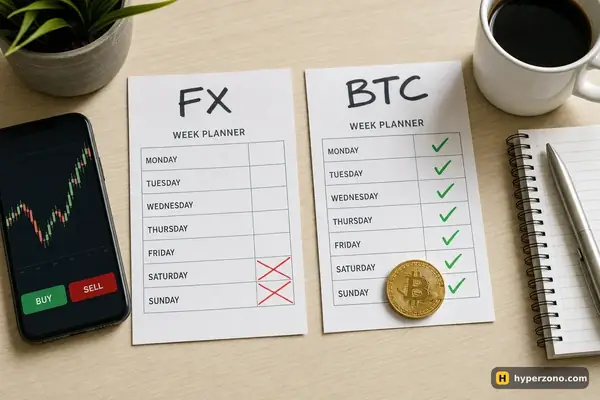
You also get to practise before risking anything. Binance has a demo mode for futures, though it is not available in every country, and the easiest way to find out is to open a Binance Futures account and look for it in the app. Crypto futures run around the clock, including weekends, which prop firms often restrict. Leverage is your choice inside the exchange's limits: on Binance, anything above 20x is locked for the first 30 days of a futures account, and the default setting depends on the experience level you pick when you open it. Other exchanges set their own limits, so check yours in the app. If leverage itself is still fuzzy, read what leverage actually does to your money once and come back.
The honest downside: nobody will stop you. The loss comes straight out of your own balance, and the exchange only steps in when your margin runs out — your position gets liquidated, and in rare market conditions a profitable position can be closed early by auto-deleveraging when the insurance fund cannot absorb a bankrupt position on the other side. The exchange will never tell you to stop after three losing trades. That rule has to come from you.
Side by side: which one fits you
| Prop firm challenge | Your own futures account | |
|---|---|---|
| Cost to start | A fee for every attempt, paid up front | Only your deposit; costs come per trade |
| Whose money moves | The firm's capital, often on a simulated account | Yours, every dollar of it |
| Who sets the rules | The firm: daily loss, total loss, target, allowed instruments | You, inside the exchange's margin and liquidation rules |
| After a bad day | The account can be closed and the fee is gone | Nothing automatic — you have to stop yourself |
| Who keeps the profit | A share for you, a share for the firm | All of it, minus fees and funding |
| Smallest realistic start | Whatever the cheapest challenge costs | From about 5 USDT of position size on many contracts |
A prop challenge makes sense for someone who already trades to a written plan, knows their average loss per trade, and wants to run a bigger size than their savings allow. For that person the fee is a business expense. For a beginner it is usually the wrong first purchase: you are paying to be tested on skills you have not built yet, under rules tighter than any you have practised, and a failed attempt teaches you less than ten small real trades do.
Learn on the cheapest money you have. Before you spend a challenge fee, trade your own money in an amount you would be relaxed about losing — 20, 50, 100 USDT, whatever amount you would not think about twice. If you can follow a stop-loss and a daily loss cap for a month with your own 100 USDT, the prop rules will feel familiar later. If you cannot, the fee would only have bought you a faster failure.
A practical order to do things in
Start on demo or with a tiny real position, write down three numbers before each trade — entry, stop, target — and keep a simple record of what happened. After twenty or thirty trades you will know something no advertisement can tell you: whether you actually follow your own rules under pressure. That is also the only honest way to judge whether someone else's rules are worth paying for. Our step-by-step start guide walks through account setup, the first deposit and the first position in order.
If you want to weigh futures against other instruments before committing, we compare futures and options and futures and margin trading the same way. Whatever you choose, check during sign-up that the exchange and its futures are available where you live — availability changes and is decided by the venue, not by us.
Is prop trading a scam?
Not by definition — proprietary trading is a real part of the financial industry, where firms fund traders and share the profit. The online challenge version is a product with a fee, and the quality varies a lot between companies. Judge it by the written terms: how the loss limits are measured, whether orders reach a live market, and how and when payouts are made.
Do prop firms really give you their money to trade?
Sometimes the account is live, and in many offers it is a simulated account with payouts made from the firm's own funds. Both arrangements exist, and the firm has to say which one it uses in its terms. If you cannot find a clear answer on their site, that is your answer.
Is a prop challenge cheaper than trading my own money?
Only if you pass on the first attempt. The fee is spent whether you pass or not, while on your own account the smallest contracts start from a few USDT of position size and the only cost is the trading fee — on Binance roughly 0.25 USDT to open a 500 USDT position and the same to close it. For a first look, your own small account is the cheaper experiment.
Can I do a prop challenge with no trading experience?
You can pay for one, but the rules are built for traders who already control their risk. A daily loss limit ends your account the moment you break it, and beginners break such limits by accident long before they break them on purpose. Learn the mechanics first on demo or with a small real position.
Can I do both at the same time?
Plenty of people do: a small live account for the freedom to experiment, and a prop account for the bigger size and the forced discipline. Keep the records separate, because the rules for each are different and mixing them is how you break one without noticing.
Will a prop firm accept traders from my country?
That depends entirely on the firm, and the same is true of exchanges. Check the eligibility section of the firm's terms before paying, and check the exchange's availability during sign-up. Never try to get around a restriction — an account opened against the rules can be frozen with your money inside it.
Sources and fact-check
Exchange terms were checked against official documents on October 21, 2026. Terms change — before you trade, check what matters to you in the exchange app and in your contract’s specs.
Binance: What Is Auto-Deleveraging (ADL) and How Does It Work?