
Contents
What actually happens when you pay by cardHow much a card deposit really costsWhy card payments get declined on crypto exchangesThe money lands on spot — you still have to move itWhen a bank transfer or P2P is simply cheaper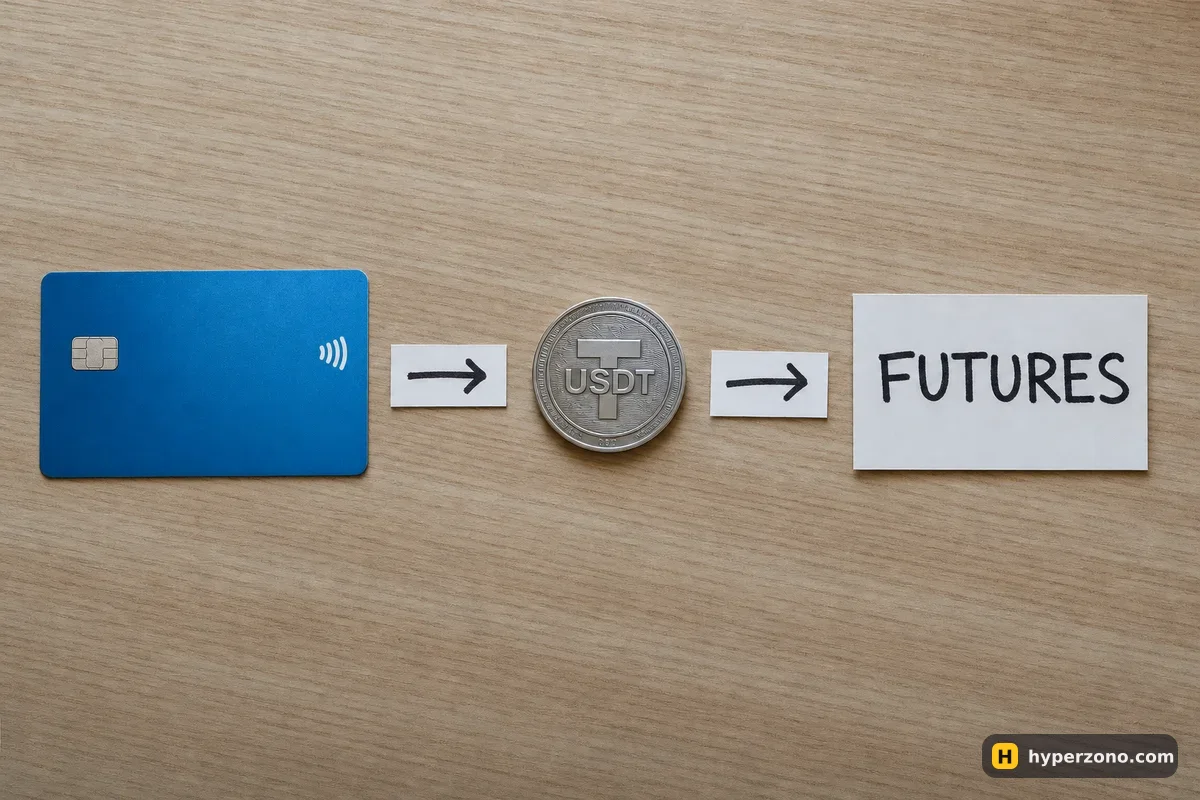
What actually happens when you pay by card
On most exchanges the card payment itself is handled by an outside payment company, not by the exchange. You'll usually notice it: the screen changes, and your bank asks you to confirm the payment with a one-time code by SMS or in your banking app (banks call that step 3-D Secure). When it goes through, the USDT appears in your exchange account.
That's why paying by card here feels a little different from an ordinary online purchase, and why two people on the same exchange can see completely different card options. Which countries and which card types are accepted depends on the payment channel available to you, and that changes from place to place.
So the honest answer to "will my card work" is: open the deposit screen and look. If you open a Binance account and go to the deposit section, you'll see the payment methods that are actually offered where you live — card, bank transfer, P2P (buying USDT straight from another user, with the exchange holding the coins until you've paid), or sometimes nothing at all. Futures themselves are also not available everywhere, so check that too while you're in the app.
How much a card deposit really costs
There are two costs and only one of them is advertised. The first is the payment fee, a percentage of the amount. The second is the price you get for the crypto, which is usually a little worse than the live market price. Together they're the reason a card purchase often feels expensive compared to other routes.
Here's what that looks like in practice (illustrative numbers — your screen will show its own). You type in 100 USD, and before you confirm, the screen says you will receive about 96 USDT. That roughly 4 USD gap is the fee plus the price markup. If your card is in local currency, your own bank may add a conversion charge on top, and some credit cards treat crypto purchases as a cash advance with interest from day one — a debit card avoids that.
Before you confirm, look for the amount of USDT you will actually receive — that number tells you the real cost, not the percentage next to it. If you can't see it, don't confirm. None of this is the trading fee, by the way. Opening and closing a futures trade costs separately, and that part is tiny by comparison — see what fees you pay when trading futures.
Make your first payment a small one. Send 10 or 20 USD before you send 200. You'll see the real rate you get, find out whether your bank lets the payment through, and lose almost nothing if something goes wrong.
Why card payments get declined on crypto exchanges
A declined card is the most common complaint about this route, and it's almost never the exchange's fault. Banks in many countries treat crypto purchases as high risk and block them automatically, without telling you in advance.
- Your bank blocks crypto payments. Many banks refuse them by default. You can write to your bank's support and ask them to allow the payment — sometimes they do, sometimes they don't.
- The bank confirmation step failed. The one-time code didn't arrive, or it arrived too late. Try again with good signal and your banking app already open.
- The card isn't supported for your country. Some payment channels accept only certain regions or only certain card networks.
- Name mismatch. The card must belong to you — the name on it has to match the verified name on your exchange account. Cards in a partner's or friend's name get rejected, and that's also an account-security problem.
- Virtual or prepaid cards. Plenty of card channels simply don't accept them.
If two attempts fail, stop retrying. Repeated declines can get your card temporarily frozen for suspicious activity. Switch to a bank transfer or a P2P purchase instead.
The money lands on spot — you still have to move it
After a successful card payment you'll see USDT sitting in your spot wallet — the ordinary buy-and-hold balance. Some exchanges label it differently, but the point is the same: the money is not in futures yet. The futures account is a separate balance inside the same exchange, and moving money between them is an internal transfer that takes a few seconds — the steps are in how to move money to your futures account. If you're wondering why everything is priced in USDT in the first place, that's explained in what USDT is and why futures use it.
When a bank transfer or P2P is simply cheaper
If you're funding 50 USD for your first practice trades, paying a few dollars for speed is a fair trade. If you're funding a few hundred, that same percentage starts to sting, and a bank transfer or a P2P purchase from another user will usually cost you much less — sometimes close to nothing. Those routes take longer and need a bit more attention the first time, and they're covered in how to buy USDT.
A reasonable plan for most people: use the card once for a small amount to get started today, and once you know the exchange works for you, switch to the cheaper route for anything bigger. The whole sequence from empty account to first trade is laid out in how to fund your futures account for the first time.
Can I deposit directly into my futures wallet with a card?
Not in one step. The card buys USDT into your spot wallet — your ordinary buy-and-hold balance — and you move it to the futures balance afterwards. That transfer is instant and happens inside your account, so it's a couple of taps, not a withdrawal.
Does a credit card work for buying crypto?
Sometimes, but it's the worst option. Many banks treat it as a cash advance, which means interest starts building immediately with no grace period, on top of the payment fee. If you can, use a debit card — and never trade futures with borrowed money.
My card was declined but money left my account. What now?
That's usually a hold, not a charge — it normally falls off within a few days on its own. Check the payment status in the exchange's order history first, and if the money hasn't come back after about a week, contact your bank with the transaction details.
Can I use someone else's card if mine doesn't work?
No. The card has to be in the name on your verified exchange account, and using another person's card will get the payment rejected and can get your account restricted. If your card doesn't work, use a bank transfer or buy USDT from another user through P2P.
Is the card rate different from the price I see on the chart?
Yes, usually slightly worse. There's a margin built into the price as well as the fee, which is why the USDT amount you end up with is a bit less than you'd expect. Compare that final number with the amount you're paying before you confirm.