Contents
What one contract actually is on each sideExpiry, trading hours and the cost of holdingThe route to each one, and whether it is open to youThe same trade idea at the same size, both waysHow to decide, and what to do first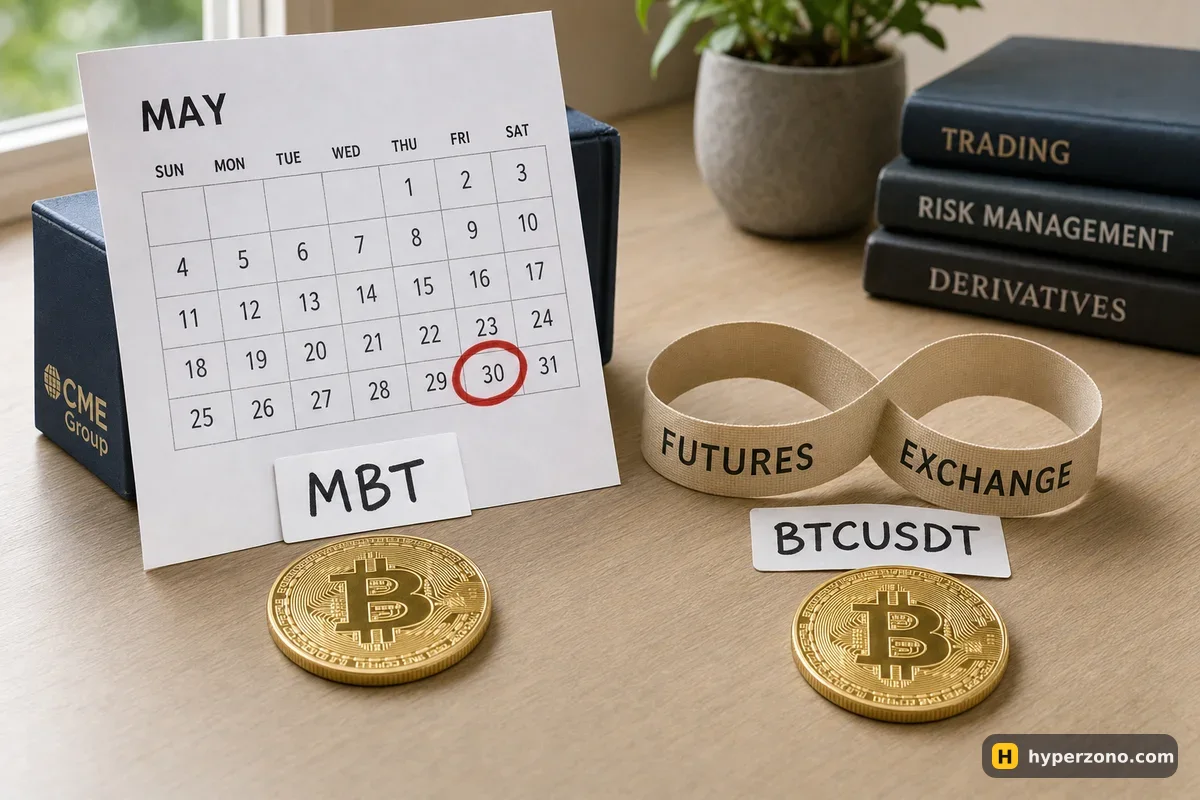
What one contract actually is on each side
One MBT contract is a fixed lump of bitcoin — 0.1 BTC. You cannot buy half of it. CME's own illustration uses a bitcoin price of $50,000, where that single contract is $5,000 of bitcoin. So at that price, 5,000 dollars of bitcoin is the smallest position this contract lets you take. That is not the money you put down — your broker asks for a deposit against it — but it is the size your profit and loss are counted on.
MBT is one fiftieth of the standard CME bitcoin contract, which covers five bitcoin. No coins ever reach you. If you hold to expiry, you are paid in US dollars at a price CME publishes once a day — it is called the CME CF Bitcoin Reference Rate. It is worked out from trading on the big spot exchanges over one hour, up to 4 p.m. London time.
On a crypto exchange you type the quantity in bitcoin yourself, and the steps are much smaller: on Binance the smallest bitcoin position is 0.001 BTC, about a hundredth of one MBT contract. Your margin and your result are in USDT — a dollar-priced token you hold in your exchange account. Hold 1 BTC and the price moves 100 USDT, and you are 100 USDT up or down. That difference in minimum size is the first thing to check if your account is small — one MBT contract may already be more bitcoin than you wanted to hold.
Expiry, trading hours and the cost of holding
With MBT you always have a few monthly contracts to choose from — the current month, the next one, and so on. Each one expires on the last Friday of its month and settles in cash to the reference rate on the last day of trading. Most traders never get that far: if your idea needs more time, you close the expiring contract yourself and open the next month. MBT trades Sunday through Friday, nearly 24 hours a day, so there is a pause in the week when you cannot adjust anything.
A perpetual has no such date. Instead there is funding: at set moments, longs and shorts pay each other a small amount based on the size of the position, and the exchange does not keep it. On Binance that settlement is every 8 hours by default, every 4 hours on some contracts. Dated futures have no funding at all; instead their price sits above or below spot and converges to it by expiry. If this split is new to you, the longer walk-through is in perpetual versus dated futures and the money side in what funding costs.
| What to compare | CME Micro Bitcoin (MBT) | BTCUSDT perpetual |
|---|---|---|
| Size of one unit | 1 contract = 0.1 BTC | You set the quantity; on Binance from 0.001 BTC |
| Margin and payout | US dollars, cash-settled | USDT in, USDT out |
| Which price decides your result | Market price of the contract while you hold it; the once-a-day reference rate only if you stay in to expiry | A fair price the exchange works out from several big spot markets — shown in the app as the mark price |
| Expiry | Last Friday of the month; several months available to trade | None — the position runs until you close it |
| Cost of holding | No funding; you roll to the next month yourself | Funding paid or received at each settlement |
| Trading hours | Sunday to Friday, nearly 24 hours a day | Runs continuously, weekends included |
| How you get there | A futures broker account | An account on the crypto exchange itself |
Look again at the row about which price decides your result. If you hold MBT all the way to the last Friday, that once-a-day rate sets the final payout. If you close earlier — which most people do — you simply sell the contract at whatever price it is trading at, exactly as you would on a perpetual. On a perpetual there is also a second price ticking all day that decides whether the exchange closes you out, and it is not the last trade flashing on the screen — here is what those prices are.
The route to each one, and whether it is open to you
MBT reaches you through a futures broker: you open an account with them, they set the minimum deposit and the margin they require per contract, and those numbers differ from broker to broker, so ask them directly rather than trusting a figure you read somewhere. A crypto exchange works the other way — you sign up yourself, verify your identity, and the futures section sits inside the same app you deposit into.
Both routes depend on where you live. Brokers decide which clients they can take, and crypto exchanges restrict or limit derivatives in a number of countries, sometimes serving them through a separate local company with a different product list. Nobody can promise you access from a web page, so check it at the source: during sign-up the app tells you what your account can open. The quickest way to see the perpetual side for yourself is to open a Binance Futures account and look at the BTCUSDT order window — quantity in BTC, margin in USDT, leverage selector, funding countdown.
The same trade idea at the same size, both ways
Say bitcoin is at 100,000 — an illustrative round number, not today's price — and you want to be long 0.1 BTC, which is 10,000 of position size. Through a broker that is exactly one MBT contract. On a crypto exchange you type 0.1 BTC in the quantity field and the margin depends on the leverage you pick: at 10x the exchange sets aside about 1,000 USDT of your money as the deposit for the trade, at 5x about 2,000 USDT. The leverage changes how much is locked up, not how much the price move pays you.
Price rises 2%, to 102,000. Your 0.1 BTC earns 0.1 × 2,000 = 200, in dollars on one route and in USDT on the other. Now the honest version: price falls 2% instead, to 98,000, and you are down 200 before costs. On Binance at the base fee level a taker pays 0.05% of the position size each way, so 5 USDT to enter and 5 USDT to exit on a 10,000 position — your loss is 210 USDT, plus any funding you paid while the position was open. On the broker route you would subtract their commission and exchange fees instead, which again you get from the broker, not from a comparison page.
The money arithmetic of the price move is the same. What differs is the smallest step you can take, the currency of the result, whether a date forces you to act, and which costs show up on the statement.
Rules from one system do not carry over to the other. If the market moves hard against you, each venue closes the position its own way, and the cushions behind the trade are different. Before you fund anything, read that venue's own page on what happens when your margin runs low — on a crypto exchange that means liquidation, and the exact price it happens at depends on the contract and your settings. Don't assume a protection you heard about somewhere else.
How to decide, and what to do first
If you want a contract denominated in US dollars, with a fixed end date and a broker relationship, MBT is built for that — just confirm the current specification, the margin your broker asks for and whether they accept clients where you live. If you want to start with a small amount, adjust size in tiny steps and trade through the weekend, a USDT perpetual fits better, and the trade-off is funding and the discipline of closing a position that will otherwise run forever.
Either way, open the contract specification of the exact product you are considering and read the size, the settlement, the hours and the fees before you fund anything. On the perpetual, set your stop-loss in the same order window where you set the quantity, and use isolated margin so only the deposit for that trade is at risk. On a 0.1 BTC position the exchange can close you out on its own if the price runs far enough against you.
Then pick one platform and do a practice run at the smallest size it allows. If you want to compare the perpetual side on a second venue before deciding, sign up on Bybit and open the BTCUSDT contract details there too — the size step and the funding countdown sit right in the order window.
Is CME Micro Bitcoin the same product as BTCUSDT?
No. They track the same asset, but MBT is one contract of 0.1 BTC, settled in US dollars and expiring on the last Friday of its month. BTCUSDT on a crypto exchange is a perpetual with no expiry, where you choose the quantity yourself and everything is counted in USDT.
Does one daily price decide my result on MBT?
Only if you hold the contract to expiry — then the once-a-day CME CF Bitcoin Reference Rate sets the final cash payout. If you close before the last Friday, you sell the contract at the market price at that moment, just like closing any other position.
Do I receive actual bitcoin from either of them?
No. MBT is cash-settled in dollars. A USDT perpetual pays you the price difference in USDT. In both cases you are trading the price, not buying coins — if you want the coins themselves, that is a spot purchase.
Which one is cheaper to trade?
It depends on the fees your broker charges and the exchange's fee tier, so compare the two lists side by side rather than guessing. One structural difference: a perpetual has funding payments while the position is open, a dated contract has none but will need rolling if you want to hold past expiry.
Can I trade MBT without a broker?
No — CME products reach a private trader through a futures broker who carries the account. A crypto exchange is the other model: you register directly and the futures section is in the same app, subject to verification and whatever restrictions apply where you live.
Which is better for a small account?
Look at the smallest trade each one allows. One MBT contract is 0.1 BTC, while on Binance the minimum bitcoin position is 0.001 BTC — a hundred times smaller. If you want to risk a few dollars per trade while learning, the smaller step makes that possible without stretching your deposit.
Sources and fact-check
Exchange terms were checked against official documents on October 22, 2026. Terms change — before you trade, check what matters to you in the exchange app and in your contract’s specs.
CME Group: Micro Bitcoin futures product overviewBybit Help Center: FAQ — USDT Perpetual and Expiry Contracts