Contents
How a fall turns into a cascadeThe part beginners never expect: your collateral can close youAuto-deleveraging: when a winning trade is closed anywayWhat happens to stop orders when the market moves that fastFive things you controlled that night — and still controlSo should a beginner trade futures at all?How a fall turns into a cascade
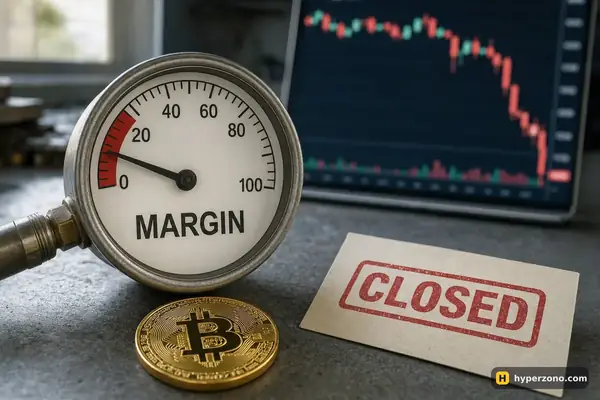
A fall on bad news is nothing unusual on its own. What turns it into a cascade is leverage: when a leveraged position runs out of margin, the exchange closes it for you, and a forced closure means the exchange sells that position at whatever price is available right now.
Longs are closed by selling, so a wave of long liquidations keeps pushing the price down. At each price level there are only so many buyers waiting, and when a lot of forced sells arrive at once those buyers get used up and each next sell goes through lower. The lower price pushes the next group of positions into liquidation, and that group pushes the price again — and in a few seconds the price on the screen can be far lower than it was a minute earlier.
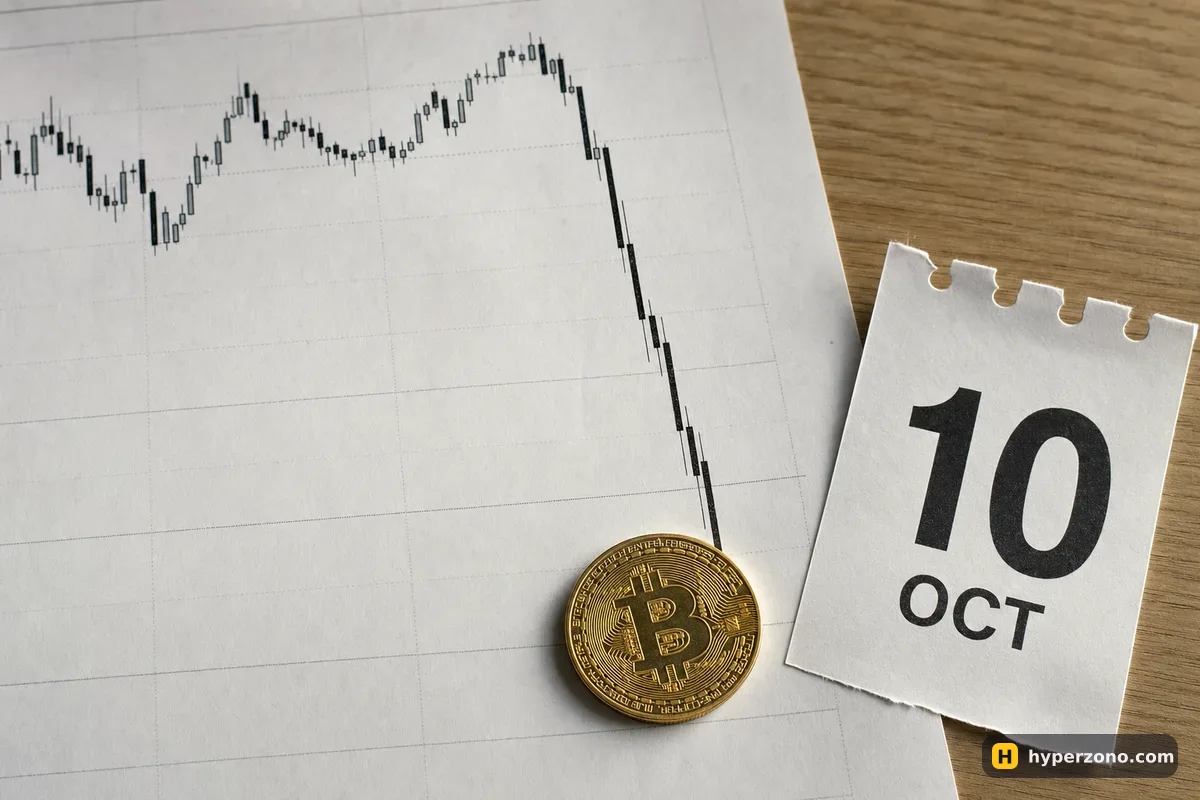
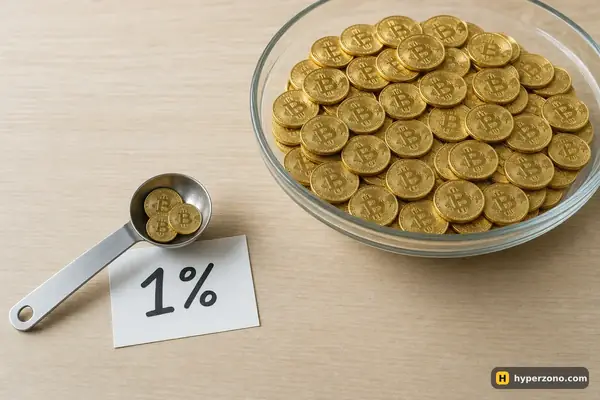
You will see huge liquidation totals quoted from that night, usually taken from trackers that add up what different venues publish in different ways, so treat any single figure with care. The number that decides your own night is much smaller and much more personal: how much of your money was sitting inside one leveraged position when it started.
The part beginners never expect: your collateral can close you
On a futures account you do not have to hold plain USDT. Exchanges let you post other coins as collateral, and while the market is quiet that feels like free efficiency — your coins sit there and still back your trades. The catch shows up on a fast day: if part of what backs your position is itself falling in price, the support under your trade shrinks at exactly the moment you need it most.
Two settings decide whether this can reach you. With cross margin your whole balance backs every position, so a problem with one asset touches everything; isolated margin keeps the damage to the margin you assigned to that one trade. And if the only thing in your futures wallet is USDT, there is no second price that can move against you while your trade is open. If you are not sure which mode you are in, our page on cross margin versus isolated margin shows exactly where to check in the app.
Auto-deleveraging: when a winning trade is closed anyway
When prices move faster than liquidations can be filled, some losing positions cannot be closed at a price that covers their loss. Somebody has to absorb that gap. Exchanges keep a pot of money aside for exactly this, and it covers the gap first. When that pot is not enough, the exchange closes profitable positions on the other side instead. This is called auto-deleveraging, or ADL. Binance describes it openly, and other exchanges have their own version of the same thing — check how your exchange handles it in its help pages.
Here is the part that upsets people most. On Binance, a profitable position taken by ADL is closed at the price where the losing position on the other side had used up all of its margin — the exchange calls this the bankruptcy price — and that price can sit outside the range you see on the chart. So you can be right about the direction, watch a large unrealized profit, and find the trade gone at a number you never chose. There is no switch to turn this off; the details are on our page about why a position gets closed by ADL.
A fast day tests your settings, not your opinion. When prices are moving in seconds and apps are busy, nobody is calmly fixing anything. Leverage, margin mode, collateral and size are decisions you make when the market is boring, and they are the only things working for you when it is not.
What happens to stop orders when the market moves that fast
A stop order has a trigger price and a fill price, and they are not the same thing. A stop-market order triggers and then takes the next price available, which in a vertical drop can be far below your level; a stop-limit order may trigger and never fill at all, leaving you still holding the position while it falls. Add slow charts and orders that take longer to confirm when everyone is trading at once, and you can see why reacting by hand in the moment is not a plan. We cover this in does a stop loss guarantee your loss, so one sentence is enough here: a stop limits your loss, it does not promise a price.
Isolated long of 1,000.00 USDT, 10× leverage, maintenance margin 0.50% of position size (example). Simplified model without closing fees, risk-limit tiers or other positions — the exchange will show its own price.
Five things you controlled that night — and still control
- Leverage. Lower leverage leaves room for a spike to pass under your position instead of through it. Our guide on what leverage a beginner should use shows how that room is calculated.
- Margin mode and collateral. Isolated margin plus plain USDT means one trade can cost you the margin you assigned to it — as long as the automatic margin top-up setting is switched off, otherwise the trade can quietly pull in more.
- Protection orders. Set a stop before you need it, and accept that it limits the loss without promising the exact price.
- Which price moves your trade. Liquidation is calculated on the mark price, a fair price the exchange works out from the wider market, not on the last trade flashing on the chart. On a wild day those two can be noticeably apart.
- Size, and where your money sits. If one trade cannot hurt your whole account, a gap or an ADL closure is annoying rather than final. Work the size out with how much to put into one trade, and keep money you are not trading outside the futures wallet, so one bad trade cannot reach it.
So should a beginner trade futures at all?
That day does not prove futures are a trap. It proves that a leveraged position behaves exactly as its settings say it will, including on the one evening a year when everything moves at once. The people who came through it with a scratch instead of a hole were not smarter about the news — they were holding small positions, in isolated margin, with modest leverage and money that was not all sitting in the futures wallet.
The useful next move is small and practical. Try it without risking much: open a Binance Futures account — check during sign-up that futures are available where you live — switch the position to isolated margin, set low leverage and a stop, and look at the order panel to see which price your liquidation is calculated from. If real money still feels like too much today, do exactly the same walk-through in demo mode first and only then put 10 or 20 USDT behind it.
Can another crash like October 10, 2025 happen again?
Yes, and at some point it will. Crypto trades around the clock, news arrives at awkward hours, and leverage builds up on one side of the market until something shakes it out. You cannot predict the date, which is exactly why the settings you choose today are the ones that will be working for you then.
How much can I lose in a night like that?
On a futures account in isolated margin, the normal worst case for one trade is the margin you assigned to it — as long as the automatic margin top-up setting is off, otherwise the trade can pull in more. In cross margin the whole free balance of the futures wallet is backing your positions, so the honest answer there is: much more. Keeping money you are not trading outside the futures wallet is the simplest fix.
Would a stop loss have saved me?
It would have limited the damage, not fixed the price. A stop-market order fills at the next available price, which in a fast drop can be well below your level, and a stop-limit order can miss entirely. A stop plus small position size handles a crash far better than a stop alone.
Can I avoid auto-deleveraging?
You cannot switch it off, and it only happens in extreme conditions, when the money the exchange sets aside for unfilled liquidations is not enough. What you can do is keep single trades small enough that losing one at an unfavorable price does not change your month, and avoid holding big leveraged positions through major scheduled news.
Were the exchanges at fault, or was it manipulation?
That argument runs in every chat group after a crash, and this page cannot settle it. What is useful to you is the mechanical part: a cascade of forced closures, collateral falling in value while it backs your trade, ADL on the winning side and stops filling worse than expected. Every one of those connects to a setting you control.
Should I just trade without leverage instead?
That is a perfectly reasonable place to start. A futures position at 1x moves much like simply holding the coin, while still letting you go short, and your liquidation price sits far away from the current market. Open the order window, set 1x, and watch how that number moves as you step the leverage up.