
Contents
How much time each style needsCrypto is 24/7 — so pick your own windowA realistic weekday routine when you work full timeWhat you actually look at in those 20 minutesWhy the 4-hour chart is easier when you work daysLet alerts do the watching for youHow much time each style needs
The hours you spend depend almost entirely on how often you want to be in and out of the market. The faster the style, the more of your day it eats, and the faster your fees add up too, because you pay on every entry and every exit.
| Style | Time at the screen | How often you trade | Works with a full-time job? |
|---|---|---|---|
| Scalping — in and out in minutes, 1–5 minute candles | 3–6 hours, without breaks | Many trades a day | Realistically, no |
| Intraday — in and out the same day, 15 minute to 1 hour candles | 1–3 hours in one block | 1–3 trades a day | Only if your hours are flexible |
| Swing — holding for days, 4 hour and daily candles | 20–40 minutes a day | 1–3 trades a week | Yes, this is the usual choice |
Beginners often assume more screen time means more money. In practice the opposite happens more often: sitting in front of the chart for hours tempts you into trades you never planned, and that is one of the main reasons beginners lose money on futures.
Crypto is 24/7 — so pick your own window
Stock markets open and close at fixed hours, so stock traders have to show up when the exchange says. Crypto futures never close, not at night, not at the weekend. That changes the whole question: you are not asking "can I be free at 9:30 in New York", you are asking "which two hours of my own day are calm and repeatable".
Pick a window you can actually keep most days — after dinner, before the kids wake up, during your commute if you only need ten minutes. The regular slot matters more than the time of day. The market will still be there at 10 p.m. in Lagos, 11 p.m. in Manila or 6 a.m. in Istanbul, with the same chart and the same contracts.
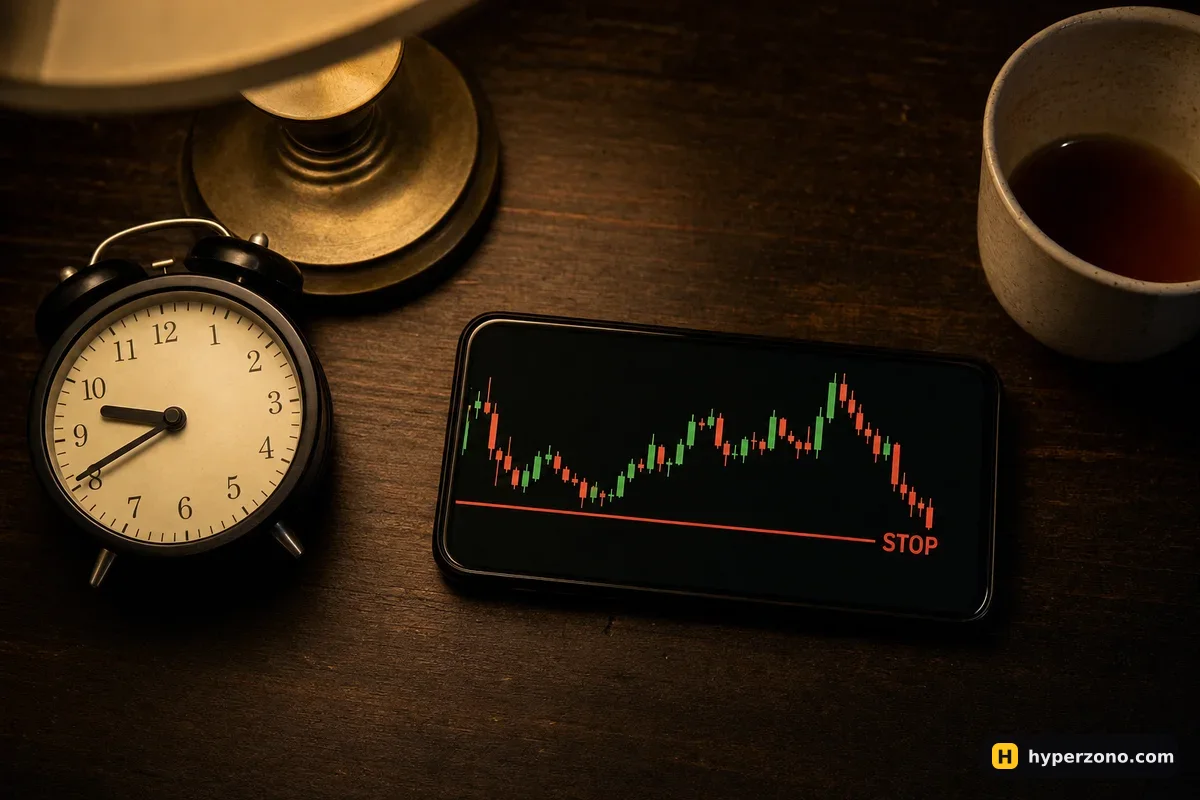
A realistic weekday routine when you work full time
Here is what a normal day looks like for someone holding one or two trades at a time over several days. Nothing in it requires you to be at your desk during working hours.
Morning, 5–10 minutes
Open the app, look at your open positions and your balance. Did anything hit your stop or your target overnight? If nothing happened, close the app. You do not need to act.
Evening, 20–30 minutes
Look at the 4-hour or daily chart of the one or two coins you follow. If you see a setup you planned for, decide your entry, your stop and your target before you open anything.
Placing the trade, 5 minutes
Open the position, then immediately attach a stop loss and a take profit in the same order window. Now the exchange is watching the price, not you.
Weekend, about an hour
Go through the week: which trades worked, which did not, and whether you followed your own plan. This hour teaches you more than ten extra hours of staring at candles.
What you actually look at in those 20 minutes
The evening check is short because most of it is looking, not doing. You open the chart of the one or two coins you follow and ask three plain questions. Has the price been going up, down or sideways for the last couple of weeks? Is it close to a price where it turned around before? And if you opened a trade here, at what price would you admit you were wrong? That last price is your stop, and it also decides how big the trade should be.
Then you glance at what you already hold: the current profit or loss, and — if you have been holding a perpetual contract for several days — whether funding has been adding to your result or quietly taking from it. On most evenings the honest answer to all of this is "nothing to do today", and you close the app. That is a normal evening, not a wasted one.
Why the 4-hour chart is easier when you work days
On a 1-minute chart a new candle appears every minute and every one of them asks for a decision. On the 4-hour chart there are six candles a day; on the daily, one. You can check in twice and miss nothing important, which is exactly what you need when your trading hours are squeezed between a job, a commute and family.
There is also a time-zone bonus. The biggest moves in crypto often come during European and American hours, which can be late evening or the middle of the night where you live — in India, Vietnam, the Philippines or Nigeria, and just as awkwardly early in Brazil. If you traded the 5-minute chart you would have to be awake for them. On the higher charts, a move that takes six hours to develop is still there when you wake up. Which chart interval to settle on is a topic of its own — see choosing a timeframe when you get to it.
Let alerts do the watching for you
The single biggest time-saver is a price alert. You tell the app to notify you if bitcoin reaches a level you care about — the edge of the range it has been stuck in, or the price where you decided you would open the trade — and then you stop checking. No buzz, no reason to open the chart. Two or three alerts replace a whole evening of refreshing the screen.
The simplest way to see how little this takes is to sign up on Bybit, open the order window on BTCUSDT and look at the fields for your amount, your stop and your target (check during sign-up that futures are available where you live). You fill them in once, and your evening is yours again.
Your stop can close you out a little worse than you set it. If the price jumps straight past your level during a fast move, your trade closes a bit below the price you chose. Here's why a stop doesn't always fill at your exact price. It still turns an open-ended problem into a small, known one, which is exactly what lets you walk away from the screen.
People sometimes ask whether a bot removes the time question entirely. It moves the work rather than deleting it: you still choose the settings, you still check on it, and it can lose money while you sleep.
Can I trade crypto futures with a full-time job?
Yes, as long as you choose a style that matches your hours. Holding trades for a few days off the 4-hour and daily charts needs a short morning check and about half an hour in the evening. What does not work is trying to open and close trades every few minutes between emails — you will miss your exits and trade on impulse.
How long do traders spend trading each day?
It ranges from a few minutes to a full working day. Someone holding a position for several days may look at the chart twice; someone trading in and out all day may sit at the screen for five or six hours. Neither group makes more money by definition — the time spent only reflects the style.
What is the best time of day to trade crypto futures?
Since the market never closes, there is no required hour. Moves are often bigger during European and US hours, but the practical answer is the window you can repeat calmly every day without rushing or borrowing sleep.
Do I have to watch my position all the time?
No. Once you have set the prices at which the trade should close, the exchange watches the market for you, even while your phone is off. That is what makes a calm style fit around a job: you make the decisions in the evening, and the rest happens without you.
How much time should I spend learning before my first real trade?
A few evenings of reading plus a couple of weeks of practice is a sensible start. Rehearsing in demo mode first costs you nothing but time, and it is the cheapest way to find out whether the twice-a-day routine actually fits your week.