Contents
Perpetual futures don't expire, so nothing forces you outWhat holding a perpetual overnight actually costsThe bigger cost of holding is risk, not feesCan you hold futures for months, or should you just buy spot?How to leave a trade open overnight without losing sleep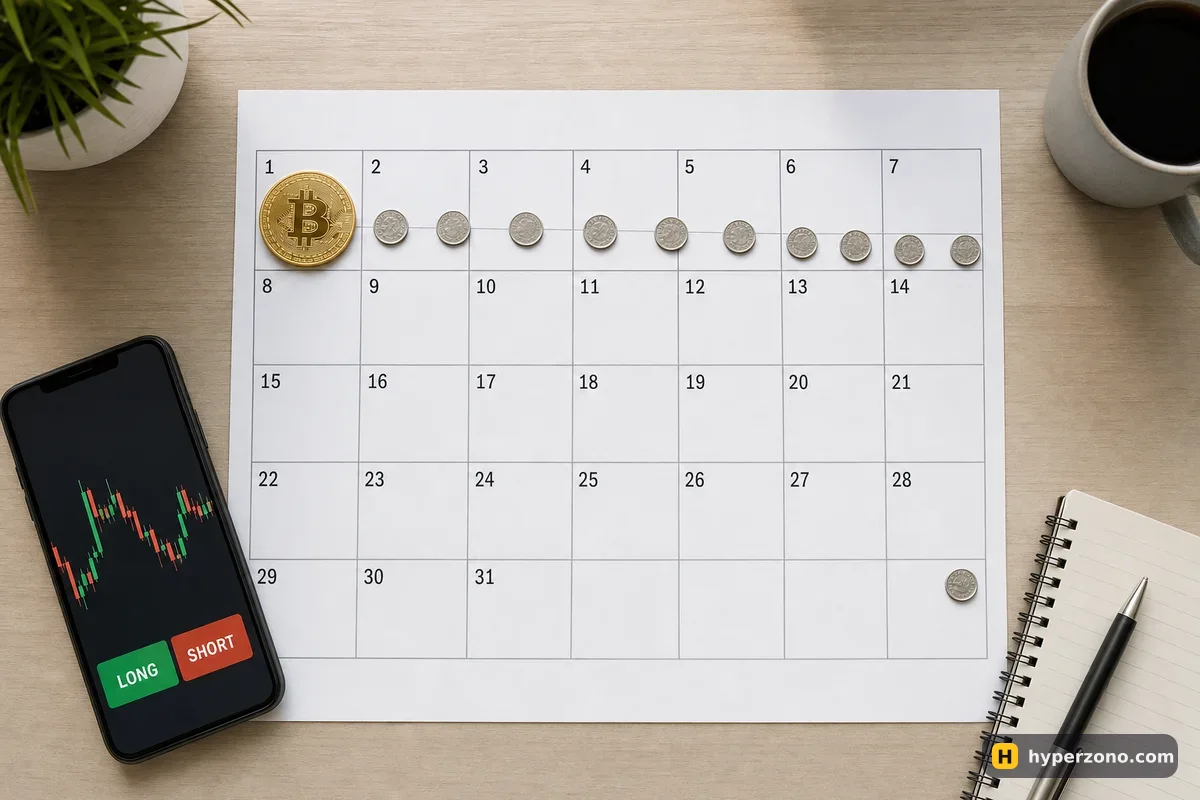
Perpetual futures don't expire, so nothing forces you out
A perpetual contract has no settlement date written into it. You open a long or a short, and the position simply sits there until something closes it. That something is one of three things: you press close yourself, a stop-loss or take-profit you set earlier fires, or the exchange closes the position because your margin ran out — that last one is called liquidation.
The exception is dated futures, the ones with a month in the contract name. Those really do have a last day: the contract settles on that date and the price drifts toward the spot price as the day gets closer, so your "how long" question is answered for you by the calendar. The practical differences are laid out in perpetual vs dated futures.
What holding a perpetual overnight actually costs
The price of time on a perpetual is called funding — a small payment passed between traders holding longs and traders holding shorts, which the exchange doesn't keep. On Binance it is settled by default every 8 hours, at 00:00, 08:00 and 16:00 UTC; some contracts run on a 4-hour schedule, and in extreme market conditions the interval can shorten to an hour. You only pay (or receive) if your position is open at the exact settlement moment — the full mechanics are in what funding is and who pays whom.
Here is what that adds up to. Say you hold a position worth 1,000 USDT and the funding rate stays at 0.01% every 8 hours — an illustrative number, since the real rate changes all the time and can be negative. Three payments a day of 0.10 USDT each gives you this:
| How long you hold | Funding payments | Total paid |
|---|---|---|
| 1 day | 3 | 0.30 USDT |
| 1 week | 21 | 2.10 USDT |
| 30 days | 90 | 9.00 USDT |
Nine dollars sounds like nothing until you remember where it comes from. If you opened that 1,000 USDT position with 100 USDT of margin at 10x, then a month of holding ate 9% of your own money before the price did anything at all — plus the trading fee you paid on the way in and will pay again on the way out. The easiest way to see the live number is to open a Binance Futures account and look at the contract's info area, where the exchange shows the current funding rate and the time left until the next payment.
Funding can also pay you. When the rate is negative, shorts pay longs instead. If you are on the receiving side, holding actually credits small amounts to your account. But the rate flips with the mood of the market, so never plan a trade around collecting it.
The bigger cost of holding is risk, not fees
Compared with what the price can do to you overnight, funding is small money — and on a quiet contract it can even land on your side. The bigger risk of a long hold is that you are exposed to every move the market makes while you are asleep, at work or travelling. Crypto trades through the night and the weekend, and a sharp move at 3 a.m. does not wait for you to wake up and react. With leverage, a position that looked comfortable in the evening can be gone by morning.
Liquidation is calculated on the mark price, a fair price the exchange derives from the wider market, so a brief spike on one order book usually won't trigger it — but a genuine move will. This is exactly why a trade you plan to keep open for days needs a stop-loss set at the same time you open it, not later. It also pays to know what happens if your phone dies or you lose internet: your position and your orders stay live on the exchange, which is good news only if you left protection behind.
Can you hold futures for months, or should you just buy spot?
You can hold for months, and some people do. But ask yourself what the trade is really for. If your thinking is "I believe bitcoin will be worth more in a year", then buying the coin on spot is usually cheaper and calmer: no funding, no margin, no price at which somebody closes you out. If you own the coin on spot and it falls 40%, you can wait it out. With 10x leverage you are closed out long before that. The comparison is spelled out in futures versus simply buying crypto.
Futures make more sense for shorter trades, and for things you cannot do on spot — betting on a fall, or opening a bigger trade with a small deposit. Most beginner trades live for hours or days, not seasons. If you find yourself holding a losing position for weeks because you don't want to admit it, that is not patience, it is an unclosed mistake, and it is one of the main reasons beginners lose money.
How to leave a trade open overnight without losing sleep
The order of these matters. The first one has to happen before you open the trade, because most exchanges lock the setting once a position or an order is live.
Set the margin mode to isolated before you open the trade
New contracts usually start in cross, which links the position to your whole futures balance. With isolated, only the margin you put into this one trade is at risk — as long as you don't switch on the option that tops it up automatically. On Binance and most other exchanges you cannot change the mode while the position is open or orders are sitting there, so do it first; the difference is explained in cross versus isolated margin.
Choose less leverage for a longer hold
The longer the position lives, the more room it needs to breathe. Lower leverage pushes the liquidation price further away from the current price, which matters most when you are asleep.
Set the stop-loss before you walk away
Decide the price where your idea is wrong and place the order right away. It sits on the exchange and works while your phone is off.
Check the funding rate and your side
If the rate is clearly against you and you plan to hold for days, count the cost first — or take the trade smaller.
Decide in advance when you will close
A price, or a date. Reviewing the trade once a day beats staring at the chart, and closing the position takes one tap when the time comes.
Do perpetual futures expire?
No. A perpetual contract has no settlement date, which is where the name comes from. It stays open until you close it, your stop or take-profit fires, or you get liquidated. Dated futures are different — they settle on the date in the contract name.
Is there a maximum time the exchange lets me hold a position?
There is no timer on your position. What can change is the contract itself — exchanges adjust leverage limits, margin requirements and occasionally retire contracts, so for anything you plan to hold a long time, check the contract specification in the app.
How much does it cost to hold a perpetual overnight?
Usually one or two funding payments, depending on the contract's schedule. At an illustrative 0.01% per settlement, one night on a 1,000 USDT position is a fraction of a dollar. The rate changes constantly though, and during a strong trend it can be many times higher, so check the live rate before you leave a trade open for days.
Can I switch my open position to isolated margin before going to bed?
Usually not. On Binance and most other exchanges the margin mode is locked while a position is open or orders are live, so the setting will be greyed out. Pick isolated in the order window before you open the trade, and keep the automatic margin top-up switched off if you want the loss capped at that one trade's margin.
Can I hold a futures position for months instead of buying the coin?
Technically yes, but month after month of funding and the constant risk of liquidation make it an expensive way to hold a long-term view. For a buy-and-wait plan, spot is usually the simpler and cheaper choice.
What happens to my position if I don't open the app for a week?
It keeps running, funding keeps settling, and any stop-loss or take-profit you left stays active. If the price reaches your liquidation level, the exchange closes the position without asking you. That is the whole argument for setting protection before you step away.
Does closing and reopening a position to avoid funding make sense?
Rarely. You pay the trading fee on every entry and every exit, so dodging a small funding payment often costs more than the payment itself — and you risk re-entering at a worse price.