
Contents
What $100 a day actually adds up toHow much capital would $100 a day need?Why a daily target works against youMoney comes in streaks, not in equal daily slicesA goal that actually makes sense for your first monthsWhy you keep seeing this exact promise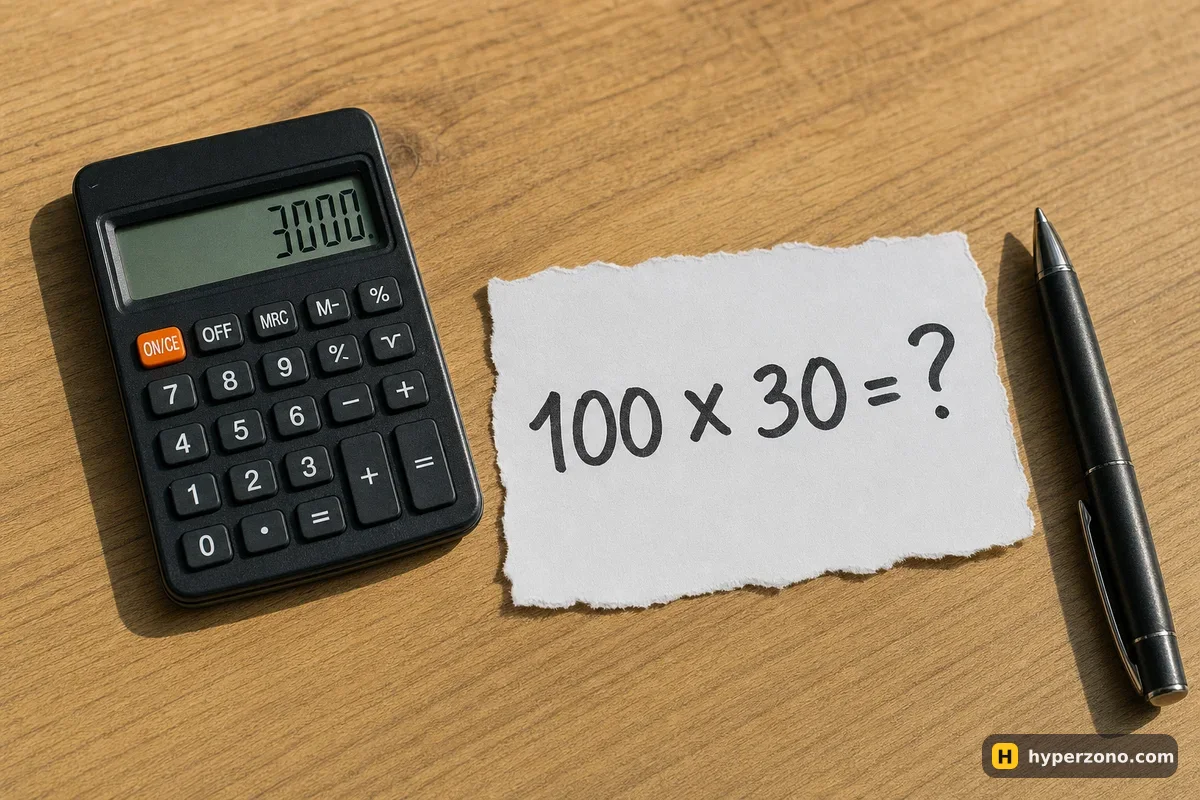
What $100 a day actually adds up to
Crypto trades every day, so thirty days of $100 is 3,000 USDT a month, or 36,000 USDT a year. Said out loud, "a hundred dollars a day" sounds modest. Written as a yearly number next to your account size, it usually stops sounding modest very quickly.
Compare it with your deposit and the picture gets sharper. If you fund your account with 100 USDT, then $100 a day is 100% per day, every day — that is not a trading goal, that is a fantasy. We go through the real arithmetic of a small account on the page about how much you can make with $100.
How much capital would $100 a day need?
Turn the question around and ask how much money has to be working for 3,000 USDT a month to be a sane target. Traders measure results in percent of the account, not in dollars, because the dollars follow the account size. Here is what different monthly returns imply.
| Monthly return on the account | Account needed for 3,000 USDT a month | How realistic is that return |
|---|---|---|
| 2% | 150,000 USDT | Hard but not crazy for an experienced trader |
| 5% | 60,000 USDT | Good months look like this; not every month |
| 10% | 30,000 USDT | Happens in streaks, almost never repeats all year |
| 20% | 15,000 USDT | Usually comes with risk that eventually wipes the account |
Notice what the table is really saying: the smaller your account, the higher the return you need, and the higher the return you chase, the bigger the risk you have to take to get it. That is why "$100 a day" quietly turns into "take huge risk with a small account" for most people who try it.
It helps to feel the same thing at the level of a single trade. Say Bitcoin moves 1% your way. On a 2,000 USDT position that is 20 USDT before fees, so to clear 100 USDT from that same 1% move your position has to be around 10,000 USDT — and a 1% move against you takes 100 USDT out just as fast. Holding a position that big with a small account means heavy leverage, and that pushes the price where the exchange closes your trade for you, called liquidation, right up against today's price.
Type your own numbers in and see how the size changes the result:
Why a daily target works against you
A target of $100 today decides when you trade. It is 9 in the evening, the market has been flat all day, you are at zero — and now you take a trade you would never take on a calm morning, because the number says you must. That is overtrading, and it is one of the most expensive habits in futures.
The second half is worse. You lose 80 USDT on that late trade, and now you need 180 to finish the day. So you double the size, drop the stop-loss — the order that closes your trade automatically at a price you picked in advance — "just this once", and one bad hour eats a week of patient work. This pattern shows up again and again in why beginners lose money.
The market does not know your bills. A daily target is a promise you make to yourself that only the market can keep. Give yourself a rule you control instead: a maximum loss per day, and a maximum number of trades. Those you can actually follow.
Money comes in streaks, not in equal daily slices
Even traders who end the year well do not earn in a straight line. A month often looks like two or three days that carry everything, a long stretch of small wins and small losses that cancel out, and a couple of ugly days. The average may work out to a decent number, but no single day was average.
This matters for your planning. If you need exactly $100 today to cover something, futures is the wrong place to get it — the market may simply not offer a setup worth taking this week. Trading money has to be money you can leave alone, which is also what separates a trading approach from a bet at a casino.
A goal that actually makes sense for your first months
For the first two or three months, the honest goal is not a dollar figure at all. It is: finish the month with your account roughly intact, with every trade having had a stop-loss, and with a short written record of what you did. If you manage that, you are already ahead of most people who start futures this year.
After that, think in percent and in months, not dollars and days. A few percent a month on a small account is a real result — on 500 USDT that is pocket change in dollars, and that is fine, because what you are building is a process that survives being scaled up later.
Risk only a tiny part of the account on each trade — there is a simple way to work out the amount in how to size a position. If you would rather rehearse first, you can open a Binance Futures account and start in demo mode, with no real money at risk. Demo is not offered in every country, so check that during sign-up.
Why you keep seeing this exact promise
"How to make $100 a day trading crypto" is a headline that sells subscriptions, courses and signal channels, because it is a small enough number to feel reachable and a big enough number to change your month. Nobody selling it shows you the account size that would be needed, and nobody shows the losing streak that comes with the strategy.
When someone shows screenshots of daily profits, ask two questions: what was the account balance, and where are the red days? If either answer is missing, you are looking at marketing. The same test applies to ready-made Telegram signals.
Can I make $100 a day with a $100 account?
Realistically, no. That is 100% per day, and the only way to get near it is leverage so high that one normal price swing closes your position. With 100 USDT, treat your first months as paid practice and measure results in percent.
How much capital do I need to make $100 a day?
It depends entirely on the return you can actually hold. At a steady 5% a month you would need around 60,000 USDT; at 2% a month, around 150,000. Those returns are not guaranteed to anyone, which is why the capital answer is really "more than most beginners expect".
Do professional traders earn money every single day?
No. They have flat days, losing days and losing weeks, and they judge themselves over months. Anyone showing an unbroken row of green days is either showing you a selected screenshot or selling something.
Would higher leverage get me there faster?
It moves your result faster in both directions. And the price where the exchange closes your trade for you, to stop the loss growing, sits much closer to today's price. That closing is called liquidation. Higher leverage is the main reason small accounts disappear in days, not a shortcut to a daily income.
What is a reasonable goal for my first month on futures?
Survive it. Every trade with a stop-loss, a small fixed risk per trade, no more than two or three trades a day, and a note after each one. If the account is about where it started and you understand what you did, that month was a success.