
Contents
The two numbers your bot is showing youHow the unrealized loss gets so bigFees and funding quietly shrink the plus sideWhat to do right nowHow to stop this happening with the next bot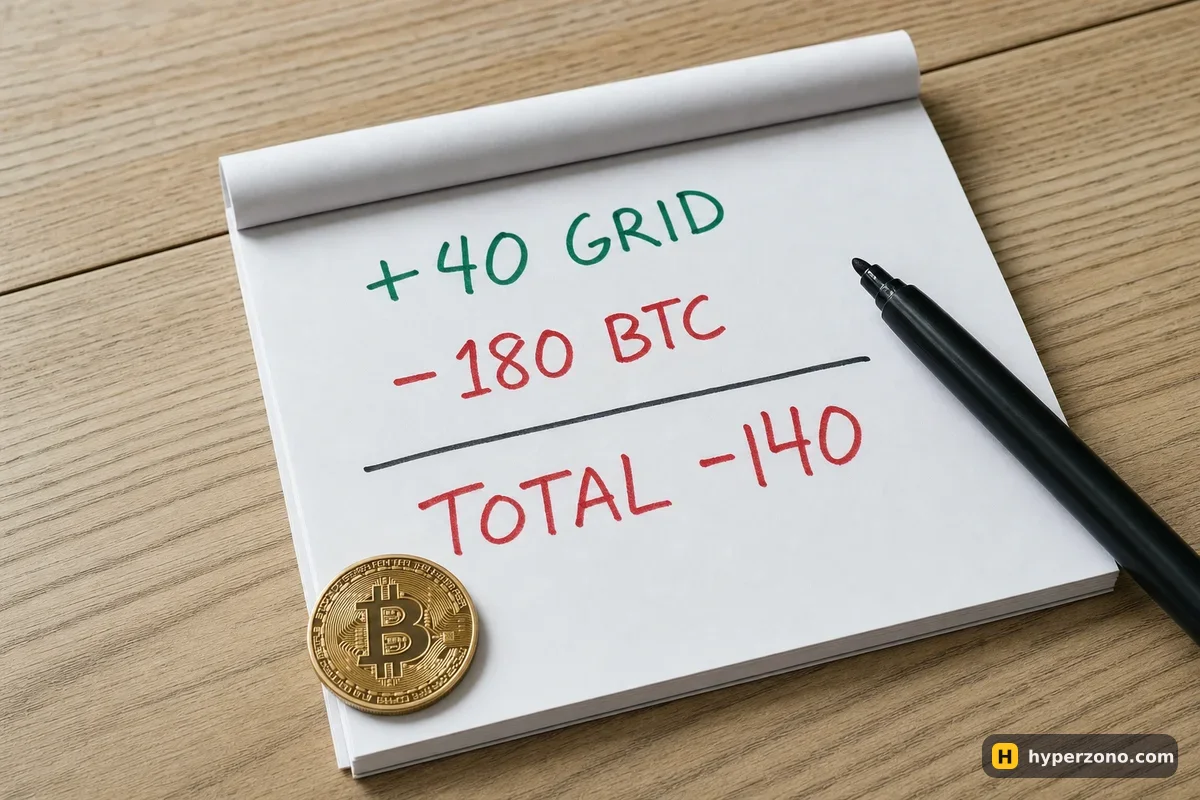
The two numbers your bot is showing you
A grid bot works by buying a bit lower and selling a bit higher, over and over inside a price range. Every time one of those pairs completes, the bot banks a small gain and adds it to the line usually called grid profit or realized profit. That number can only go up — it never subtracts anything.
Your total is a different thing. It takes that grid profit and adds the result of the position the bot is still holding right now, the one it built up while the price moved against it. If the price fell out of your range, the position sits below the average price the bot paid for it, and that unrealized loss is usually far bigger than the handful of completed pairs. The mechanics of how the grid fills in the first place are explained in how a grid bot actually works.
How the unrealized loss gets so big
Say you start a long grid on ETH with 300 USDT, no leverage, and a range that looks generous. The price drifts down, so at each level the bot adds to your long — that is exactly its job. Every fill makes your position bigger, and every further drop now loses money on a larger position than before.
Once the price slides below the bottom of your range, the bot stops buying and stops selling. It just holds the full position and waits. This is the point where people check the app, see grid profit +18 and total −42, and think the numbers are lying. They are not — the bot simply added the whole way down, which is what a grid does in a trend. Run the same grid with leverage and that same price move eats a much bigger share of your margin, and a deep enough drop can reach your liquidation price.
Fees and funding quietly shrink the plus side
Every completed grid pair is two trades — one buy and one sell — and you pay a fee on each of them. A bot that fires dozens of small trades a day pays that toll dozens of times, and on tight grids the fees can take a real bite out of each little gain.
On perpetual contracts there is also funding, paid or received every few hours. Funding is charged on your whole position, not just on the piece the bot happens to be buying and selling at that moment. If the position is stuck outside the range, you can be paying funding on all of it for days. If the money seems to vanish even when your closed trades look fine, the same arithmetic is unpacked in profitable trades, shrinking balance.
What to do right now
There is no free option here — each choice trades one risk for another. Pick based on how much more you are willing to lose, not on how much you want to be right.
- Wait. If the price comes back into your range, the unrealized loss shrinks and the bot starts working again. The cost: funding keeps running, and the price may never come back.
- Widen the range downward. The bot can keep trading lower down, but it will keep adding and your position grows. Only do this if you have free margin and are ready to lose more.
- Stop the bot but keep the position. The grid stops adding to your size, and you manage what is left by hand with a stop loss. Simple, and it caps any new buying.
- Close everything. You take the loss today and it is over. The cost is that you make final a loss that is only unrealized right now.
Stopping a bot is not always the same as closing the position. When you stop a bot, the open position does not always go with it. If it stays on your account, it keeps moving with the price and keeps paying funding. Check what the stop actually does to the position before you tap it, rather than assuming.
How to stop this happening with the next bot
When you set up the next bot, look through the settings for two things: a price at which the bot stops working, and an option to close the open position when it stops. Setting only the first one leaves the position sitting on your account. Together they turn an open-ended drift into a loss you picked in advance, so give the bot an amount you can afford to lose entirely and keep leverage low.
It also helps to run the first one small and watch both numbers side by side for a few days, so grid profit and total stop surprising you. If you want to see the range and stop settings before you risk money, sign up on Bybit and set up the smallest grid it will let you run — first check in the app that futures are available where you live. For the wider picture of how these tools fail, read can a futures bot lose all my money.
Is my grid bot broken if grid profit is positive but I am losing money?
No, both numbers are correct. Grid profit only counts pairs the bot has already closed, and it can never go down. Your total adds the open position the bot is still holding, which is where the loss is.
Will the loss disappear if the price comes back?
If the price returns into your range, the unrealized loss shrinks and the bot resumes buying and selling. But nobody can tell you whether it will come back or how long that takes, and funding keeps ticking while you wait.
Why does my grid bot keep losing money in a trend?
A grid assumes the price moves up and down inside a range. In a steady trend it keeps adding into a falling market, or keeps selling into a rising one, so the position grows in the wrong direction while the small closed pairs barely move the total.
Does grid profit already include fees and funding?
Usually not in the way beginners expect. Treat grid profit as a gross number and check your account's actual balance change, which reflects every fee paid on entries and exits plus any funding on the open position.
Should I stop the bot or let it run?
That depends on whether you can afford for the position to get bigger. If you have no spare margin and no stop set, stopping it keeps the loss from growing; if you have room and a clear price where you will give up, you can let it work and set that stop now.
Where can I practise a grid bot without risking much?
Start with the smallest budget the exchange allows and the lowest leverage, on a coin you already follow. Watch the grid profit line and your total side by side for a few days before you add money.