
Contents
Why a number like +480% tells you almost nothingThe five numbers that actually matterRed flags you can spot in thirty secondsCopy two or three traders, not oneStart small and review after about 30 copied trades
Why a number like +480% tells you almost nothing
Open the copy trading list on any exchange and the first thing you see is a percentage, usually labelled ROI (return on investment) — it might say +480%, sometimes a four-digit number. It is normally a real figure, but it is the profit measured against the trader's own money, over a stretch of time when things went well for them. It tells you nothing about how close they came to losing everything along the way, and someone trading 200 USDT at very high leverage who got lucky twice will show a bigger percentage than someone managing a large account with care.
There is a second trap. The list is sorted by that percentage, so what you are looking at is the people who were lucky recently, not the people who are consistent. The ones with the same style who lost everything last month are simply not on the list anymore. Treat that percentage as the thing that got your attention, and nothing more — your real decision happens inside the profile.
The five numbers that actually matter
Open a profile and you get a chart of their account over time plus a block of statistics. Five numbers are worth your attention, and most of them are not profit percentages. The question you are answering is not "how much did they make" but "could I have held on through their worst month without panicking and switching everything off at the bottom".
| What to look at | What it tells you | When to walk away |
|---|---|---|
| Worst drop from a peak (often called max drawdown) | How far your balance fell below its highest point at the worst moment | If seeing that much of your copy amount gone would make you close everything in a panic |
| How long the track record runs | Whether they have traded through more than one market mood, not just one good rally | Under about three months is not a track record, it is a lucky streak |
| Average holding time | Whether they trade for minutes or hold positions for days, which costs you more in running fees | Very long average holds often hide losing positions that are never closed |
| Copied funds and number of copiers | Whether other people's money stayed with them over time | A spectacular percentage with almost nobody copying it |
| Average win vs average loss | Whether one bad trade can erase ten good ones | A 90% win rate built on tiny wins and one enormous loss |
Of these five, the worst drop from a peak is the one I would read first. A trader who made 300% but was once 70% down has a style that will, sooner or later, do that again. If you copy with 100 USDT and the same thing happens, you watch your balance fall to 30 USDT and you have to decide, in that moment, whether to stay. Most people don't stay — they quit at the bottom and keep the loss.
Red flags you can spot in thirty seconds
Some profiles disqualify themselves before you even read the statistics. Scroll past when you see any of these:
- A history of three or four weeks with a huge number on top. Anyone can be up 200% in three weeks with enough leverage.
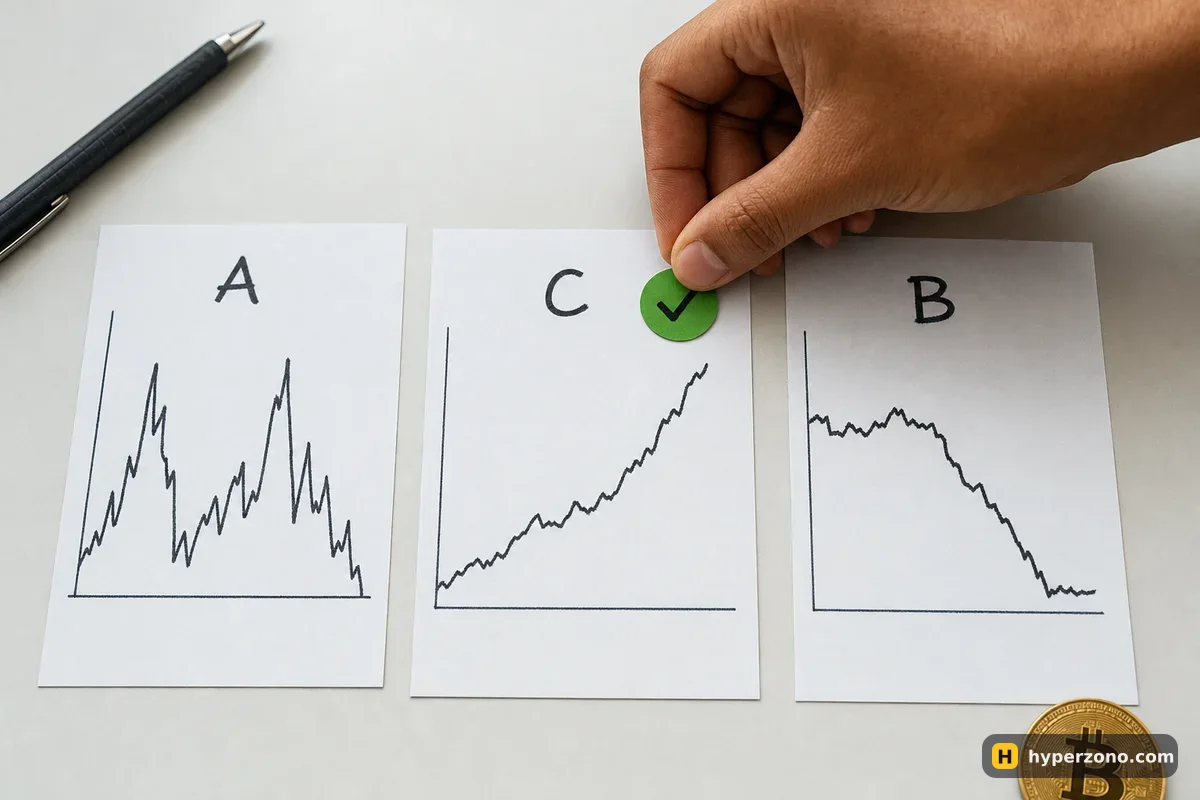
- A curve that climbs in a smooth staircase and then has one vertical cliff. That shape usually means the trader adds to losing positions until the price comes back — it works many times in a row, and then once it doesn't.
- Most of the profit coming from a single trade. Check the trade history: if one lucky position made the chart, the rest of the record is flat.
- No closed losing trades at all. Losers may simply still be sitting open, waiting for a recovery that may not come.
- Almost every position opened at very high leverage. That is not a strategy, that is a coin flip with your money on it.
- A profile that mainly advertises a paid channel. If you want to think about signal sellers, that is a different question — see ready-made Telegram signals.
Copy two or three traders, not one
One trader, however good the card looks, is one style and one set of habits. If that style is short-term trades in a calm market and the market stops being calm, your whole copy account suffers at once. Splitting 150 USDT into three copies of 50 USDT behind three different traders is almost always calmer than putting 150 USDT behind the single biggest percentage on the list.
The point is different styles, not just different names. One who holds positions for days, one who trades a few times a day, one who mostly trades bitcoin and ether rather than small coins — that mix gives you something to compare. If all three happen to be long on bitcoin at the same moment, you don't have three traders, you have one large bitcoin position with three fee bills. It is the same idea as deciding how much to put into one trade, applied to people instead of positions.
Start small and review after about 30 copied trades
Whatever the card promises, your first copy amount should be the smallest the exchange allows, or close to it — money you can afford to lose while you learn to read these people. You pay the normal trading fee on every position they open and close for you. If a position stays open for days, there are also small payments every few hours between buyers and sellers that come out of your balance too — that's funding. And the trader keeps a share of your profit: on Binance that share is usually 10% of net profit, settled weekly, so a trader who opens twenty small trades a day has to beat all of that before you see anything.
Shortlist five profiles
Sort the list however you like, then open five cards and write down the same five numbers for each one: worst drop from a peak, months of history, average holding time, copied funds, and average win against average loss.
Cross off the obvious ones
Anything under three months, anything with a vertical cliff in the curve, anything where one trade made the chart. You will usually be down to two or three names.
Copy small, with your own limits set
Choose the minimum copy amount — on Binance the copy amount starts at 10 USDT. If the exchange lets you set a stop for the whole copy portfolio, and Binance does, set it before you confirm, so the account has a floor you chose yourself.
Review after about 30 closed trades
Not after one week. Ask: did the worst drop match what the card promised, and did I sleep normally? Keep the ones where the answer is yes, replace the ones where it is no.
You cannot always stop whenever you want. Some portfolios come with a lock-up term — on Binance, once you confirm one, you cannot stop copying, change the portfolio stop-loss or withdraw until the term ends, and a portfolio stop-loss is required in that case. Before you confirm anything, check whether the portfolio you picked has a fixed term, and start with one that doesn't.
When you are ready to look at real profiles with these five questions in hand, open copy trading on Binance and read five cards the slow way, writing the numbers down. It takes about ten minutes and it changes what you see entirely. Copy trading is restricted in some countries, so check during sign-up that it is available where you live; and if you are still deciding between following a person and running an automated strategy, compare them in bot or copy trading for a beginner.
How much money do I need to start copy trading?
Each exchange sets its own minimum copy amount — on Binance the copy amount starts at 10 USDT, elsewhere check the figure in the app when you set the copy up. Start at or near that minimum. The goal of the first month is information about the trader, not profit.
Is a trader with a 90% win rate a good trader?
Not by itself. A high win rate often comes from closing winners quickly and letting losers run until they are huge, so nine small wins get erased by one bad day. Compare the average win with the average loss, and look at the worst drop from a peak.
How many traders should I copy at once?
Two or three is enough for a small account. One leaves you exposed to a single person's bad month; five or six splits your money so thinly that fees eat the result, and you cannot follow what any of them are doing.
How much does copying someone cost me?
You pay the usual futures fee on every entry and exit the trader makes for you, the small payments between buyers and sellers if a position is held for hours or days, and a share of your profit to the trader — on Binance usually 10% of net profit, settled weekly. On another exchange, look for that percentage on the trader's card before you confirm.
Can I lose my whole copy amount?
Yes. Copied positions are real futures positions with real leverage, and they can be liquidated like any other. If the exchange lets you set a stop for the whole copy portfolio — Binance does — set it before you confirm; if you don't see that setting, check in the app what limits you get. More on how losses add up in can you lose your whole deposit.
How does the money actually move when I copy someone?
Your copy account opens its own positions in proportion to the amount you set, at the prices available to you at that moment, so your result is close to the trader's but never identical. The mechanics are explained in what copy trading is and how it works.