
Contents
A bot is just "if this, then that"The main types of crypto trading botsWhat this looks like with 100 USDTWhy the pretty test chart is not what you will getExchange bots, or someone else's service with access to your accountA bot is just "if this, then that"
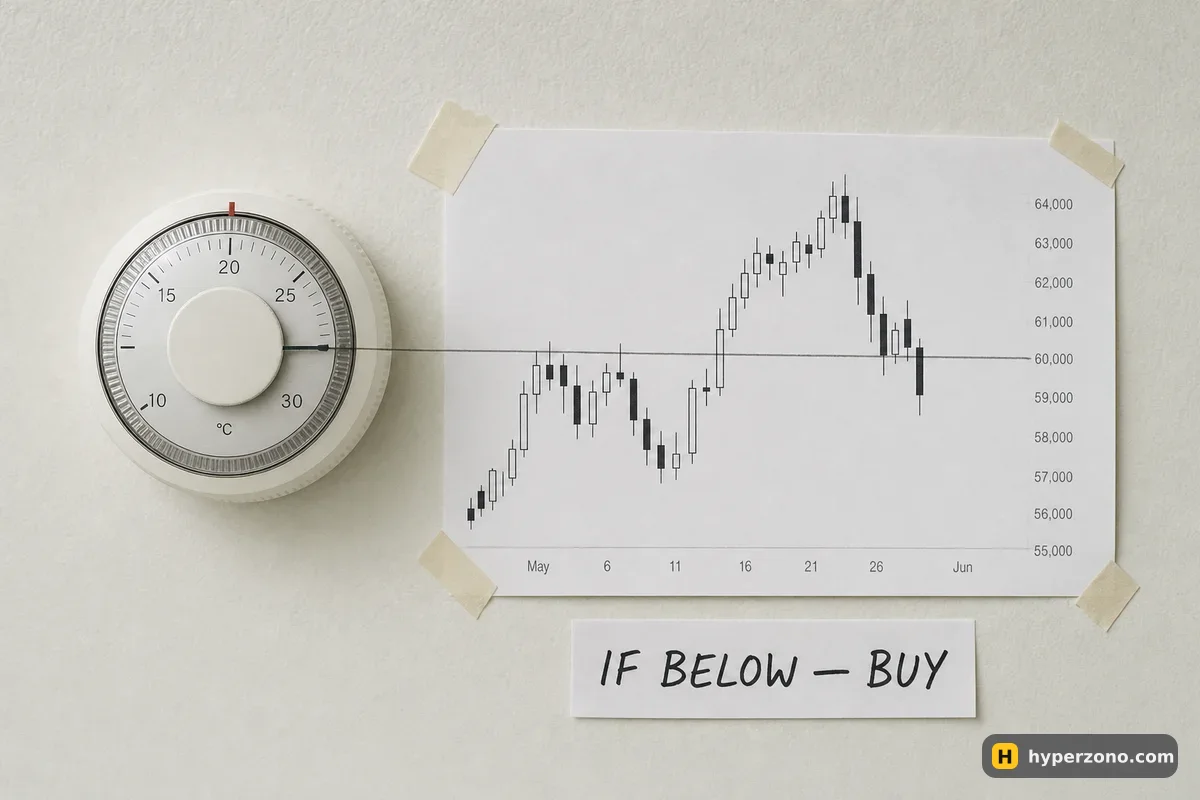
Think of a thermostat at home. You set it to 22 degrees; when the room gets colder, the heating switches on. A trading bot works the same way, only the trigger is a price: if the coin drops to this level, buy this much; if it rises to that level, sell it again. The orders go to the exchange exactly like the ones you place by hand — the bot is not some trader somewhere else, it is your own rule running on the exchange's servers.
This matters for your expectations. A bot never gets tired, never panics and never forgets to take profit, which is genuinely useful. But it also never notices that the news changed or that the market stopped moving the way you assumed when you set it up. Everything clever in a bot comes from the rules you chose.
The main types of crypto trading bots
Exchange apps usually offer three or four families of bots, and almost everything you will read about online is a variation of them.
- Grid bot. You pick a price range and the bot splits it into levels, buying lower and selling higher inside that range, again and again.
- DCA bot. Instead of one entry, it buys in portions — on a schedule or every time price falls by a set step — so your average entry price moves with the market.
- Martingale bot. A DCA with growing portions: every new buy is bigger than the last. It recovers small dips quickly and can burn through your margin fast in a long move against you.
- Signal or strategy bot. It waits for an outside trigger — an indicator crossing, or an alert sent from a charting site — and opens or closes a position when that trigger arrives.
On futures each of these can run long or short, which is what separates them from the spot versions. OKX has its own futures DCA bot and a bot that reacts to alerts from a charting site, so if you already use one of those sites, OKX is worth a look — though it does not offer derivatives in a number of countries, so check during sign-up whether futures are available where you live.
What this looks like with 100 USDT
A grid bot is not guessing where the coin is going. It just sells a little higher than it bought, over and over, for as long as price keeps coming back into your range.
Here is what that means in money, with illustrative numbers. You give the bot 100 USDT and leave the leverage at 1x, so it works with 100 USDT of position in total. You pick a coin trading around 2 USDT and set a range from 1.80 to 2.20 split into 10 levels, which puts about 4 cents between levels and about 10 USDT into each one. Four cents on a 2-dollar price is 2%, so one completed round trip — the bot buys a 10 USDT piece one step lower and sells it one step higher — brings in about 20 cents before fees.
Ten of those round trips on a quiet day is about 2 USDT. That is the honest size of a grid on 100 USDT without leverage: cents per cycle, a couple of dollars on a good day. Set the same bot to 3x and it works with roughly 300 USDT, so each level becomes about 30 USDT and a round trip about 60 cents — and the loss on whatever the bot ends up holding grows by exactly the same 3x. That trade-off is the whole of what leverage does.
There is a practical reason the example uses a cheap coin. On Binance the smallest bitcoin order is 0.001 BTC, which at a price near 83,500 USDT is about 83 USDT of position — so ten bitcoin grid levels need more than 800 USDT of position, which a 100 USDT balance only reaches with high leverage. Most altcoin contracts start from around 5 USDT of position per order, and that is where small grids usually live.
Now the coin falls to 1.60 and stays there. Your range is behind you, every level has been bought, and the bot is holding about 100 USDT of coin bought at an average price near 2.00. The closed cycles still show their 2 USDT of green on screen, while the open position shows around 20 USDT of red — and that red number is the one that decides what you actually have. The mechanics are laid out in how a grid bot actually works.
At 1x, a 20 USDT paper loss is unpleasant but the exchange has no reason to touch you. Turn the leverage up and the same price move eats the margin instead: if price runs far enough out of your range, the exchange closes the whole thing and the money the bot was using is gone. Keep the amount and the leverage small, and use isolated margin so only the part you handed the bot is at risk. If the word is new to you, liquidation is explained here.
Why the pretty test chart is not what you will get
Some bot screens offer a preview of how your settings would have done on past prices. If you see one, treat it as a sketch. Real trading adds three costs that a sketch usually underplays: a fee on every entry and every exit, a slightly worse fill price than you expected when the market moves fast, and funding payments every few hours on perpetual contracts. A grid that does fifty small trades a day pays fifty sets of fees, and when each cycle earns 20 cents, that alone can turn a thin profit into a thin loss.
Exchange bots, or someone else's service with access to your account
Bots built into the exchange run on your own account, with no passwords shared and nothing to install. The easiest way to see what the settings look like is to open a Binance Futures account, find the trading bots section and look at the fields — range, number of levels, order size, leverage — without funding anything yet.
Outside services work differently. You ask the exchange for a special access code that lets another program trade on your account — it is called an API key — and paste it into their site, and from then on their servers send the orders for you.
If you ever create an API key, leave withdrawals switched off. A trading key only needs permission to place and close orders. Without withdrawal rights, the worst a leaked key can do is trade badly — it cannot move your money off the exchange.
For a first attempt, a bot inside the exchange app is simply less to go wrong. Some exchanges also have a demo mode with practice money — check in the app whether the bot section works there, because it is not available everywhere. When you are ready to actually switch one on, start with how to launch your first bot.
Do trading bots actually make money?
Some setups make money in the conditions they were designed for, and lose it when those conditions change. A grid earns while price swings inside a range and bleeds when the trend runs away from it. Nobody can promise you a result — what you can control is the size you risk and whether you understand the rule you switched on.
How much do you need to run a futures grid bot?
It depends on the coin, because each grid level has to be a valid order. On most altcoin contracts an order starts from about 5 USDT of position, so ten levels need roughly 50 USDT of position; on bitcoin the smallest order is 0.001 BTC, which is far bigger. Check the minimum order size for your chosen contract in the app before you set the number of levels.
What is a DCA bot in crypto?
DCA means buying in portions instead of all at once. The bot adds to the position on a schedule or each time price drops by a set step, so your average entry price follows the market down. It softens a bad entry, but it also means your position gets bigger exactly when the trade is going against you.
Does a bot keep trading when my phone is off?
Yes. The rules live on the exchange's servers, not in your phone, so an exchange bot keeps placing orders while you sleep or lose signal. That is the main reason people use one — and the main reason to decide in advance how much it is allowed to lose.
Can I run a bot on a demo account first?
Some exchanges have a demo mode with practice money, but whether the bot section works there depends on the exchange and sometimes on your country, so check in the app. If bots are not available in demo, you can still practise the plain mechanics of opening and closing a trade. And remember that demo fills are kinder than real ones, and your feelings about a losing position are completely different when the money is yours.
Is a bot safer than trading by hand?
It removes emotional mistakes and adds mechanical ones. A bot will follow a flawed rule perfectly, all night, without asking whether it still makes sense. Leverage and liquidation work exactly the same for a bot position as for one you opened yourself.