
Contents
What stays exactly the sameCan a spot bot get liquidated?What a futures bot adds: margin, liquidation and fundingShort and neutral grids only exist on futuresWhich one should be your first botWhat stays exactly the same
In both versions the bot does the boring work you'd otherwise do by hand: it splits a price range into levels, buys when the price drops to a level and sells when it comes back up. You choose the range, the number of levels and the amount, and the bot keeps clicking. If you want the mechanics of those levels in detail, that's how a grid bot actually works.
So the logic isn't the thing that makes one riskier than the other. What changes is the account it runs on.
Can a spot bot get liquidated?
No. On spot you're buying the coin itself with your own money, nobody lends you anything, so there is no margin and no liquidation price. If bitcoin falls 40% while your bot is running, the bot simply ends up holding coins that are worth less than you paid. Nobody takes the coins away from you — you can wait. But waiting is not a plan: some coins come back, some never do, and your money is locked up the whole time.
That's the real cost of a spot bot. It may sit in a coin you now don't want, for weeks or months, while the grid earns nothing because the price has walked out of your range.
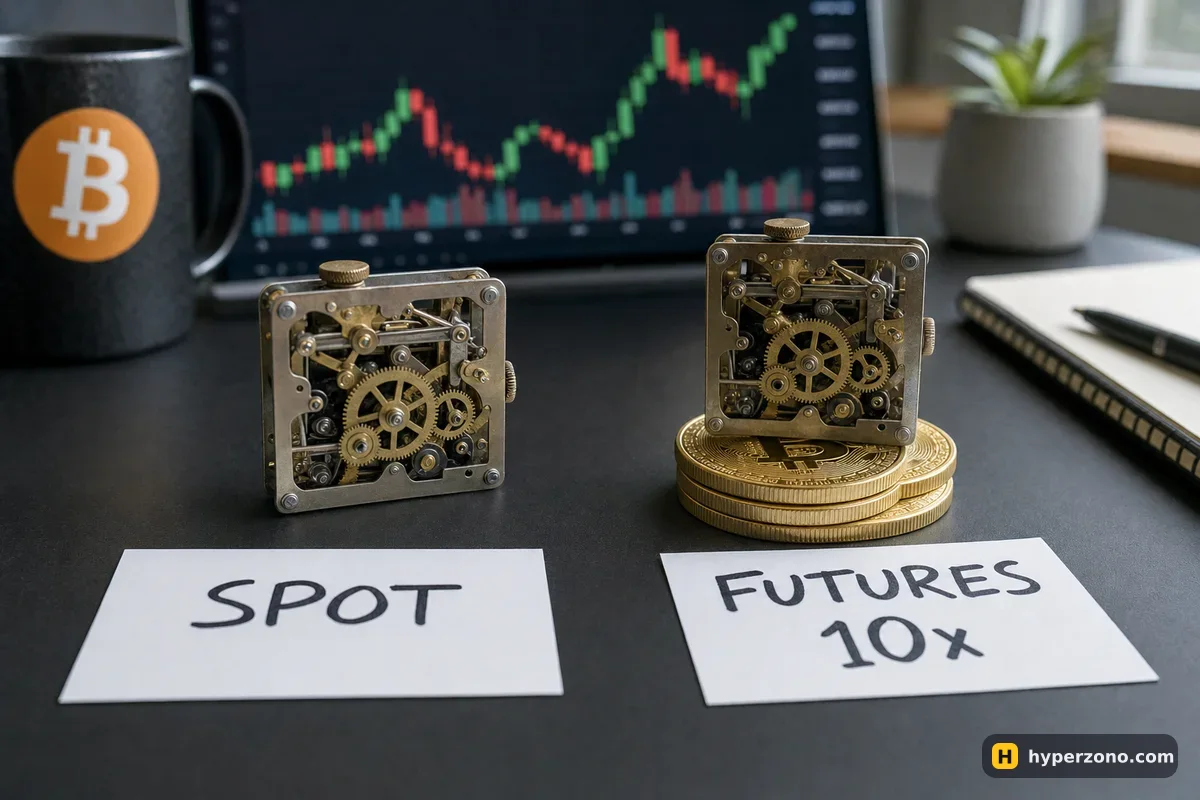
What a futures bot adds: margin, liquidation and funding
On futures the bot doesn't buy coins, it opens positions. The exchange holds part of your money as a deposit (margin) and lets you run a position bigger than that deposit. Once that happens, there's a price at which the exchange closes the position for you. That's liquidation, and a spot bot simply doesn't have one. In a fast move the close can land worse than that price, so treat your margin as money you can lose, not as a hard floor.
One setting decides how bad the worst case is. In isolated margin the bot can only lose the money you gave it; in cross margin it can reach the free balance of your whole futures account — and on some exchanges cross is the default, so check cross or isolated before you press start. For a bot that runs overnight while you sleep, this is the single most useful switch on the screen.
The second new line in your results is funding — a small payment between traders holding long positions and traders holding short ones, usually every eight hours and on some contracts more often. When the rate is positive, the longs pay the shorts, so a long grid pays out a little every few hours. When it's negative, you're the one getting paid. On a small bot it's cents at a time, but over a week of holding it adds up, which is why it's worth knowing how funding works before you leave a bot running.
One funding payment on a 500.00 USDT position. Traders pay each other, not the exchange. Each contract has its own rate and interval.
Leverage doesn't make the grid smarter. It just makes every level bigger with the same money and pulls the liquidation price closer to where the price is now. A futures grid at 10x in a range that breaks down doesn't just lose a little more than a spot grid. It can lose the whole margin.
Short and neutral grids only exist on futures
A spot bot can only do one thing: buy low, sell higher. It needs coins to sell, so it can't profit from a falling market. On futures you can also run a short grid, which sells high and buys back lower, or a neutral one, which starts with no position at all and simply trades the range in both directions, going slightly long below the middle and slightly short above it. That's a genuine advantage if you think a coin is going to grind sideways or downwards — and it's the reason many people go to futures bots in the first place.
| Spot bot | Futures bot | |
|---|---|---|
| What you hold | Real coins in your spot wallet | A position backed by margin |
| Leverage | None | Yours to choose, and it's the main risk |
| Can it be liquidated? | No | Yes, at a liquidation price |
| Direction | Long only | Long, short or neutral |
| Funding | None | Paid or received while the position is open |
| Worst case | Coins worth much less, money locked up | The margin you gave it — or more of your balance if the bot runs in cross margin |
Which one should be your first bot
If your exchange offers a grid on spot, that's the calmer place to learn. You get the same feel for how a grid behaves — how often it fills, what happens when the price leaves your range, how the numbers in the bot screen compare with your actual balance — without a liquidation price watching you. A demo futures account does a similar job where it's available, and it lets you watch a futures grid specifically. Either way, once the surprises have stopped being surprises, a small futures grid at low leverage is a reasonable next step, and the ways a bot can lose everything will make a lot more sense by then.
One thing to carry with you whichever you start with: the profit figure the bot shows is only the profit of closed cycles. Your real result also includes the open position, fees and funding. The simplest way to see the difference between the two kinds of bot is to open a Binance account and look at what the bot section offers — check which bots are available to you there before you plan anything, and compare the settings each one asks for.
Can a spot grid bot get liquidated?
No. There's no borrowed money and no margin, so there's no liquidation price. The worst that happens is that you end up holding the coin at a much lower price than you bought it, with your money tied up in it.
Which bot is safer, spot or futures?
Spot, clearly — same algorithm, no leverage, no forced close. A futures bot can be run carefully at low leverage and in isolated margin, but the option to lose the whole margin is always there.
Should I run a futures bot in cross or isolated margin?
Isolated keeps the damage inside the money you gave the bot, which is what most beginners want from something that runs unattended. Cross lets the bot pull on the free balance of your futures account, and on some exchanges new contracts open in cross by default, so look at that setting before you start.
Does a futures bot pay funding even while it's just sitting in the range?
Yes, as long as a position is open at the settlement moment. When the rate is positive, longs pay shorts, so a long grid pays. When it's negative, the long side receives instead.
Can a spot bot make money when the price falls?
Not directly. It only sells coins it already bought, so a falling market just means it keeps buying. Short and neutral grids are a futures-only thing.
Do I need more money to run a futures bot?
Not necessarily. The minimum depends on the contract and on how many levels you set, so check the numbers in the bot screen in the app before you plan an amount. The real question of how much money a bot needs is about having enough margin to survive the range, not about meeting the minimum.